
INDUSTRY ANALYSIS
Are Drones Entirely China's Market? Looking Beyond DJI Through the Supply Chain
DJI is often the first name people associate with drones, making opportunities for other countries seem limited. Yet aerial photography, industrial inspection, and military reconnaissance have different technical and procurement requirements. Looking behind aircraft brands to chips, sensors, communications, and software reveals China's strengths, other suppliers' positions, and possible entry points for Taiwan.
Which company first comes to mind when you hear “drone”?
If your answer is DJI, you may also have wondered: with Chinese manufacturers already so strong, what can Taiwan, the United States, or other countries still do?
The answer starts by separating the applications. A camera drone in a travel video, an aircraft inspecting power infrastructure, and a military reconnaissance system serve different customers under different competitive conditions.
Recognizing a strong brand is a starting point. Following its upstream and downstream relationships reveals who else participates.
China's advantage rests on a substantial manufacturing base
Public data supports the scale of China's drone industry. Shenzhen's 2025 statistical communiqué reported local civilian-drone output of 7.4538 million units, up 40.1% year over year. This is Shenzhen production, not global market share, but it demonstrates considerable manufacturing scale. [1]
Chinese capabilities also extend to professional applications. DJI's industrial Matrice 400 integrates lidar and millimeter-wave radar and supports various mission payloads. Describing China as merely good at making inexpensive camera drones would underestimate its technology and integration capabilities. [2]
Discussing opportunities elsewhere therefore starts by acknowledging that established base, then identifying what different markets require.
Customers buy different outcomes under the same “drone” label
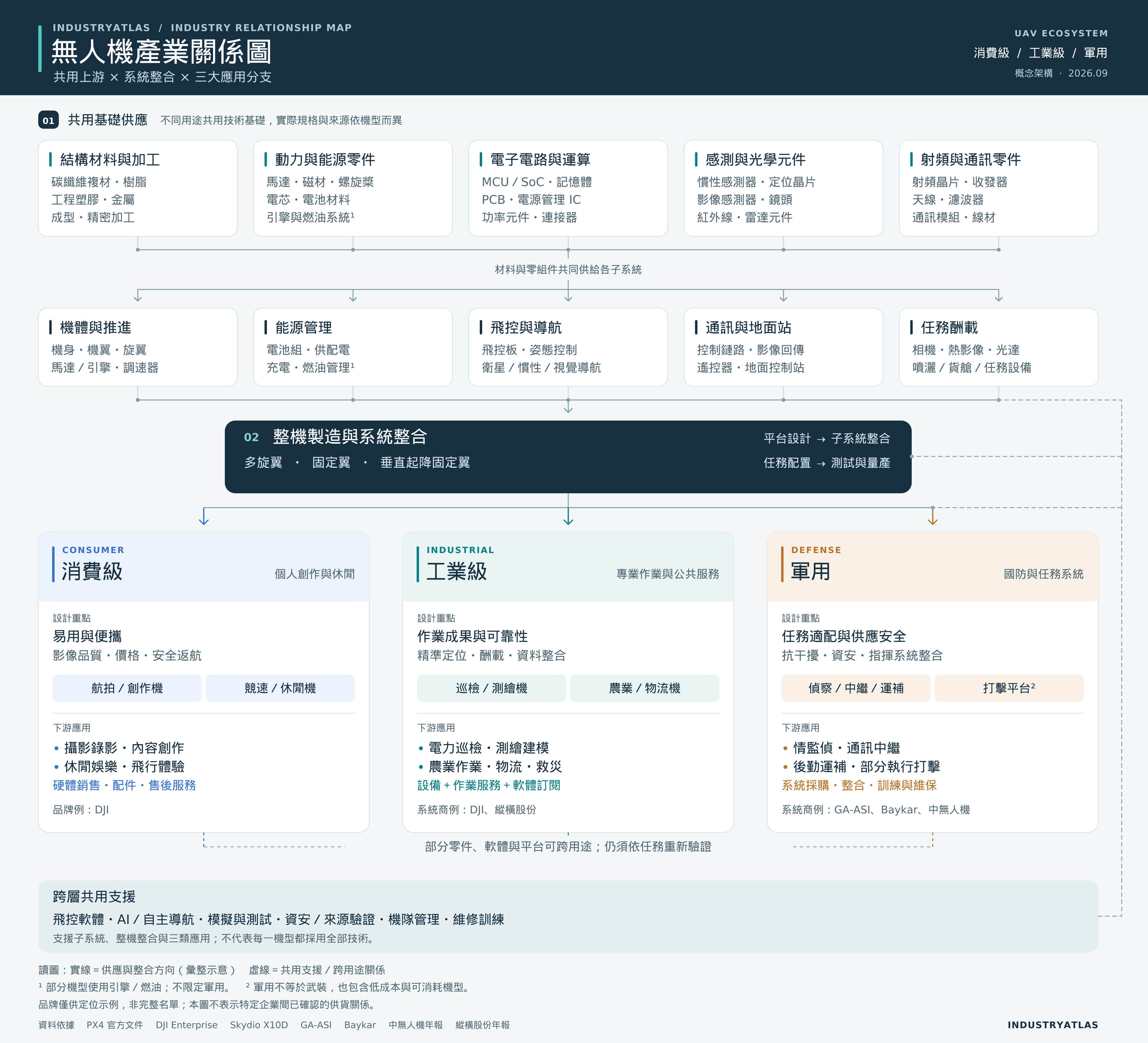
The market can initially be divided into three application branches:
| Application | What customers want to accomplish | Common competitive priorities |
|---|---|---|
| Consumer | Travel photography, content creation, and recreational flying | Imaging, ease of use, portability, and price |
| Industrial | Inspection, surveying, agriculture, logistics, and disaster response | Operational accuracy, reliability, mission payloads, and data integration |
| Military | Intelligence, surveillance, communications relay, resupply, and, for some systems, strikes | Mission fit, communications/navigation resilience, system integration, and supply provenance |
These are overlapping use categories, not a ranking from low to high performance.
General Atomics' MQ-9B SkyGuardian, for example, addresses long-duration intelligence, surveillance, and reconnaissance. Baykar's TB2 is another medium-altitude, long-endurance military platform. Their mission and integration requirements differ greatly from those of a personal camera drone. [3][4]
China also has participants in this segment. The Wing Loong and Cloud Shadow families disclosed in AVIC's Chengdu UAV company's annual report show that its industry includes large unmanned-aircraft systems. [5]
Consumer-brand visibility does not represent the entire military market. The existence of military products likewise does not prove that a country leads every drone technology.
Inside one aircraft, more familiar companies appear
Much of the supply chain lies behind the logo on the airframe.
For its X10D, US company Skydio publicly identifies NVIDIA Jetson Orin onboard computing and a Teledyne FLIR Boson+ thermal-imaging sensor. [6]
One product thus shows several roles: the aircraft brand integrates the platform, the compute supplier provides processing, and the sensor supplier provides components for observing the environment.
Further upstream are flight controllers, inertial sensors, satellite positioning, motors, electronic speed controllers, batteries, and communications. Downstream are mission planning, operator training, maintenance, and processing and application of flight data. [7]
This example establishes a particular product's disclosed configuration. It does not mean all drones use the same components, or reveal how much drone revenue each supplier earns.
It does show that entering the drone industry can begin with one critical function, without first becoming a household-name aircraft brand.
In some markets, component provenance is part of the product
Some customers focus on imaging and price. Others must also ask where components come from, who maintains the software, and whether the system meets their cybersecurity and sourcing requirements.
The US Defense Innovation Unit's 2025 Blue UAS assessment guidance includes supply-chain provenance, country-of-origin documentation, component procurement, and relevant software, firmware, and hardware information. [8]
As an industry inference, these requirements affect eligibility for particular procurements. Components with similar functions can face different conditions for winning orders. Changing the assembly location does not automatically make the entire supply chain compliant.
Military applications also face cost pressure. Another public DIU program explicitly calls for commercial off-the-shelf components to support low-cost, expendable systems that can be manufactured at scale. [9]
Technology, price, supply capability, and provenance must therefore be assessed together.
Taiwan's opportunities need to be tied to specific products and customers
This makes Taiwan's role easier to understand.
Taiwan's Industrial Development Administration stated in 2026 that R&D support during 2024–2025 covered complete aircraft, flight/guidance/control, communications, mission payloads, and AI-based autonomous recognition. The development effort already spans multiple stages. [10]
When studying a Taiwanese drone-related company, ask four questions: What product does it supply? Which mission does it serve? Has it completed customer qualification? Are deliveries and revenue verifiable?
These distinguish technical development, cooperation announcements, and actual business more effectively than inclusion on a list of “drone stocks.”
Supply-chain changes can create entry opportunities, but production, reliability, after-sales support, and customer adoption still have to be achieved step by step.
Relationships explain the industry better than a list of brands
Drones are well suited to a supply-chain map. Shared upstream suppliers provide materials, components, and subsystems. Aircraft and system integrators connect them to consumer, industrial, and military applications. Software, validation, and maintenance support multiple stages.
One technology can serve several markets, and one application can involve companies from different countries.
The next time a company announces that it is entering the drone business, first locate its position: what does it supply, who does it connect to, and what problem does it solve?
This is the more intuitive way I want readers to understand industries—from materials to end applications, following the relationships between companies and their roles.
Sources & notes
- Sources accessed September 30, 2026. Supplier information establishes disclosed product positioning and configuration, not independent performance testing or market-share rankings. The market classification and analytical questions are the author's synthesis.
- [1] Shenzhen Statistics Bureau, Shenzhen 2025 Statistical Communiqué on National Economic and Social Development, published in 2026. Civilian-drone output is a Shenzhen regional statistic, not global sales or market share.
- https://www.sz.gov.cn/zfgb/2026/gb1416/content/post_12848555.html
- [2] DJI Enterprise, Matrice 400 official product information.
- https://enterprise.dji.com/matrice-400
- [3] General Atomics Aeronautical Systems, MQ-9B SkyGuardian official product information.
- https://www.ga-asi.com/remotely-piloted-aircraft/mq-9b-skyguardian
- [4] Baykar, Bayraktar TB2 official product information.
- https://baykartech.com/en/uav/bayraktar-tb2/
- [5] AVIC (Chengdu) Unmanned Aerial Vehicle System Co., Ltd., 2025 Annual Report Summary, March 17, 2026.
- https://static.cninfo.com.cn/finalpage/2026-03-17/1225012985.PDF
- [6] Skydio, X10D official product information; identifies NVIDIA Jetson Orin and Teledyne FLIR Boson+.
- https://www.skydio.com/x10d
- [7] PX4, Basic Concepts. Flight controllers, sensors, propulsion, power, communications, mission computers, and ground stations.
- https://docs.px4.io/main/en/getting_started/px4_basic_concepts
- [8] Defense Innovation Unit, Update: DIU Announces Recognized Assessors to Support Blue UAS NDAA Compliance Certification, September 19, 2025.
- https://www.diu.mil/latest/diu-seeking-recognized-assessors-to-support-blue-uas-ndaa-compliance
- [9] Defense Innovation Unit, Three Companies Selected To Provide Solutions to the Problem of Communications in an Electromagnetic Environment (EMI) to the DoD, August 21, 2024.
- https://www.diu.mil/latest/diu-selects-three-companies-to-provide-solutions-to-the-challenges-of
- [10] Taiwan Industrial Development Administration, announcement on the Taiwan pavilion at a major US drone exhibition and estimated potential business opportunities of NT$1.3 billion, May 21, 2026. This article cites R&D areas, not estimated exhibition opportunities as realized orders.
- https://www.ida.gov.tw/ctlr?PRO=news.rwdNewsView&id=43211