
INDUSTRY ANALYSIS
How Does Sony’s XYN Glasses-Free 3D Display Work? Microlenses, Eye Tracking, and New Supply-Chain Roles
Sony’s 6-inch ELF-MN1 brings glasses-free 3D characters to a desktop display through eye tracking, real-time rendering of two viewpoints, and fixed microlenses. This article explains how it works, the resolution trade-offs, and related technologies from BenQ Materials, Himax, and AUO / AUO Display Plus, distinguishing technical capabilities from evidence of actual supply.
A character inside the screen reveals new roles in the display supply chain
On October 28, 2026, Sony announced the 6-inch ELF-MN1 Spatial Reality Display as part of its XYN spatial-content solutions, with a Japanese launch scheduled for December 11. Users can connect a compatible smartphone or computer and view three-dimensional characters and objects through supported applications without wearing 3D glasses.[1]
For the supply chain, the key question is which capabilities are added beyond the LCD: locating both eyes, calculating two viewing perspectives in real time, and using precision optics to send the corresponding image to each eye. The additional value therefore spans optical layers, sensing, image processing, and manufacturing calibration, rather than residing solely in the panel.[2][4]
The companies discussed here are representative suppliers with publicly disclosed relevant technologies or products. Unless otherwise stated, none has been confirmed as a supplier to Sony’s ELF-MN1. The Sony materials reviewed do not provide a complete component-supplier list. A company’s product disclosures, demonstrations, or partnerships also do not establish its volume-shipment scale.
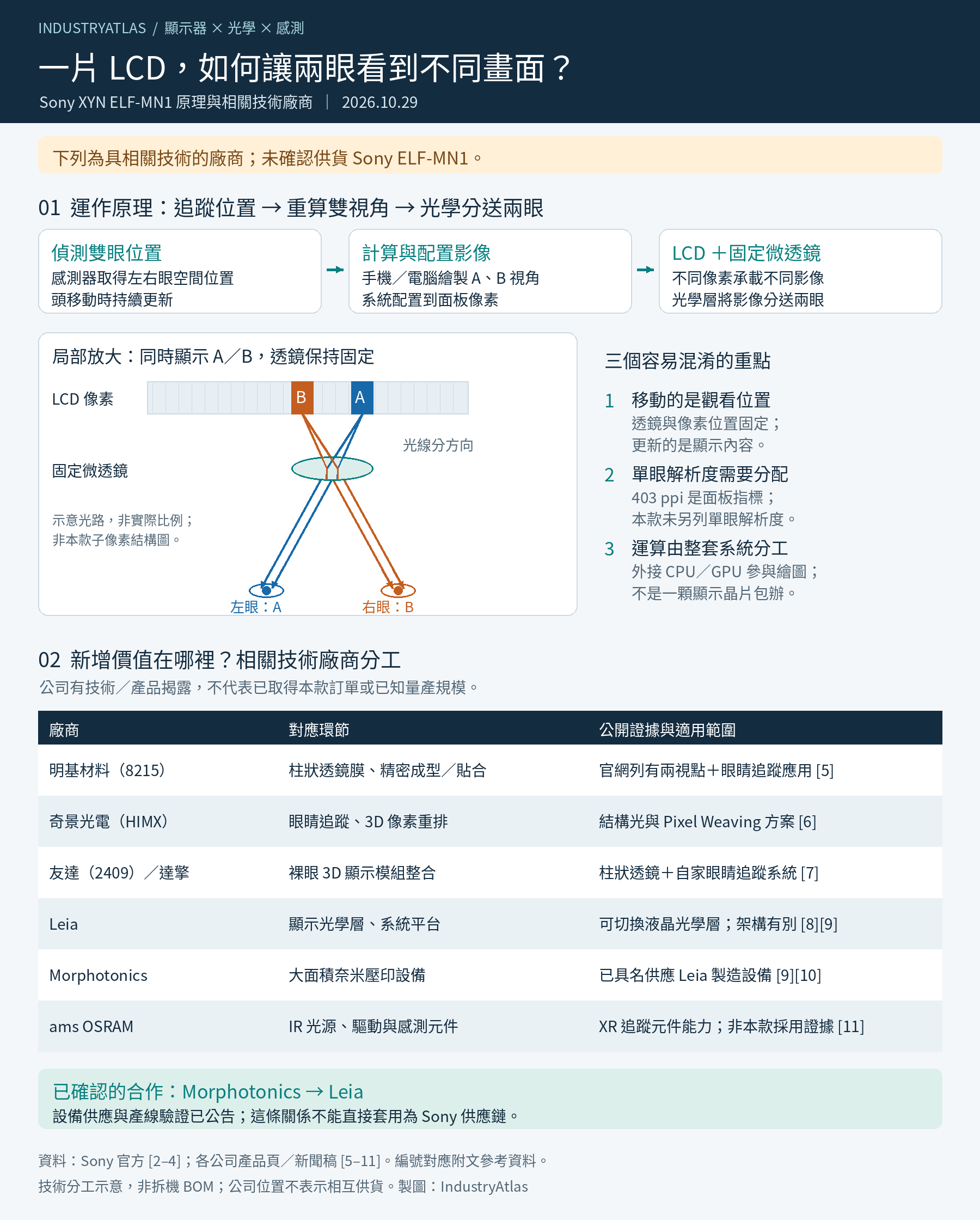
*Figure: The upper section illustrates a typical two-view glasses-free 3D system; the lower section lists companies with relevant technologies. Optical paths and pixel layouts are schematic, not a teardown of ELF-MN1. Company placement does not imply supply relationships. Sources: [2], [4]–[10].*
1. How can one LCD provide two images at once?
Render a separate view for each eye from the same 3D model
Our eyes occupy different positions and therefore see an object from slightly different angles. The brain uses this binocular disparity to perceive depth. A glasses-free 3D display seeks to reproduce the different images that each eye should see.
The system first determines the eyes’ positions in space, then sets two corresponding virtual viewpoints within the same 3D scene and renders each view. As the viewer moves, the images update to show different angles and occlusions. This is not simply shifting a flat image sideways: the scene is recalculated according to the model’s depth and shape.[2][4]
Map both images onto the same panel
Conceptually, some pixels carry the left-eye image and others carry the right-eye image, finely distributed across the panel. The left half of the screen is not reserved for the left eye, nor does the entire screen simply alternate between two fixed pictures.
Microscopic optical lenses fixed in front of the panel direct light from different pixels in different directions, sending the appropriate image to each eye. A useful analogy is a lenticular picture card whose surface lenses stay fixed while the image underneath updates in real time. Sony explicitly describes microlenses attached to the panel surface with high precision, paired with algorithms that generate images according to eye position.[2][4]
Actual subpixel layouts, image mapping, and calibration are product-design details. Public information is insufficient to describe ELF-MN1 as switching fixed odd and even pixel columns, or to infer that each lens physically turns with the viewer’s eyes.
A single chip inside the display does not perform all the computation
ELF-MN1 requires a compatible external smartphone or computer. Sony’s specifications explicitly state CPU and GPU requirements for real-time 3D rendering. At least the scene rendering therefore depends on the external computing platform. More technical information is needed to establish how sensing, image rearrangement, and display control are divided between host and display.[3]
Other divisions of work exist in the industry. Himax’s published solution, for example, implements eye tracking and some pixel rearrangement in dedicated hardware. Similar glasses-free 3D experiences can therefore use different combinations of chips and software.[6]
2. What resolution trade-off does stereoscopic viewing require?
Allocating panel pixels between the two eyes reduces the spatial samples available to each eye. Sony’s technical documentation for the earlier ELF-SR1 explains the principle in terms of approximately half the panel’s pixels being used for each eye. This divides the total pixel count; it does not halve both horizontal and vertical resolution simultaneously.[4]
The allocation in an earlier model cannot, however, be treated as ELF-MN1’s precise per-eye specification.
| ELF-MN1 item | Official disclosure | Interpretation |
|---|---|---|
| Panel size | 6 inches | Intended for close-range desktop viewing |
| Panel resolution | 1,080 × 2,160 | Approximately 2.33 million panel pixels, not 2.33 million pixels for each eye |
| Panel pixel density | 403 ppi | A panel metric, not directly the effective per-eye resolution |
| Stereoscopic method | Two viewpoints | Left- and right-eye images follow the viewer’s position |
| Viewing conditions | One viewer, 30–80cm; 25 degrees in each of the up, down, left, and right directions | A limited effective viewing region |
| Effective per-eye resolution | Not separately specified on the reviewed specifications page | No particular horizontal-by-vertical resolution is inferred |
Sources: [2][3].
Eye tracking lets the system concentrate resources on the two views the viewer currently needs, instead of allocating many pixels to multiple fixed viewing directions simultaneously. It does not eliminate the underlying pixel-allocation trade-off. Perceived sharpness also depends on viewing distance, optical quality, and crosstalk between the left- and right-eye images.[4]
3. The challenge is integrating optics, tracking, and calibration
From an engineering perspective, producing a 3D effect and keeping it clear and stable as the viewer moves are different challenges.
First, lenses must align precisely with panel pixels; light traveling in unintended directions can increase inter-eye crosstalk. Second, eye-position detection, image updates, and panel display must maintain low latency. Finally, the whole panel needs consistent optical performance and calibration across positions and viewing angles. These are engineering priorities inferred from the architecture; Sony likewise identifies high-precision sensing, real-time rendering, and precision display optics as its core technologies.[2][4]
The additional supply-chain value therefore cannot be measured simply as “one more film on a panel.” Optical design, microstructure fabrication, precision lamination, and hardware/software calibration jointly determine product quality.
4. Which companies have disclosed relevant technologies?
The following classification follows actual public disclosures. Having relevant technology and supplying Sony are different levels of evidence; the table does not establish the latter.
| Company | Relevant stage | Public technology or product | Scope of evidence |
|---|---|---|---|
| BenQ Materials (8215, Taiwan) | Lenticular films, microstructure fabrication, and lamination | Designs tailored to PPI, pixel layout, and viewing distance; lists two-view displays with eye tracking | Official product and application disclosures; Sony supply unconfirmed [5] |
| Himax Technologies (NASDAQ: HIMX, Taiwan) | Eye tracking and 3D pixel rearrangement | Structured-light vision AI, image processors, and 3D Display Pixel Weaving | Company solution and demonstration disclosures; Sony supply unconfirmed [6] |
| AUO (2409) / subsidiary AUO Display Plus (Taiwan) | Integrated glasses-free 3D display modules | Lenticular optics combined with AUO’s eye-tracking system | Official solution; Sony supply unconfirmed [7] |
| Leia (United States) | Display optical layers and 3D system platforms | Switchable liquid-crystal optical layers integrated with tracking and related functions | Its own technology approach; cannot be assumed identical to Sony’s [8][9] |
| Morphotonics (Netherlands) | Large-area microstructure manufacturing equipment | Nanoimprint equipment for structures including lenticular and microlens arrays | Named cooperation with Leia; Sony supply unconfirmed [9][10] |
| ams OSRAM | Infrared and sensing components for eye tracking | IR LEDs, LED / VCSEL drivers, image sensors, and related products | Public examples focus mainly on XR / smart glasses, representing adjacent component capabilities; adoption in this model unconfirmed [11] |
BenQ Materials: the additional light-separating optical layer
Conventional LCDs already contain several optical films. The extra requirement for glasses-free 3D is an optical structure that directs different images to each eye. BenQ Materials publishes a lenticular-film manufacturing process covering precision engraving, curing and forming, cutting, and lamination. It also lists a 10.1-inch, two-view display application with eye tracking. This establishes a more direct technical connection than the broad label “optical-film manufacturer.”[5]
Himax: extending from display chips into sensing and pixel rearrangement
In announcements related to CES 2025, Himax described an integrated structured-light tracking and pixel-weaving solution. It adjusts images in real time according to eye position and uses dedicated hardware to reduce latency and processing demands. Such functions extend display-semiconductor roles from driving pixels to arranging stereoscopic images and integrating sensing.[6]
AUO / AUO Display Plus: delivering an integrated display solution
AUO Display Plus combines lenticular optics with AUO’s eye-tracking system in a glasses-free 3D solution that lists medical-display applications. Its role is closer to an integrated panel, optics, and tracking solution than to a standalone optical-film or sensor supplier.[7]
5. A confirmed partnership: Morphotonics → Leia
In December 2025, Leia and Morphotonics announced completion of the Aurora 1100 production line’s installation and qualification. Morphotonics supplies large-area nanoimprint equipment supporting manufacture of Leia’s display optical layers.[9]
This establishes a named supply-chain relationship: microstructure-manufacturing equipment → display optical-layer supplier. Formal partnership announcements provide stronger evidence of supply relationships than a conceptual connection alone.
However, Leia described a switchable liquid-crystal optical layer in that announcement, differing from Sony’s publicly described fixed microlenses. The partnership illustrates equipment demand for glasses-free 3D; it cannot be transplanted into Sony’s supply chain.[2][9]
What can currently be established is the existence of branded eye-tracked glasses-free 3D products, Taiwanese technology solutions, and named equipment partnerships. Whether this becomes a larger growth market still depends on price, the content ecosystem, viewing quality, and application demand. A single product launch does not establish a material increase in the relevant companies’ profits.
Sources & notes
- 1. Sony, “Launching the compact 6-inch ELF-MN1 Spatial Reality Display,” October 28, 2026. https://www.sony.jp/CorporateCruise/Press/202610/26-1028/
- 2. Sony, ELF-MN1 features: stereoscopic display, sensing, and micro-optical lenses. https://www.sony.jp/spatial-reality-display/products/ELF-MN1/feature_1/
- 3. Sony, ELF-MN1 specifications and computing-platform requirements. https://www.sony.jp/spatial-reality-display/products/ELF-MN1/spec/
- 4. Sony XYN, Technical Background: stereoscopic display principles and pixel allocation using ELF-SR1 as an example. https://xyn.sony.net/ja/developer/technical/spatial-reality-display/whitepaper
- 5. BenQ Materials, display applications: microstructures and glasses-free 3D solutions. https://www.benqmaterials.com/tw/product-detail/77__9/
- 6. Himax, “Himax to Unveil Groundbreaking 3D Naked-Eye Display Technology at CES 2025,” December 19, 2024, company press release. https://www.globenewswire.com/news-release/2024/12/19/2999505/8267/en/Himax-to-Unveil-Groundbreaking-3D-Naked-Eye-Display-Technology-at-CES-2025.html
- 7. AUO Display Plus, “3D Display Technology.” https://www.auodplus.com/zh-TW/technology/threeD_Display_Technology
- 8. Leia, Immersity Hardware. https://www.leiainc.com/hardware
- 9. Leia, “Leia and Morphotonics Complete Aurora 1100 Installation to Scale Immersity Cell Production,” December 10, 2025. https://www.leiainc.com/news-articles/leia-and-morphotonics-complete-aurora-1100-installation-to-scale-immersity-cell-production
- 10. Morphotonics, “Delivering glasses-free 3D displays,” application leaflet. https://morphotonics.com/wp-content/uploads/2023/05/MPH_Application-Leaflet_3D_20230509.pdf
- 11. ams OSRAM, “Eye, face and hand tracking for VR/AR and smart glasses.” https://ams-osram.com/applications/mobile-wearables/eye-face-hand-tracking