
INDUSTRY ANALYSIS
From SiC and GaN to AI Server Power Supplies: Mapping the Supply Chain and Taiwan’s Supplier Roles
SiC and GaN are changing the efficiency and size of power conversion, but a competitive server power supply also depends on magnetics, capacitors, packaging, thermal management, and control design. This article follows the chain from semiconductor materials through wafers, power devices, power supplies, and rack power distribution. It maps the roles of 12 representative Taiwanese suppliers and explains the significance of the shift toward 800V power architectures.
AI Server Performance Also Depends on How Power Reaches the Chips
Discussion of AI servers usually centers on GPUs, HBM, and high-speed networking. Yet stable operation of all these components shares another prerequisite: a power system that converts electricity efficiently and remains stable as loads change rapidly.
A power supply converts incoming electricity into the voltage and current the equipment needs. As the power rating of an individual unit rises, designers must handle more heat and higher currents within limited mechanical space. SiC, or silicon carbide, and GaN, or gallium nitride, are attracting attention because they offer new device choices for these problems.
Concrete products and designs already illustrate the shift. In 2025, Delta announced a 5.5kW server power supply certified to 80 PLUS Ruby, with stated peak conversion efficiency of 97.5%. Infineon’s 12kW reference design, introduced the same year, combines Si, SiC, and GaN.[1][2]
Both examples show that power-supply upgrades involve joint design of materials, circuits, and systems. Understanding the industry opportunities begins with separating the supply-chain layers.
1. How Do Si, SiC, and GaN Share the Work Within a Power Supply?
Si is silicon, while SiC and GaN are wide-bandgap semiconductors. Their wider bandgaps and other material properties can allow devices to withstand higher electric fields or reduce losses under particular operating conditions. Material selection still depends on operating voltage, switching frequency, conduction losses, thermal management, and cost.
| Material | Main advantages | Common roles in power supplies | Design trade-offs |
|---|---|---|---|
| Si: silicon | Mature processes, broad selection, and competitive costs | High-voltage superjunction MOSFETs, low-voltage synchronous rectification, output protection, and control ICs | Switching losses need careful management in high-frequency, high-voltage designs. |
| SiC: silicon carbide | High voltage capability and good thermal conductivity, suited to high-power conversion | High-voltage power switches, PFC, and higher-voltage DC/DC conversion | Material and process costs, gate drive, packaging, and reliability requirements |
| GaN: gallium nitride | Fast switching with potential for high-frequency operation and miniaturization | High-frequency AC/DC, isolated DC/DC, and some low-voltage conversion | Greater sensitivity to parasitic inductance, gate-drive design, and electromagnetic interference |
These are common roles, with overlap in actual circuits. Infineon’s 12kW reference design, for example, uses SiC in the front-end PFC stage and GaN in the isolated LLC conversion stage. A separate TI reference design uses GaN in both PFC and LLC stages. SiC therefore cannot be rigidly classified as a “front-end material,” or GaN as a “downstream material.”[2][3]
Silicon also continues to serve high-end power supplies. Engineers choose suitable devices stage by stage, so using all three materials in one unit can be a rational system-design outcome.
2. From Materials to Chips: SiC and GaN Follow Different Paths
The power-semiconductor supply chain can be divided into five layers: substrates, epitaxy, device design, wafer fabrication, and packaging/testing. Some companies span several layers; others specialize in a particular process.
SiC: A Crystal and Substrate Come First, Followed by the Device’s Epitaxial Layer
SiC power devices typically begin with conductive SiC substrates. After crystal slicing and polishing, an epitaxial layer suited to the device design is grown before wafer fabrication. Defects, uniformity, and electrical properties in both the substrate and epitaxy affect the final device. Wolfspeed and Coherent product information similarly distinguishes conductive SiC for power applications from materials used in other applications.[4]
GaN: Power Devices Can Be Grown on Silicon Substrates
One important route is GaN-on-Si: growing a GaN-containing epitaxial structure on a silicon substrate. MOCVD processes can use precursors such as trimethylgallium and ammonia to form thin films in a controlled environment. The supply chain therefore also includes specialty chemicals, gases, deposition equipment, and metrology tools.[5]
Taiwan’s Episil-Precision publicly offers GaN-on-Si epitaxial products, providing a concrete example of this role. GaN-on-Si also demonstrates that a “GaN device” does not imply the entire substrate is gallium nitride. GaN-on-SiC, common in radio-frequency communications, involves different substrate choices and design requirements that cannot simply be carried over to server power supplies.[6][7]
| Supply-chain stage | Main work | Deliverable to the next stage |
|---|---|---|
| Substrates and materials | Crystal growth, slicing, polishing, and purity/defect control | Wafer substrates such as Si and SiC |
| Epitaxy | Grow thin crystalline layers with specified thickness, composition, and electrical properties | Si, SiC, and GaN epitaxial wafers |
| Device design | Design voltage capability, conduction, switching behavior, and protection | Power-device and control-IC designs |
| Wafer fabrication | Perform lithography, etching, deposition, and other processes according to the design | Wafers and bare dies with completed device structures |
| Packaging and testing | Establish electrical connections and thermal paths, then verify electrical performance and reliability | Power devices ready for use by power-supply manufacturers |
Packaging involves much more than enclosing a chip. High-current connections, package parasitics, and heat-removal paths all affect whether a device can achieve its performance. ASE’s power-packaging portfolio includes solutions for SiC and GaN devices.[8]
3. What Is Inside a PSU Besides Power Chips?
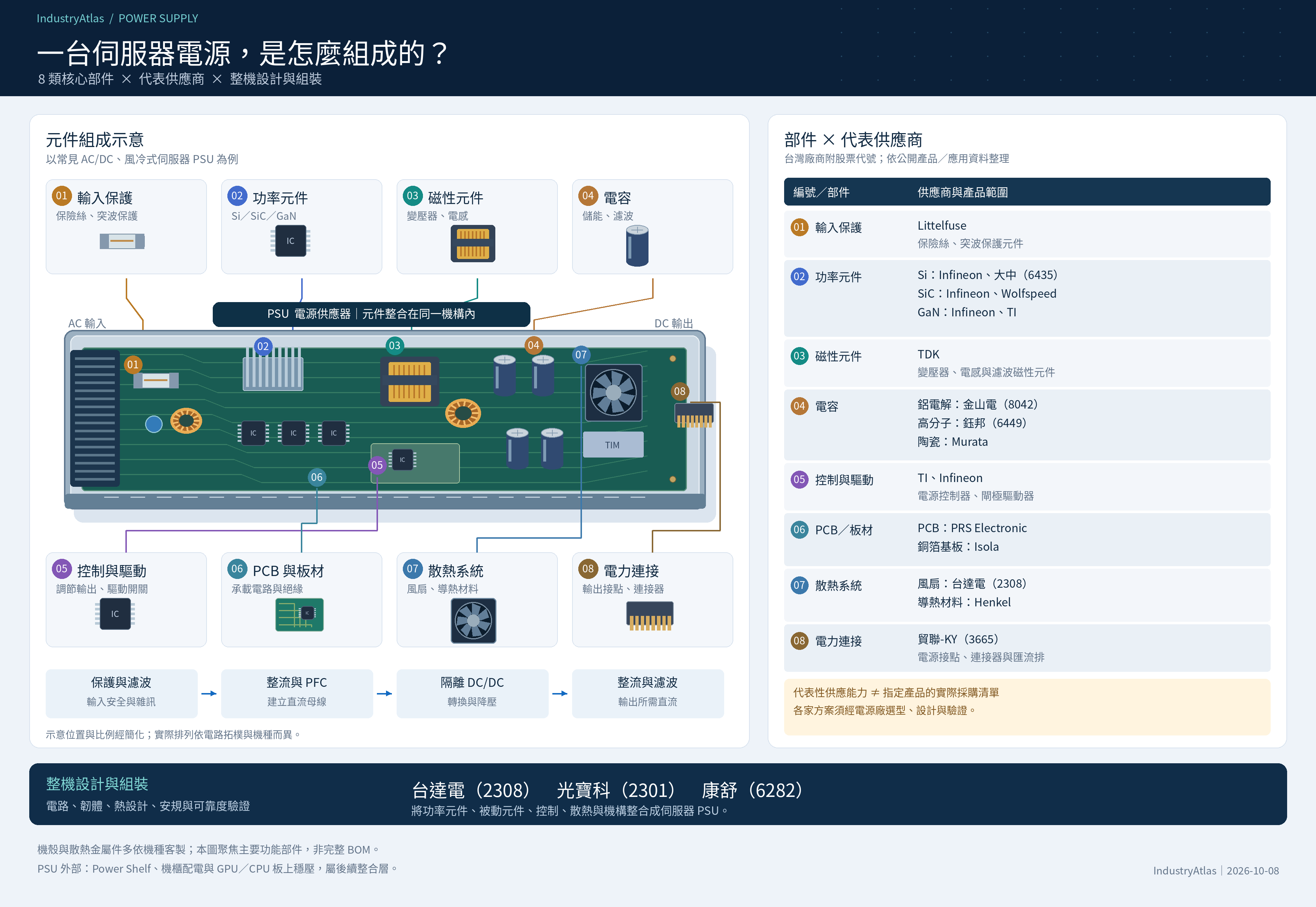
A typical AC-input server PSU, or power supply unit, first handles input protection and electromagnetic interference. Rectification and power factor correction (PFC) establish a DC supply, followed by isolation, voltage conversion, rectification, and filtering. Controllers continually monitor voltage, current, and temperature while coordinating the stages.[9]
PFC primarily improves the AC input current waveform and power factor. Conversion efficiency measures how much input power becomes useful output power. Both matter, but they are different metrics.
Opening a PSU reveals several converging material and component supply chains:
| Component | Common materials or structures | Role in the power supply |
|---|---|---|
| Power switches and rectifiers | Si, SiC, or GaN dies with metal wires, lead frames, or other package structures | Current control, energy switching, and rectification |
| Transformers, inductors, and chokes | Ferrite or other magnetic materials; copper windings, foil, or PCB windings; insulation | Isolation, energy storage, conversion, and noise suppression |
| Aluminum electrolytic and polymer capacitors | Aluminum foil, an aluminum-oxide dielectric, and liquid electrolyte or conductive polymer | Energy storage, filtering, and voltage stabilization |
| Ceramic and film capacitors | Ceramic dielectrics and metal electrodes, or plastic films and metallized electrodes | Filtering, decoupling, and noise suppression across different frequency ranges |
| PCBs and copper-clad laminates | Copper foil, resin, glass fiber, and related materials | Support circuitry and provide conductive and insulating structures |
| Control, drive, and protection | Control ICs, gate drivers, sensors, isolators, fuses, and related parts | Regulate output and manage overcurrent, overvoltage, overheating, and other conditions |
| Thermal and mechanical components | Aluminum or copper heat sinks, thermal interface materials, fans, and housings; liquid cooling in some designs | Remove heat generated by losses |
| Power connections | Copper or copper-alloy conductors, contact plating, and insulating plastics | Connect PSUs, power shelves, and rack loads |
The table describes common materials and functions; actual combinations depend on circuit and product requirements. Magnetics, capacitors, laminates, and thermal materials can be cross-checked against technical or product information from TDK, APAQ, Murata, Isola, and Henkel.[10][11][12][13][14]
GaN’s support for higher switching frequencies may create room to shrink magnetic components, but core losses, winding losses, temperature rise, and electromagnetic interference must be rebalanced. Higher power density often requires coordinated changes to chips, magnetics, PCB layout, and cooling.
4. Where Do Taiwanese Suppliers Fit?
Taiwan participates from upstream wafers through rack power delivery. The following 12 representative companies are classified using public product and company information. Their listed capabilities do not establish particular supply relationships among them.
| Stage | Representative Taiwanese supplier | Established role and interpretation |
|---|---|---|
| Wafers and compound-semiconductor materials | GlobalWafers (6488) | Supplies silicon wafers and is developing material products including SiC and GaN; an upstream materials role.[7] |
| Epitaxy | Episil-Precision (3016) | Develops and produces Si, SiC, and GaN epitaxial wafers, with publicly offered GaN-on-Si products; the focus is epitaxial processing.[6] |
| Power-device foundry | Episil Technologies (3707) | Manufactures devices including power MOSFETs, SiC, and GaN; a different stage from Episil-Precision’s epitaxy.[15] |
| Power-device design | Sinopower Semiconductor (6435) | Develops MOSFETs, IGBTs, and high-voltage ICs for applications including computers, servers, and switching power supplies.[16] |
| Packaging | ASE, part of ASE Technology Holding (3711) | Offers power-device packaging, including SiC and GaN solutions, with a role in device connections and package thermal management.[8] |
| Polymer and hybrid capacitors | APAQ Technology (6449) | Offers conductive-polymer aluminum and hybrid capacitors, among other products, in the passive-component chain for power supplies and electronics.[11] |
| Aluminum electrolytic capacitors | Taiwan Chinsan (8042) | Supplies aluminum electrolytic capacitors for applications including power supplies; selection must meet voltage, ripple, and life requirements.[17] |
| Board-level power inductors | TAI-TECH (3357) | Offers high-current inductors for GPU, CPU, and memory power delivery, mainly serving board-level voltage regulation.[18] |
| Busbars and power connections | BizLink (3665) | Supplies rack busbars, power connectors, and cables for distribution among power shelves, BBUs, and equipment.[19] |
| PSUs and rack power | Delta Electronics (2308) | Public products include high-efficiency PSUs, power shelves, and high-voltage DC solutions.[1][20] |
| Power supplies and power-system integration | LITEON Technology (2301) | Displayed a 110kW power shelf and an 800VDC liquid-cooled power rack in 2026, reflecting its system-integration direction.[21] |
| PSUs and power shelves | AcBel Polytech (6282) | Its OCP product page lists a 33kW power shelf made from six hot-swappable 5.5kW PSU modules.[22] |
These companies occupy different technical positions. Epitaxy suppliers manage material quality; foundries turn designs into devices; capacitor and inductor suppliers support energy storage and filtering; power-supply makers handle complete-unit design, integration, and qualification. Identifying which product layer a company delivers is the first step to understanding how technology upgrades affect it.
5. From PSUs to Complete Rack Power, Product Boundaries Are Expanding
Power-related coverage often discusses different product levels together, but an individual PSU’s rating cannot be directly compared with an entire power shelf’s output.
| Term | Position in the power system |
|---|---|
| PSU: power supply unit | Performs specified power conversion; a common server AC/DC PSU converts AC input to DC output |
| Power shelf | Integrates multiple power modules, controls, and connection interfaces for higher total power and serviceability |
| Busbar | Distributes power to equipment in the rack, emphasizing current carrying, contacts, and distribution |
| BBU: battery backup unit | Provides short-duration support during events such as supply interruptions; requires batteries, management, and conversion circuitry |
| Board-level power / VRM | Further reduces voltage near GPUs and CPUs to supply the low voltage and high current chips require |
AcBel’s publicly listed 33kW power shelf combines six 5.5kW PSUs. LITEON’s 110kW power shelf displayed at COMPUTEX 2026 is a higher-power system-level product.[21][22] Comparisons also need input and output voltages, cooling conditions, and power available to the load after allowing for redundancy.
This also clarifies the different roles of TAI-TECH and BizLink. TAI-TECH’s relevant inductors can serve conversion near GPUs and CPUs, while BizLink’s busbars and connectors transmit power within the rack. Both participate in server power delivery, but their products and qualification requirements differ.[18][19]
6. Why Are Power Architectures Moving Toward 800V?
As distributed power rises, current becomes a challenge. Using power = voltage × current and ignoring losses, delivering 100kW requires approximately 2,000A at 50V, but only about 125A at 800V. This compares distribution at equal power; it does not mean an actual rack routes all its current through one connector.
Higher distribution voltage reduces current, easing demands on conductors, contacts, and resistive losses. Once power enters the equipment, further conversion is still required to produce the low voltages needed by GPUs and CPUs.
In an official August 2026 article, NVIDIA described a gradual move toward high-voltage DC using 800VDC power racks compatible with existing AC infrastructure, listing the second half of 2026 for their introduction. This is a product and architecture roadmap that can be tracked, not evidence that data centers have universally adopted 800V.[23]
For the supply chain, the shift affects high-voltage conversion devices, isolation, protection, connectors, busbars, and thermal design together. Changing supply voltage also increases the importance of system integration.
Looking downstream from SiC and GaN reveals a chain from materials to complete systems. Looking upstream from GPUs reveals the links among board-level regulation, rack distribution, and data-center power. Taiwanese suppliers participate at several intersections of these paths. Understanding each company’s role and the evidence for its product progress provides a clearer view of changes in the power industry.
Sources & notes
- Sources primarily comprise manufacturer technical information, company announcements, and OCP product documentation. Product capabilities are used to identify industry roles; undisclosed customers, orders, and supply relationships are not inferred.
- 1. Delta: 5,500W server PSU and 80 PLUS Ruby certification — April 2025.
- 2. Infineon: 12kW PSU reference design combining Si, SiC, and GaN — September 10, 2025.
- 3. TI: TIDA-010062 — GaN PFC and LLC power-supply reference design
- 4. Wolfspeed: SiC materials; Coherent: SiC for Power Electronics
- 5. AIXTRON: MOCVD process and precursors
- 6. Episil-Precision: Company business; GaN-on-Si epitaxial products
- 7. GlobalWafers: Products; Compound-semiconductor materials
- 8. ASE: Lead Frame / Power Package
- 9. TI: AC/DC PSU design resources for 12V and 48V/54V outputs
- 10. TDK: Transformers for AC/DC converters
- 11. APAQ: Polymer, hybrid, and aluminum electrolytic capacitors
- 12. Murata: Inorganic materials technology
- 13. Isola: 370HR laminate information — An example of resin and glass-fiber laminate construction.
- 14. Henkel: Thermal management materials
- 15. Episil Technologies: Company overview and manufacturing services
- 16. Sinopower: Corporate information; Product applications
- 17. Taiwan Chinsan: AN series capacitors and power-supply applications
- 18. TAI-TECH: AI servers and board-level power inductors
- 19. BizLink: Data-center power connections, busbars, and OCP products
- 20. Delta: COMPUTEX 2025 power and rack solutions
- 21. LITEON: COMPUTEX 2026 company press release — Issued by LITEON through PR Newswire, June 3, 2026.
- 22. Open Compute Project: AcBel 19-inch 33kW Power Shelf
- 23. NVIDIA: Why Scaling AI Compute Performance Requires a New Power Architecture — August 11, 2026.
- 24. Infineon: REF-12KW-HFHD-PSU specifications