
INDUSTRY ANALYSIS
Low-CTE Glass-Cloth Shortages Persist: Potential Beneficiaries and the Prospects for Quartz Cloth
AI chips are driving larger, higher-layer-count package substrates, while low-CTE glass-cloth supply struggles to keep pace. Beyond Nittobo, Taiwan Glass, Baotek, and Honghe have formally disclosed customer-qualification progress, while Fulltech, Asahi Kasei, and Nan Ya have their own initiatives. This article examines potential benefits for each supplier and the qualification and cost conditions needed for quartz cloth to become an alternative.
AI-chip capacity bottlenecks are extending into upstream materials.
The Taiwan Printed Circuit Association (TPCA) and ITRI’s Industry, Science and Technology International Strategy Center forecast $19.51 billion in global package-substrate output value in 2026, up 32.3% year over year. Yet low-CTE glass cloth used in advanced substrates remains tight as demand expands. Bringing new capacity online, improving yields, and qualifying additional suppliers all take time.[1]
This creates opportunities for glass-cloth suppliers: incumbents may increase shipments, while new entrants may benefit as customers diversify procurement. The scale of benefit depends on product progress and delivery capability, however; suppliers are not interchangeable.
1. Why do AI package substrates need low-CTE glass cloth?
CTE, the coefficient of thermal expansion, describes how much a material expands or contracts with temperature. Chip packages experience temperature changes during manufacturing, solder reflow, and operation. Differences in the expansion of constituent materials increase deformation and stress on interconnects.
Low-CTE glass cloth provides lower thermal expansion and dimensional stability. Nittobo’s official reference data, for example, list T-glass at approximately 2.8 ppm/°C, versus 5.6 ppm/°C for conventional E-glass. Tensile elastic modulus rises from 75 GPa for E-glass to 86 GPa for T-glass. The combination of low expansion and high stiffness is a key material advantage.[2]
These are material reference properties, not values for an entire substrate combining resin, copper, and glass cloth. Substrate manufacturers ultimately need sufficient dimensional stability and reliability in the finished package.
Two requirements must also be distinguished: low-Dk / low-Df materials target high-speed signal transmission, while low-CTE materials target thermal expansion and structural stability. Both may benefit from AI demand, but their products and supply conditions are not identical.[2]
This article uses low CTE as a general term for low-expansion product lines. T-glass is Nittobo’s representative product name; other suppliers’ low-expansion materials may use different formulations.
2. Which suppliers are positioned to benefit?
The assessment follows formal company disclosures. When a company explicitly states that its low-CTE glass cloth has passed customer qualification, the product line is treated as having achieved qualification progress. Monitoring then shifts to supply scale, yield, and revenue contribution. If a disclosure refers only to “glass-fiber products,” a qualification target, or specialty-cloth cooperation, its original scope is preserved.
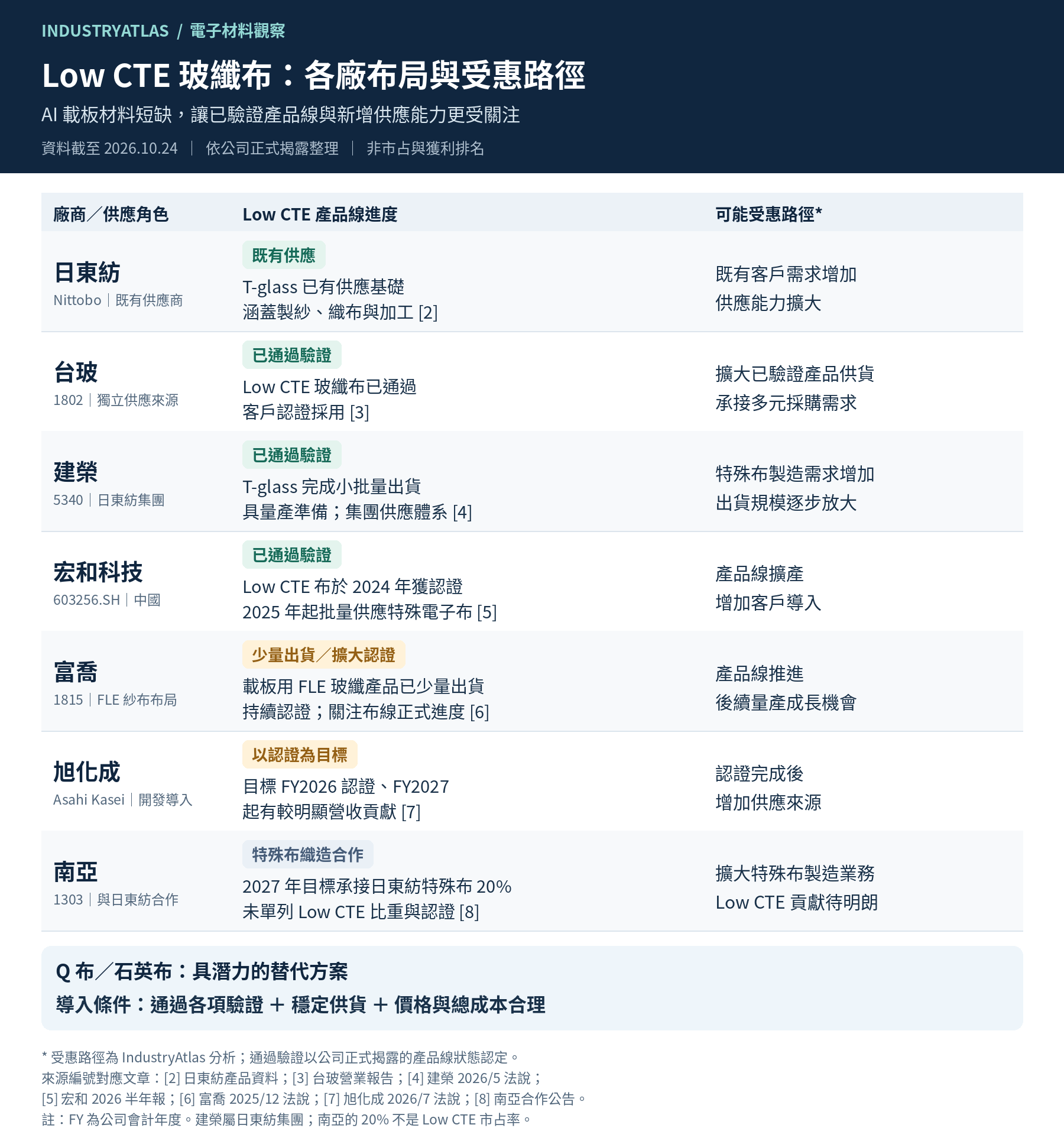
*Figure: Supplier positioning by product-line progress, without ranking market share or profits. Potential benefits are IndustryAtlas’s analysis of each company’s supply-chain role.*
| Supplier | Low-CTE positioning and disclosed progress | Potential benefit pathway | What to monitor |
|---|---|---|---|
| Nittobo | Established T-glass supplier with yarn production, weaving, and processing capabilities.[2] | Increased demand from existing customers and expanded supply capacity | New capacity, shipments, and product mix |
| Taiwan Glass (1802) | Formally disclosed customer qualification and adoption of low-CTE glass cloth.[3] | Scaling qualified products and meeting demand for diversified sourcing | Capacity utilization, yields, and low-CTE contribution |
| Baotek Industrial (5340) | May 2026 investor presentation disclosed T-glass qualification, completed small-batch shipments, and production readiness; part of the Nittobo group.[4] | Increased specialty-glass-cloth manufacturing within the group | Shipment ramp and T-glass revenue share |
| Honghe Technology (603256.SH) | Its 2026 interim report said low-expansion glass cloth was qualified by downstream customers in 2024; volume specialty-electronic-cloth supply began in 2025.[5] | Capacity expansion and customer adoption for qualified products | Low-CTE shipment growth and specialty-cloth mix |
| Fulltech Fiber Glass (1815) | FLE / low-CTE glass-fiber products for substrates shipped in small volumes in Q4 2025, with qualification continuing to expand.[6] | Progress and subsequent scaling of integrated yarn-and-cloth product lines | Explicit low-CTE cloth qualification disclosures and production contribution |
| Asahi Kasei | July 2026 official guidance targeted customer qualification in FY2026 and more meaningful revenue from FY2027.[7] | Entry into the supply chain after new-product qualification | Completed qualification and commercialization timing |
| Nan Ya Plastics (1303) | Cooperates with Nittobo on specialty-cloth weaving; the announcement does not separately specify low-CTE volumes or qualification progress.[8] | Expansion of specialty-cloth manufacturing through cooperation | Product scope, output, and actual low-CTE contribution |
Taiwan Glass and Honghe: after qualification, the focus shifts to scaling supply
Taiwan Glass’s formal business report includes low-CTE glass cloth among products qualified and adopted by customers. It can therefore be treated as a supplier with product-line qualification and a basis for serving demand.[3]
Honghe’s interim report explicitly distinguishes low-dielectric from low-expansion glass cloth. Both have downstream-customer qualification, and the report also discloses specialty-electronic-cloth supply and capacity expansion.[5]
IndustryAtlas’s view is that when customers seek additional sources, companies that have passed qualification are better placed to turn market shortages into actual orders. The next differentiators are deliverable volume, consistent quality, and cost control—not simply having introduced a product.
Nittobo and Baotek: expanding an established supply system
Nittobo is an established T-glass supplier, while Baotek has formally disclosed qualification and small-batch shipment progress.[2][4]
They should be understood within the same group supply system. Nittobo benefits from demand for its established materials business; Baotek’s opportunity lies in increased specialty-cloth manufacturing. Baotek can benefit, but the two should not be counted as entirely independent sources of material supply.
Fulltech, Asahi Kasei, and Nan Ya: opportunities at different stages
Fulltech has added FLE / low CTE to its substrate-material portfolio and disclosed limited shipments and expanding qualification. Because the announcement describes “glass-fiber products,” this article treats the program as progressing. A subsequent formal disclosure of glass-cloth qualification would support upgrading the product-line status.[6]
Asahi Kasei provides a clearer timetable, but it remains a company target. FY2026 and FY2027 refer to its fiscal years and should not be interpreted as commitments to completion by calendar year-end.[7]
Nan Ya’s cooperation with Nittobo targets Nan Ya weaving approximately 20% of the specialty glass cloth Nittobo supplies to the market by 2027. This is an overall specialty-cloth cooperation target, not a 20% addition to low-CTE market supply.[8]
3. How can the shortage create supplier benefits?
IndustryAtlas identifies three main potential pathways:
1. Higher shipments. Qualified suppliers with delivery capability may increase utilization and deliveries. 2. A better product mix. A rising share of advanced low-CTE materials may shift revenue toward higher-value products. 3. Deeper customer relationships. Shortages encourage customers to establish additional sources, increasing the chance that qualified products enter recurring procurement.
These are industry opportunities, not guarantees of profit growth for every company. Depreciation on new lines, yield-ramp costs, yarn availability, and order allocation all affect how quickly revenue becomes profit.
Likewise, $19.51 billion is the forecast value of global package-substrate production, not the size of the low-CTE cloth market. The 32.3% substrate growth rate cannot be applied directly to glass-cloth consumption or individual suppliers. The more meaningful signal is sustained growth in low-CTE shipments and revenue contribution.
4. Quartz cloth is a potential alternative, subject to qualification and reasonable cost
Q-cloth means quartz-fiber cloth. Its appeal lies in low thermal expansion and low dielectric loss. Beyond high-speed PCBs, it may also serve semiconductor package substrates.
Shin-Etsu Chemical’s SQX product information, for example, lists CTE of approximately 0.5–0.6 ppm/°C and identifies thin package substrates as an application. This provides a materials basis for evaluating quartz cloth.[9]
Q-cloth is therefore best described as a promising alternative. Moving from candidate material to broader adoption requires three conditions together:
| Adoption condition | Questions to resolve |
|---|---|
| Pass the relevant qualifications | Processing, electrical, thermal-mechanical, and long-term reliability requirements must be met when combined with resin and the substrate structure |
| Stable supply | Sustainable volume, quality, and yield must be sufficient to relieve the materials shortage |
| Reasonable pricing and total cost | Assessment must include processing efficiency, consumables, yield, and scrap costs, not cloth price alone |
Shortages may encourage customers to evaluate alternatives more actively and accept higher material prices. If processing costs or yield losses are too high, however, a low-CTE specification advantage is insufficient to drive a broad transition.
Quartz cloth should not yet be counted as available supply that can fill the low-CTE substrate-material gap. Adoption is more likely to begin gradually in qualified applications where performance benefits justify the cost.
5. IndustryAtlas perspective: track qualified supply first, then alternative materials
The significant change is that competition in AI substrates now extends into upstream glass-fiber materials. Existing suppliers such as Nittobo have opportunities to expand, while Taiwan Glass, Baotek, and Honghe—each with disclosed qualification results—must convert product-line progress into stable deliveries.
Fulltech, Asahi Kasei, and Nan Ya each have further opportunities, with assessments updated according to qualification, production, and cooperation details. Quartz cloth remains an alternative direction, pending the combined maturity of qualification, supply capability, and pricing.
Sources & notes
- 1. TPCA: AI drives advanced-substrate upgrades; global substrate output value forecast at $19.51 billion in 2026: substrate-market outlook and low-CTE material bottlenecks.
- 2. Nittobo: Glass cloth for electronic materials: T-glass and NE-glass applications and reference properties.
- 3. Taiwan Glass: official business report; 2025 shareholder-meeting handbook: customer qualification and adoption of low-CTE glass cloth.
- 4. Baotek: May 15, 2026 investor presentation, page 18: T-glass customer qualification, small-batch shipments, and production readiness.
- 5. Honghe Technology: 2026 interim report, announced August 14, 2026, Section 3, Management Discussion and Analysis: full company announcement reproduced by Sina Finance; low-expansion cloth qualification and specialty-electronic-cloth supply progress.
- 6. Fulltech: December 31, 2025 investor presentation, page 18; 2025 sustainability report, issued August 4, 2026: FLE / low-CTE glass-fiber product shipments and portfolio.
- 7. Asahi Kasei: July 31, 2026 first-quarter earnings Q&A, page 6: qualification and revenue-contribution targets for low-CTE and quartz cloth.
- 8. Nan Ya: strategic cooperation with Nittobo on specialty glass cloth, November 28, 2025: weaving cooperation and 2027 targets.
- 9. Shin-Etsu Chemical: SQX quartz-cloth product information: quartz-cloth properties and package-substrate applications.