
INDUSTRY ANALYSIS
Largan Moves From FA to FAU: How Will Cooperation and Competition in the Optical Supply Chain Change?
At its October 8 investor conference, Largan disclosed plans to expand from fiber arrays (FA) into fiber array unit (FAU) integration and pursue carrier assembly. This puts greater focus on cooperation opportunities for Ability Opto-Electronics Technology, competition facing FOCI, and the roles of component suppliers such as Genius Electronic Optical and Himax. Successful mass production could ease some CPO supply bottlenecks, but benefits for each supplier still depend on customer nominations, product qualification, and actual purchasing.
What Changed at This Investor Conference?
Our earlier article, “FA/FAU and Optical Coupling: Will Largan and Genius Electronic Optical Become FOCI’s Partners or Competitors?”, proposed a way to assess new entrants: are they delivering individual components, or optical units for which they can take responsibility for overall performance and delivery? Different delivery scopes create different boundaries between cooperation and competition.
Largan’s direction became clearer at its October 8 investor conference. According to Central News Agency (CNA) and MoneyDJ reports, Largan has shown customers an FAU production line, customers want to purchase complete FAUs directly, and the company is also seeking the work of mounting FAUs onto a carrier.[1][2]
This increases overlap with existing FAU integrators while leaving room to source optical components externally. The central questions in the emerging division of labor are who supplies the parts, who integrates them, and who takes responsibility for delivery.
From FA to FAU, Delivery Responsibilities Extend Downstream
An FA, or fiber array, is an assembly of optical fibers arranged at specified positions and spacing. The integration scope of an FAU, or fiber array unit, varies with product design and supplier terminology. Not all FAUs can be defined as the same combination of components. FOCI’s publicly disclosed ReLFACon, for example, is one solution incorporating lensed fiber-array connections and packaging-compatibility considerations.[9]
Under the plan Largan disclosed, it will manufacture FAs in-house, purchase optical components such as PMLAs—prismatic microlens arrays—and complete the FAU. The table below separates the company’s disclosed direction from the limits of each reported milestone.[1][2][3][4]
| Item | October 8 disclosure | How to interpret the current stage |
|---|---|---|
| FA customer qualification | The FA has passed qualification with one customer | A confirmed milestone; it does not establish qualification of the complete FAU. |
| FAU integration | Customers want to buy FAUs directly, and a related production line has been demonstrated | A clear expansion in delivery scope, with further qualification and production work still required. |
| Purchased optical components | Plans to source PMLAs externally; the customer has already specified the prism for this generation | External component suppliers retain a role, but supplier identities were not disclosed. |
| FAU plus carrier | Seeking the work of mounting FAUs onto a carrier | Integration work being pursued, not a confirmed order. |
| Production schedule | Targeting completion of capacity installation by the end of Q2 2027 and FAU mass production in the second half | Company targets; actual shipments depend on line installation, yield, and customer adoption. |
MoneyDJ reported that customers’ preference for complete FAUs relates to reducing disputes over assembly yield and responsibility. If Largan completes the integration, it can take on more of the delivery work, alongside greater manufacturing and quality responsibilities.[2]
How Relationships May Change for Six Suppliers
The table describes possible roles as Largan expands FAU integration. “Greater cooperation opportunity” does not mean confirmed production supply; “potential benefit” does not mean an order has been won; and “more competition” does not mean revenue has already declined.
| Supplier | Public product or partnership foundation | Interpretation of the relationship change | What needs confirmation next |
|---|---|---|---|
| Ability Opto-Electronics Technology (3362) | V-grooves; has sought to submit samples together with Largan’s CPO products.[5] | Greater cooperation opportunity: clearer evidence of complementary upstream and downstream roles | Qualification, inclusion in production purchasing, and actual supply share |
| Genius Electronic Optical (3406) | Prisms, microlens arrays, V-grooves, and MT ferrules.[6] | Neutral / potentially beneficial: can provide components needed by integrators | Customer approval or nomination as a supplier, and any expansion of delivery scope |
| FOCI (3363) | Fiber connections and FAU-related integration solutions, co-developed with Himax.[8][9] | More competition: Largan is moving into a more overlapping delivery layer | Qualification on the same platforms, allocation of orders, and retention of integration advantages |
| Himax Technologies (HIMX) | Wafer-level optics and silicon-photonics packaging solutions developed with FOCI.[8][10] | Impact remains to be established: a change of integrator need not involve a change of components | Actual optical-component adoption, supply responsibilities, and subsequent customer deployments |
| Asia Optical (3019) | CPO prisms and collimating lenses.[11] | Neutral / potentially beneficial: opportunities from additional component demand | Whether sampling converts into qualification and purchasing, and identification of actual customers |
| Young Optics (3504) | MT ferrules and other components, plus lens and optical-transceiver module development.[12] | Neutral / potentially beneficial: component businesses can complement integrators | Whether pilot projects enter production; progress must be assessed separately for each product |
Ability Has Clearer Cooperation Indicators, but Production Adoption Still Matters
Ability Opto-Electronics Technology has entered V-grooves and publicly sought to submit samples alongside Largan’s products. This supports a potential direction for cooperation, but does not confirm that Largan’s production line has adopted its products.[5]
If Ability completes qualification and enters the purchasing plan, Largan’s FA/FAU expansion could create shipment opportunities. The next issues for Ability are its share of purchasing, pricing, and yield requirements—not simply the size of Largan’s announced expansion plans.
Genius May Benefit, but “Customer-Specified” Does Not Mean Genius Was Selected
Genius Electronic Optical has several precision optical component initiatives and potential scope to work with FAU integrators. However, Largan’s statement that the prism for this generation was specified by the customer supports only the position of the existing nominated supplier. It does not identify Genius as that supplier.[3][6]
Genius can therefore be considered a potential beneficiary among component suppliers. Adoption in an existing design or subsequent qualification would establish a firmer supply position. If the customer uses another supplier’s component and the current design is already fixed, near-term entry may be limited.
In an executive interview, Genius also said that whether it moves into FAUs will depend on customer needs. Its present component-supply direction should not be read as a permanent commitment never to compete with integrators.[7]
FOCI Faces More Competition, but Orders on the Same Platforms Need to Be Tracked
Largan’s move into complete FAUs brings its role closer to FOCI’s. Competition will involve integration, qualification, and delivery capabilities; the precision of a single component cannot determine the outcome.
FOCI and Himax already have a joint-development foundation. Himax’s official August 2026 announcement said their collaborative products had entered an engineering-production ramp in the third quarter, while customer qualification and volume-production preparations continued. Formal production timing depends on customer deployment.[8]
What can be concluded now is that the direction of competition is clearer, not that FOCI has lost a particular order. If market demand continues to expand, FOCI’s shipments could also rise. Changes may first appear in its share of new orders, quotations, and bargaining power.
Himax’s Exposure Depends on the Component Layer; Asia Optical and Young Optics Depend on Adoption
Himax’s collaboration with FOCI includes wafer-level optics and silicon-photonics packaging solutions.[8][10] If a customer changes or adds an FAU integrator, the optical components could remain the same or change as well. Because Largan has not identified its external PMLA supplier, we cannot infer that Himax has won Largan orders or that competition facing FOCI will affect Himax proportionally.
Asia Optical and Young Optics have entry opportunities in precision components. Asia Optical has disclosed work on prisms and collimating lenses. At its July investor conference, Young Optics said an MT ferrule project had entered pilot production, while other products remained at different development stages.[11][12] Benefits depend on meeting the purchasing design and completing qualification. Neither can simply be classified as an established Largan supplier.
Customer-Specified Components Can Allow Cooperation and Competition at the Same Time
The external sourcing plan shows that FAU integrators may not be free to replace every component. Customers can retain approved optical components while adding different integrators to expand supply or compare delivery capabilities.
Under that division of labor, competition among module integrators would increase while some component suppliers could serve several of them. Relationships can also vary by project: a company may supply a part for one product and compete in integration for another.
This is an industry scenario inferred from customer nominations and external sourcing, not an announced cross-company supplier list. A supplier’s position should be assessed through its actual deliverables and customer adoption, rather than simply whether it is associated with CPO.
For CPO, This Adds Supply Options; the Actual Effect Depends on Mass Production
At the investor conference, Largan CEO Adam Lin said FA and FAU supply was tight.[1] If Largan’s integration and capacity investments become consistent supply that customers can use, they could ease some fiber-connection bottlenecks and turn previously constrained demand into shipments.
There are two limits to this inference. First, new capacity does not automatically create end demand; its effect depends on unmet demand already existing. Second, FA/FAU is only one part of CPO. More supply at this stage does not establish that all bottlenecks across the CPO system have been resolved.
Improved supply can support commercial deployment, but the profit effects may differ by company. Customers gain more sourcing options, and existing suppliers may face tougher comparisons on price and lead time. Industry shipment growth and individual suppliers’ profits still need to be assessed separately.
Equipment suppliers face a similar distinction. Largan said much of the equipment on these lines is developed in-house, so its expansion should not be directly converted into orders for external coupling or alignment-equipment vendors. Demand from other equipment customers must be evaluated separately.[2]
What to Track in 2026–2027
The main new information in 2026 concerns FA qualification and the direction of FAU integration. In 2027, the company plans to move through line installation and mass production. The 2028 project associated with multirow FAs and the 2030 factory planned on newly purchased land follow different timelines and should not be counted as available capacity in 2027.[1][4]
| Development to track | Why it matters |
|---|---|
| Customer qualification and volume shipments of complete FAUs | Distinguishes FA qualification and a demonstrated line from stable commercial supply |
| Adoption of FAU-plus-carrier assembly | Establishes the integration scope Largan actually takes on |
| Component suppliers and purchasing arrangements | Turns potential cooperation into confirmed supply relationships |
| Stable yield, output, and lead times | Shows whether installed capacity becomes effective supply |
| New projects and gross margins at existing integrators | Separates market-wide growth from changes in allocation caused by competition |
Largan’s investor conference clarified competitive boundaries in FA/FAU: integration work is expanding while component supply still leaves room for cooperation. Ability’s cooperation opportunities, potential benefits for Genius and other component vendors, and competition facing FOCI should all be reassessed as qualification, purchasing, and production data become available.
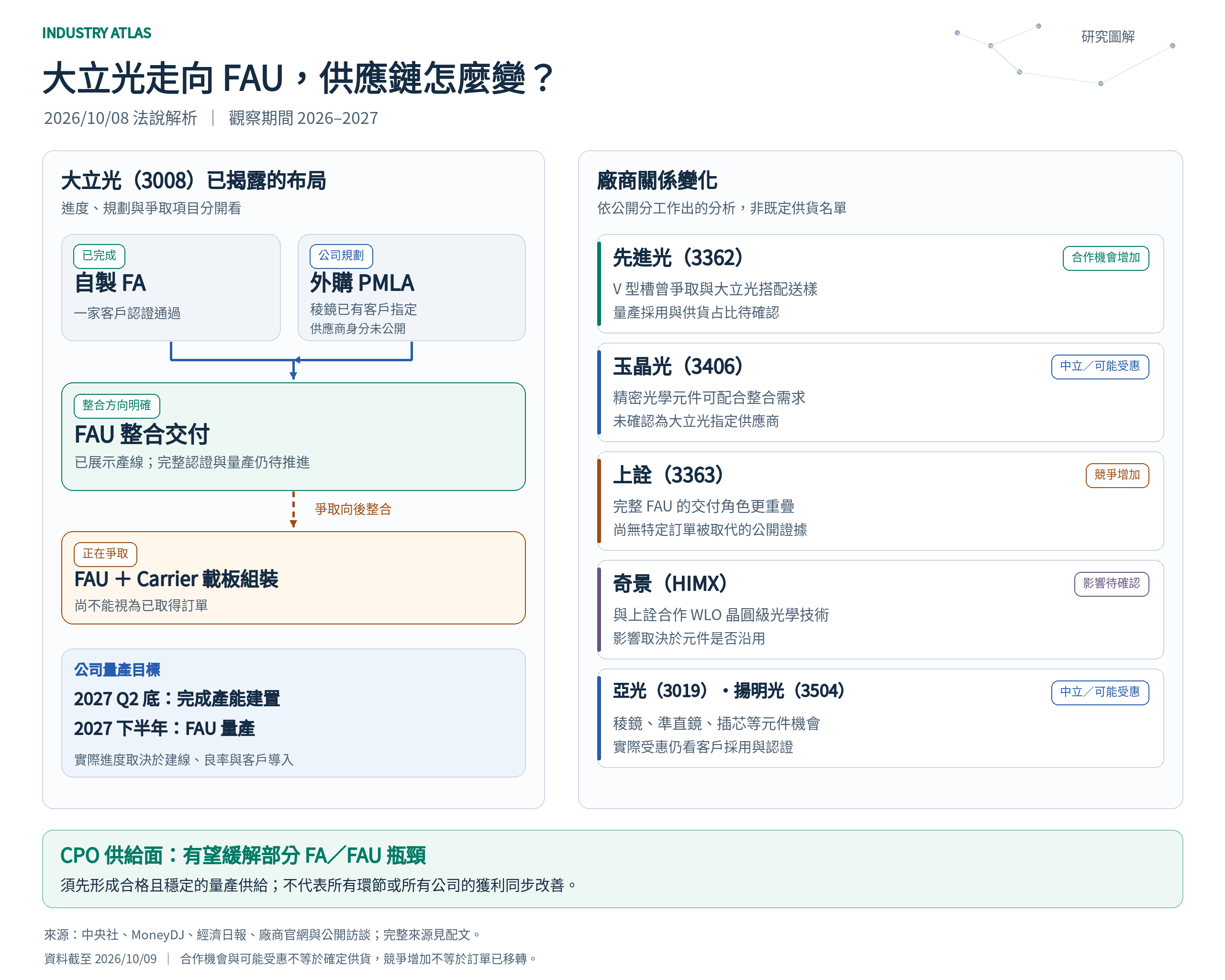
Figure: The left side summarizes the progress, plans, and opportunities pursued that Largan disclosed on October 8, 2026. The right side presents relationship changes inferred from publicly disclosed roles. Cooperation opportunities and potential benefits do not establish confirmed supply, and greater competition does not establish that orders have already shifted.
Sources & notes
- 1. CNA: Largan accelerates CPO plans; Adam Lin says FA has passed qualification and FAU targets production next year — October 8, 2026
- 2. MoneyDJ: Largan expects possible smartphone weakness in November; targets FAU production around mid-next year — October 8, 2026
- 3. Economic Daily News: Largan pursues three CPO initiatives toward integrated delivery — October 9, 2026; reporting on the previous day’s investor conference
- 4. Liberty Times Finance: Largan targets FA and FAU production around mid-next year; Q4 gross-margin pressure — October 8, 2026
- 5. Economic Daily News: Ability pursues CPO and joint sampling with major shareholder Largan — June 4, 2026
- 6. Genius Electronic Optical: Optical Communications and Co-Packaged Optics — official product page, accessed October 9, 2026
- 7. Economic Daily News: Bringing in strategic investors to support performance — June 22, 2026; interview with a Genius executive, archived by IEK
- 8. Himax Technologies, Inc. Reports Second Quarter 2026 Financial Results; Provides Third Quarter 2026 Guidance — August 6, 2026; company release through GlobeNewswire
- 9. FOCI releases advanced new CPO connector: ReLFACon — January 18, 2023; used to establish product positioning, not 2026 production progress
- 10. Himax: CPO collaboration and strategic partnership with FOCI remain ongoing and unchanged — official statement, January 5, 2026
- 11. CNA: Asia Optical samples humanoid-robot lenses; CPO components could contribute revenue next year — August 18, 2026; republished by Economic Daily News
- 12. Liberty Times Finance: Young Optics outlines three CPO initiatives; FAU products in pilot production — July 24, 2026