
INDUSTRY ANALYSIS
What NVIDIA’s PTFE Switch-Board Display Reveals About Supply-Chain Change
NVIDIA’s NVLink PTFE Board display has drawn attention to next-generation high-speed interconnect initiatives at Taiflex, Flexium, Shengyi, and other suppliers. The list spans materials and board manufacturing, highlighting opportunities across different technologies. This article examines seven companies’ roles, compares them with the established NVSwitch supply chain, and assesses potential benefits, competitive pressures, and changes that still require mass-production evidence.
Why one display matters to the advanced PCB supply chain
At the October 2026 OCP Global Summit, NVIDIA announced progress in opening its Vera Rubin rack and compute-tray architectures. A circulating photograph of an “NVLink PTFE Board” display renewed interest in whether next-generation high-speed switch boards could change the division of work between materials and PCB suppliers.[1][2]
The question matters because changes in materials or manufacturing processes can alter competitive positions. Existing customer relationships remain valuable, but advantages in current products do not automatically carry into the next generation. New materials suppliers may gain an entry point, while manufacturers able to process those materials reliably into circuit boards may reshape market opportunities.
However, a trade-show display, material qualification, and volume-production orders are three different types of evidence. Public reporting has not established whether the display lists every participant, each supplier’s production share, or a complete bill of materials. This article treats inclusion as a participation signal and limits positive or negative assessments to competition for this particular project. It does not infer stock prices, revenue, or confirmed lost orders.[2]
Distinguishing PTFE boards, CCL, and switch trays
PTFE—polytetrafluoroethylene—can serve as a dielectric material in high-frequency circuit boards. CCL means copper-clad laminate, which PCB manufacturers process into boards with circuits and interlayer connections. PTFE CCL is itself a type of CCL, so competition from new materials should not be described as “PTFE replacing all CCL.”[4][5]
PTFE also does not necessarily mean glass-fabric-free. Both glass-fabric-reinforced and glass-fabric-free PTFE substrates exist. Any reduction in glass-fabric demand depends on the specific formulation and stackup.[4][5]
Board scope must also be distinguished:
| Term | Meaning in this article | Conclusions that should not be extrapolated |
|---|---|---|
| NVLink PTFE Board | The PTFE-related NVLink board referenced by the display | The name alone does not establish that every layer uses PTFE |
| Switch board | A board carrying circuits associated with switching functions | It is not an entire switch or rack |
| Switch tray | A tray containing switching boards, power, cooling, and mechanical structures | A material change does not imply replacement of every tray supplier |
| Backplane / midplane | Boards providing interconnection within a system | They serve different design roles from switch boards; material news cannot be transferred directly between them |
The display supports discussion of board and material competition, but does not by itself establish that all backplanes will move to PTFE or that copper cabling will disappear from racks.
Where do the seven companies fit in the manufacturing process?
A public transcription of the display lists Flexium, Kinwong, SCC, SYTECH, Taiflex, TTM, and VGT. Multiple Taiwanese media outlets also reported the inclusion of Taiflex and Flexium.[2][3]
The table below maps companies to supply-chain roles using their publicly disclosed products and capabilities. It is not NVIDIA’s supplier-by-supplier procurement allocation. Companies within a segment may compete, and links between segments must not be treated as confirmed one-to-one supply relationships.
| Company | Main position | Public capabilities and corresponding work | Still unconfirmed |
|---|---|---|---|
| Taiflex (8039) | CCL materials | Glass-fabric-free, low-loss PTFE copper-clad laminates | Project-specific part numbers, volume adoption, and share |
| Shengyi Technology (SYTECH) | CCL and bonding materials; the group also manufactures PCBs | PTFE, hydrocarbon, and high-speed materials; controlled subsidiary Shengyi Electronics manufactures PCBs | Final material selection and whether Shengyi Electronics makes PCBs for this project |
| Flexium (6269) | Circuit boards, interconnects, and modules | Flexible PCBs, modules, and MetaLink technology, focused on forming circuits and interconnect structures from materials | The display board’s specific MetaLink structure and scope of supply |
| Kinwong | PCB manufacturing | PTFE / hydrocarbon processing, circuit formation, and related high-frequency board processes | Project-specific board specifications and production share |
| Shennan Circuits (SCC) | PCB manufacturing | Advanced multilayer boards, backplanes, HDI, and electronic assembly | Actual processes and boards supplied for this project |
| TTM Technologies | PCB manufacturing | High-layer-count boards, low-loss material processing, backdrilling, and high-aspect-ratio holes | Volume-production scale for the new material solution |
| Victory Giant Technology (VGT) | PCB manufacturing | High-layer-count boards and advanced HDI for AI servers and data-center switches | Volume adoption and share in this project |
Roles are compiled from company websites and product information.[4]–[9] Existing RF PTFE processing experience does not establish successful mass-production qualification for this high-layer-count AI board.
Shengyi must be understood at both the individual-company and group levels, rather than being classified only as a CCL supplier. Shengyi Technology’s main materials businesses include CCL and bonding materials. Its controlled subsidiary Shengyi Electronics (SYE, 688183) develops, produces, and sells PCBs for applications including servers and communications-network equipment. Shengyi Electronics’ 2026 interim report explicitly identifies Shengyi Technology as its controlling shareholder, confirming the group’s presence in both upstream materials and downstream PCB manufacturing.[5][17]
Having both businesses does not establish that both have won orders for this board. The transcribed display names SYTECH, and material-part-number testing research provides additional evidence. There is currently insufficient public evidence to identify Shengyi Electronics as the manufacturer of the displayed PCB. Figure 1 therefore includes the group’s PCB business as context, without counting Shengyi Electronics as an eighth company on the display.
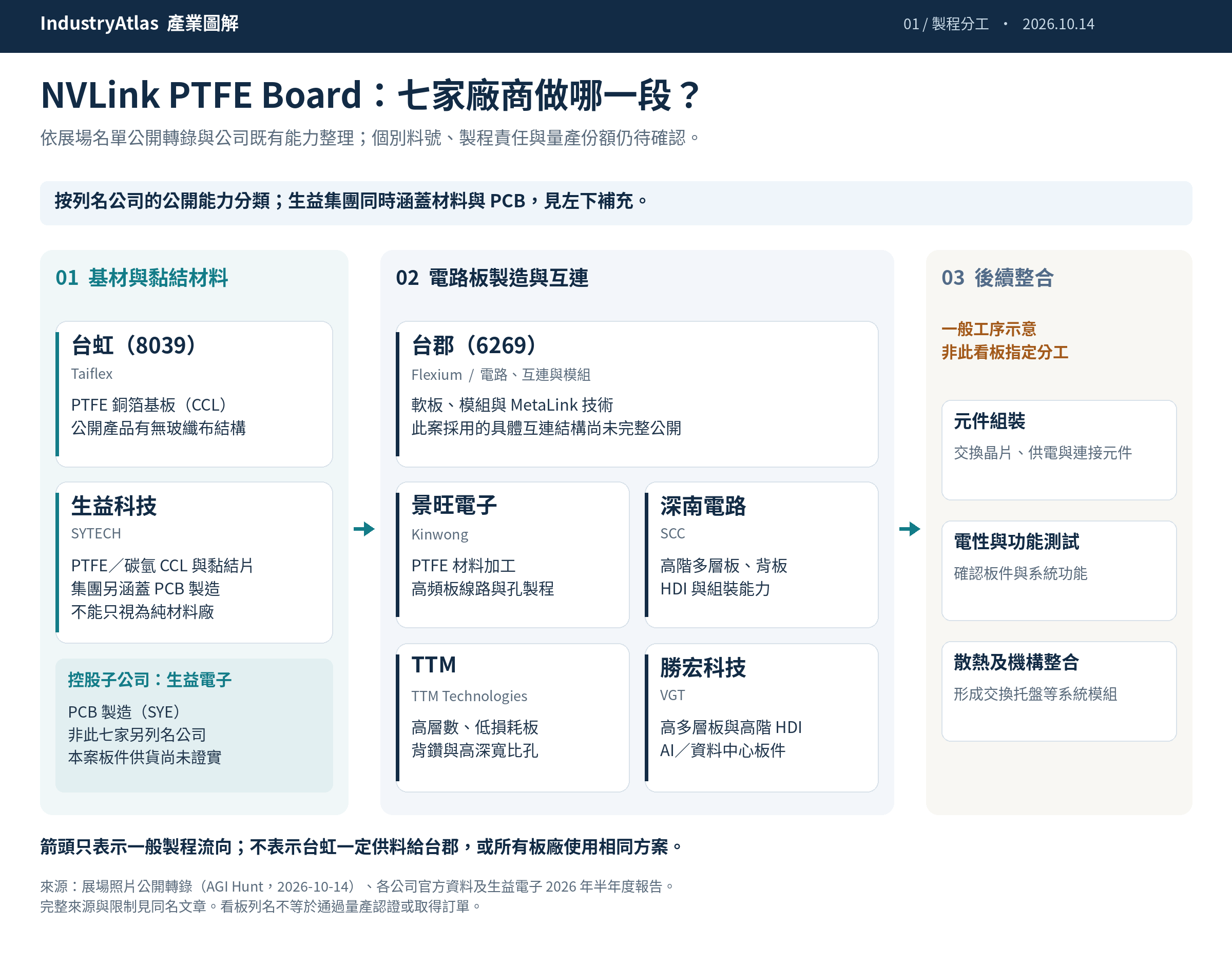
Figure 1: Public capabilities map the seven companies to materials, PCB manufacturing, and subsequent integration, with the relationship between Shengyi Technology and its controlled subsidiary Shengyi Electronics added. Arrows indicate the general process sequence, not confirmed purchasing relationships. Shengyi Electronics’ production of this project’s PCB remains unconfirmed.
Established suppliers have not all disappeared
Using GB200 and GB300 NVSwitch boards as a historical baseline, publicly reproduced brokerage research from 2025 identified Elite Material and Shengyi in related materials, and WUS, TTM, and VGT in switch-board manufacturing across different generations.[10]
| Comparison | GB200-era research list | GB300-era research list | Public transcription of the current display |
|---|---|---|---|
| CCL materials | Elite Material | Elite Material, Shengyi Technology | Taiflex, Shengyi Technology |
| Switch-board PCBs | WUS, TTM | WUS, TTM, VGT | Flexium, Kinwong, SCC, TTM, VGT |
This compares participants across generations; it is not a complete replacement list for one product. Historical brokerage research also cannot establish current precise shares. Shengyi Technology appears in the materials row according to that research and the materials evidence. This does not mean the group lacks a PCB business, or that Shengyi Electronics has been confirmed among this project’s board manufacturers.
One important point nevertheless emerges: Shengyi, TTM, and VGT appear in both historical supply-chain information and the new display. Material upgrades do not necessarily displace all incumbents. Existing suppliers capable of new solutions may compete again alongside other participants.
Shengyi’s renewed inclusion makes the absence of Elite Material and TUC more noteworthy
Shengyi was already in the relevant supply chain and appears again on the new display. The list therefore includes established partners and should not be assumed to introduce only new suppliers. Shengyi’s presence across materials and PCBs also reminds us that the display may combine different levels of cooperation; every name cannot be read as part of a complete CCL adoption list.
This inference depends on a crucial unresolved premise: whether the display includes all materials suppliers for the board.
If it fully identifies the materials suppliers for a particular display configuration, an unlisted company is less likely to have participated in that configuration as a materials supplier. If it highlights only selected development or demonstration partners, other participants remain possible. Even a confirmed display configuration cannot be extrapolated to all future production versions.
The positive evidence for Shengyi extends beyond its name on the display. Ming-Chi Kuo’s September 30, 2026 supply-chain survey identified Shengyi as a leading supplier in NVL576 switch-tray material testing, naming SG5300N glass-fabric-free PTFE CCL, SG1030N glass-fabric-free hydrocarbon CCL, and SIF09 glass-fabric-free hydrocarbon bonding sheets.[11]
IndustryAtlas’s assessment is that Shengyi has more specific public evidence of participation in the new materials project, while Elite Material and Taiwan Union Technology (TUC) lack similarly detailed named-adoption evidence. That indicates relative competitive pressure for the new project, not confirmed lost orders.
Elite Material and TUC also face different situations:
- Elite Material appears in historical NVSwitch materials-supply research, making next-generation material share and material value supplied per board direct monitoring priorities. - TUC and ITEQ compete in advanced materials, but this display alone cannot establish that they lost orders for this particular board that they previously held. Their submitted solutions must also be identified project by project as PTFE, hydrocarbon, or other hybrid materials.
Which suppliers face opportunities or pressure?
The classifications below are inferences about competitive opportunities in a specific new project. “Positive” does not mean volume-production revenue already exists, and “negative” does not mean the entire company’s profits will decline.
| Supplier | Directional assessment | Basis and potential effect | Limits |
|---|---|---|---|
| Taiflex (8039) | Positive | Public participation signal for glass-fabric-free PTFE materials increases opportunities in advanced switch boards | Qualification, capacity, and shipments still need confirmation |
| Flexium (6269) | Positive | Board and interconnect capabilities may extend into new AI-board applications | The full value of a switch board cannot be attributed to Flexium |
| Shengyi Technology group | Positive for materials; PCB role unconfirmed | Named material-testing research; its PCB business through Shengyi Electronics creates potential for materials / process coordination | Does not establish a board order for Shengyi Electronics or exclusive material supply |
| TTM | Positive | Appears in both the established switch-board supply chain and the new display, suggesting continued participation | Does not establish higher share |
| VGT | Positive | Appears in historical switch-board research and the new display | Still depends on yields, costs, and production allocation |
| Kinwong | Positive | Named on the new display and has PTFE-processing capabilities | Does not mean this is its first participation in NVIDIA’s entire supply chain |
| SCC | Positive | Named on the new display, with advanced-board capabilities | Specific boards and production role remain undisclosed |
| Elite Material (2383) | Relatively negative | An incumbent switch-board materials supplier faces new-material competition without equivalent public inclusion evidence | Hybrid-stackup supply or cooperative routes may remain |
| TUC (6274) | Neutral to negative | Weaker public participation evidence; alternative materials increase competition for advanced products | Prior orders for this board and PTFE qualification part numbers are unconfirmed |
| ITEQ (6213) | Neutral to negative | An advanced-materials competitor that needs to establish its role in the new project | Does not mean orders have already been lost |
| WUS Printed Circuit | Neutral to negative | A historical switch-board supplier absent from the public seven-company transcription; evidence of continued supply needs strengthening | Absence from the display does not exclude participation in other versions |
| Glass-fiber materials suppliers including Nittobo, Taiwan Glass (1802), and Fulltech Fiber Glass (1815) | Conditionally negative | Glass-fabric-free structures could reduce reinforcing-fabric use in the relevant board layers | Individual exposure is unclear; an overall demand decline cannot be inferred |
| Ample Electronic Technology (4760) | Indirectly positive | Alloy-paste products can serve high-frequency, high-speed interconnect processing; a report identifies adoption in Flexium’s MetaLink | Not one of the seven listed companies; results depend on actual pairing and production ramp |
| Gold Circuit Electronics (2368), Unimicron (3037), and Tripod Technology (3044) | Neutral; monitor | Different board and market exposures prevent conclusions from one display list | Track GPU module boards, motherboards, and switch boards separately |
| Asia Electronic Material (4939) and Ventec International (6672) | Neutral; monitor | Materials-related interest has increased, but neither appears in the seven-company transcription | Association with the theme does not establish orders for this project |
For Shengyi, operating in both CCL and PCB manufacturing may support material development and manufacturing feedback while creating access to different value-chain stages. This is an inference from its business structure, not evidence that the group supplies both materials and finished boards or has taken share from other PCB manufacturers. Assessing Shengyi Electronics specifically requires project qualification and supply evidence.[17]
Ample’s alloy-paste capabilities appear in company materials; its relationship with Flexium comes from an October 14 news report. These carry different levels of evidence.[14][15] The glass-fiber effect is conditional on glass-fabric-free construction; the listed suppliers have not all been confirmed as direct suppliers to this board.[4][5][16]
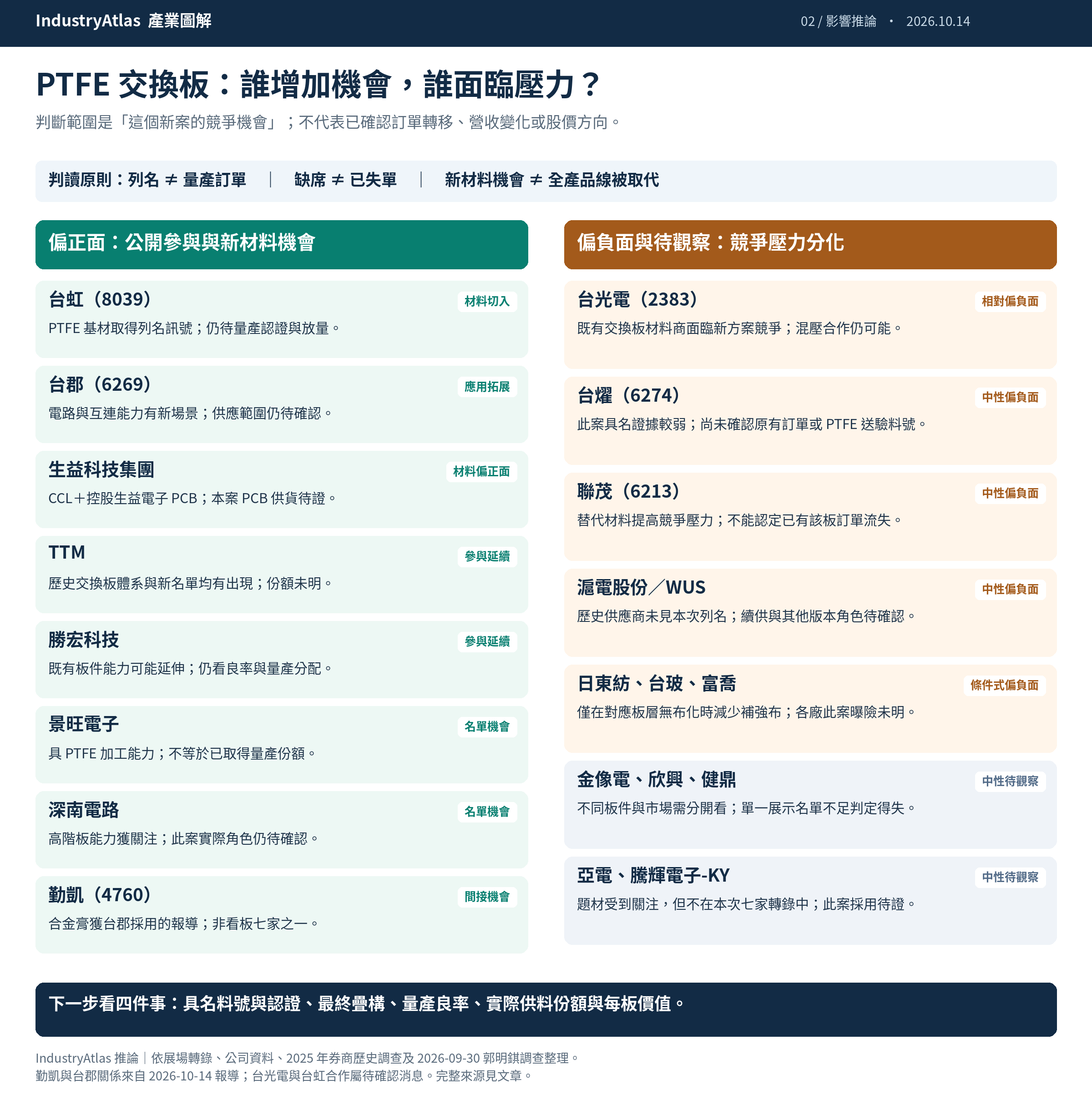
Figure 2: Positive and negative indicate competitive direction for the new project, not stock ratings or confirmed production orders. Companies absent from the display are assessed using historical supply-chain information and product positioning.
Elite Material and Taiflex could compete—or cooperate in one solution
On August 27, 2026, the Financial News Express reported claims of cooperation and cross-qualification between Elite Material and Taiflex.[12] The report does not confirm specifications or NVIDIA adoption, but highlights the possibility that different materials suppliers can coexist in different layers or material categories within one board.
Taiflex’s inclusion therefore increases its PTFE opportunity without directly implying an equal revenue loss for Elite Material. Conversely, a cooperation report cannot establish that Elite Material has retained all its share.
The relevant questions are whether Elite Material supplies other substrates or bonding materials for this configuration, how material value per board changes, and whether a joint solution formally enters volume production.
TUC’s website has also published technical events concerning M10 / M11-class CCL materials.[13] This supports continued investment in advanced materials, but product-grade progress and qualification for a particular NVIDIA board remain distinct issues.
The final material stackup will determine how value is allocated
Kuo’s September 30 survey reported earlier testing of glass-fabric-free PTFE CCL with glass-fabric-free hydrocarbon bonding sheets, followed by evaluation of hydrocarbon CCL as a replacement for the PTFE CCL while retaining the same bonding-sheet part number. The survey explicitly said the selection was not final.[11]
The relationship between PTFE and hydrocarbon materials may therefore change with design objectives.
The most useful signal from the display is that next-generation board materials and processes are redefining the capabilities required to participate. Shengyi, Taiflex, and the listed board manufacturers have stronger public participation evidence. Elite Material needs to demonstrate how its established materials advantages carry forward, while TUC, ITEQ, and WUS still need clearer evidence of their roles in this particular project. Tracking these distinctions is more informative than declaring any supplier a comprehensive winner or loser.
Sources & notes
- [1] NVIDIA official announcement, October 12, 2026: Opening the Vera Rubin architecture at OCP. Supports the event and open-architecture background, not a list of seven volume-production suppliers.
- [2] Economic Daily News, October 14, 2026: NVIDIA’s NVLink PTFE display draws attention. Supports circulation of the display, inclusion of Taiflex and Flexium, and the need to confirm formal supply.
- [3] AGI Hunt, October 14, 2026: Transcription of the trade-show photograph. The full seven-company list follows a public transcription, not an official NVIDIA procurement document. Company spellings are standardized to their official names.
- [4] Taiflex: PTFE CCL. Supports product capabilities and glass-fabric-free construction, not adoption of the website’s specific part numbers in this NVIDIA project.
- [5] Shengyi Technology: PTFE materials. Supports its materials business and the existence of glass-fabric-reinforced PTFE products.
- [6] Flexium: Company Overview. Supports its flexible-PCB, module, and MetaLink technology positioning.
- [7] Kinwong: RF PCBs. Supports PTFE / hydrocarbon processing capabilities.
- [8] Shennan Circuits: 2022 annual report summary. Supports the company’s business positioning only, not progress in the new project.
- [9] TTM: Data Center Computing Capabilities; VGT: company and product overview. Supports PCB manufacturing capabilities.
- [10] PCB industry research by 福邦投顧, August 2025 (public reproduction). Tables 10 and 11 are used only as historical supply-chain references, not as NVIDIA qualification lists or current market shares.
- [11] Ming-Chi Kuo, September 30, 2026: NVL576 switch-tray testing of glass-fabric-free PTFE / hydrocarbon materials. Supply-chain research, not NVIDIA’s final volume-production decision.
- [12] Financial News Express, August 27, 2026: Reported Elite Material–Taiflex cooperation and cross-qualification. Cooperation and qualification reports require further confirmation by the companies or end customer.
- [13] TUC: News & Events. September 8, 2026 event on M10 / M11-class CCL technology. Product information does not establish adoption in a specific NVIDIA project.
- [14] Ample Electronic Technology: AI alloy-paste and semi-sintering adhesive products. Supports materials capabilities.
- [15] China Times information service, October 14, 2026: Report of alloy-paste adoption in Flexium MetaLink. A news report, not an NVIDIA disclosure of Ample’s procurement share.
- [16] Nittobo: Electronic Materials business. Supports the positioning of low-dielectric glass-fiber materials in high-speed electronics.
- [17] Shengyi Electronics: 2026 interim report. Pages 4 and 7. Original company announcement hosted by a third-party platform; identifies Shengyi Technology as controlling shareholder and describes the PCB business. Supports the group relationship and business positioning, not supply to this NVIDIA display board.