
INDUSTRY ANALYSIS
What Is an Active Optical Cable? From 1.6T AOC to ALC and LPO: Low-Power Interconnects and Taiwanese Suppliers
AI data centers need faster, more energy-efficient connections as well as faster chips. Active optical cables integrate fiber and optoelectronic conversion at both ends, serving different needs from passive fiber and high-speed copper cables. This article compares the reach and power consumption of high-end 1.6T products, reviews Taiwanese suppliers’ published specifications, and explains how ALC and LPO reduce power consumption—and why product launches, standards participation, and mass production are distinct milestones.
1. What makes an optical cable “active”?
Two cables may look alike yet transmit data in entirely different ways.
An active optical cable (AOC) integrates optical fiber, light-emitting and receiving components, and the necessary driver, amplification, or signal-processing circuits into a complete cable assembly. When connected to compatible equipment, one end converts electrical signals into light, which travels through the fiber and is converted back into electrical signals at the other end.
“Active” therefore does not mean the fiber itself amplifies signals. It means the product includes electronic and optoelectronic components that require power. Typical data-center AOCs draw power from equipment ports and do not require a separate external power adapter.
The product is delivered as an integrated connection: users generally do not need to buy two optical transceivers and select a fiber patch cord separately. Product documentation from Centera, ezconn, and Amphenol specifies conditions such as fiber type, electrical interfaces at both ends, operating temperature, and power consumption.[1][2][7][9]
How are AOCs manufactured?
A typical process includes assembling driver and receiver circuits, installing emitters and photodetectors, aligning and coupling the fibers, packaging the connectors at both ends, and testing electro-optical performance and the complete link.
The challenge extends beyond putting fiber inside a jacket. Coupling loss, consistency across lanes, high-speed signal quality, heat dissipation, and stability after bending or temperature changes all affect performance. Products may use VCSELs and multimode fiber, or silicon photonics and single-mode fiber. AOCs do not all share the same manufacturing process or architecture.[1][2][9]
2. What problems do AOCs, passive fiber, and copper cables solve?
Start with two separate questions: Does the cable carry light or electricity? Does the cable assembly contain active circuitry?
| Type | Transmission medium | Contents of the cable assembly | How to interpret power consumption | Common reasons for choosing it |
|---|---|---|---|---|
| Passive optical cable / fiber patch cord | Fiber | Fiber, jacket, and connectors; no optoelectronic conversion | The cable itself needs no active power; transceivers at both ends still consume power | Separate transceiver and cabling choices facilitate replacement, maintenance, and longer reach |
| AOC: active optical cable | Fiber | Fiber, optoelectronic conversion at both ends, and associated electronics | Distinguish per-end consumption from the total for both ends | Integrated delivery for fixed-length equipment connections |
| DAC: direct attach copper cable | Copper | Copper conductors and connectors, without active signal-compensation circuitry | No active power consumption in the cable itself; host equipment still consumes power | Short connections sensitive to cost and power consumption |
| ACC: active copper cable | Copper | Copper plus active analog compensation or similar circuitry | Compensation circuits consume power; specifications vary by model | Extending copper’s usable range in some short-reach applications |
| AEC: active electrical cable | Copper | Copper plus signal-recovery, retiming, and other electronics | Active electronics consume power depending on speed and architecture | Improving high-speed electrical signal quality within the supported reach |
The copper cables in this table are primarily high-speed direct-attach products for data centers. Their reach limits should not be applied directly to household RJ45 Ethernet cables. ACC and AEC terminology and implementations also need to be checked against each manufacturer’s specific models.[6]
For example, FIT’s published catalog lists 800G OSFP DACs supporting up to 2m, QSFP-DD ACCs up to 4m, and OSFP AECs up to 7m. These are capabilities of specific products, not universal limits for all copper cables.[6]
A passive optical cable, meanwhile, does not independently determine a “1.6T, 500m” link rating. Link speed and reach depend on the transceivers at both ends, fiber type, connector losses, and link budget. Walsin Lihwa’s communications fiber cables occupy the cable-manufacturing segment; making passive optical cable does not establish the optoelectronic integration capability required for a 1.6T AOC.[18]
3. Where are active optical cables used?
AOCs commonly connect servers to switches, switches to one another, and equipment within or between racks. They also serve high-performance computing and storage networks.[7][8][11]
Fiber becomes attractive when copper’s length, weight, cabling density, or signal loss becomes a constraint. Integrating both ends and the intervening fiber allows an AOC to be validated and deployed as a complete product. However, a failure at one end generally requires replacement of the entire cable, offering different maintenance flexibility from separate transceivers and patch cords.
For AI clusters, the network being connected also matters. Ethernet, InfiniBand, and proprietary interconnects have different protocol and compatibility requirements. An 800G or 1.6T label does not mean a cable can plug into every device operating at that nominal speed.
Selection should begin with interface and protocol, required speed, and cabling distance, followed by power, reliability, cost, and maintenance. A shorter maximum reach may reflect a deliberate choice for a particular deployment, cost target, or architecture; it does not automatically indicate inferior technology.
4. How advanced are current specifications? Comparing 1.6T products
Among the manufacturer materials verified for this article, 1.6T AOCs with approximately 200G per lane are a notable high-end category. Amphenol’s full datasheets provide the main comparison samples here, alongside other approaches. This is not a claim that these are the market’s only fastest products.
1.6T denotes the product’s nominal aggregate rate, not the rate of each optical lane. For example, the Amphenol products use eight transmit-and-receive lanes with a line rate of 212.5Gb/s per lane, which is a different measure from the nominal 1.6T Ethernet rate.[1][2]
Even at 1.6T, power and reach differ considerably
| Manufacturer and model / solution | Product form | Published reach | Published per-end power measure | Disclosure status |
|---|---|---|---|---|
| Amphenol AOP13PI8-XXX-3(R) | Complete DSP-based AOC | Up to 100m, single-mode fiber | Maximum 26W per end | Published datasheet marked Draft 2.0 [1] |
| Amphenol AOP13LI8-XXX | LPO-based AOC | Up to 100m, single-mode fiber | Typical 10W per end; maximum-power field lists 11W per end | Published Rev 1.1 datasheet with standard cable lengths [2] |
| Amphenol OP13LI8-005D | LPO pluggable transceiver with separate fiber | Up to 500m, single-mode fiber | Typical 10W per module; product features state <11W | Published Rev 2.0 datasheet [3] |
| GIGALIGHT OSFP224 HYBRID PSM8-AOC | AOC with hybrid signal processing | 500m, single-mode fiber | Wattage not disclosed on the product page | Specifications published, but part number remains TBD [4] |
| Credo ZeroFlap ALC | Integrated cable using micro-emitter arrays and fiber bundles | Target reach up to 50m | Designed for 12W per end | Announced October 12, 2026; shipments expected in 2027 [5] |
These are published specifications for different products, not a ranking based on power measurements in a common laboratory. A datasheet alone does not establish large-scale shipments. To convert per-end figures into the sum for a symmetrical two-ended link, the power definitions must be consistent. Host-side consumption must also be included when evaluating system-level savings.
The maximum-power fields for Amphenol’s two 100m AOCs above are 26W and 11W, respectively. The latter’s specified ceiling is approximately 58% lower. This indicates substantial potential savings from architecture choices, but does not guarantee the same measured reduction across all switches, temperatures, and loads.[1][2]
A particularly important distinction is that Amphenol’s LPO AOC supports 100m, while its separate LPO transceiver supports 500m. The specifications must not be mixed. Nor can Credo’s 50m ALC be treated as a substitute for every 500m product simply because of its lower power consumption.
5. Where do Taiwanese suppliers stand?
Taiwanese and Taiwan-affiliated suppliers already offer a range of 400G and 800G AOCs. Differences concern optoelectronic architecture, reach, low-power approaches, and customer qualification—not simply whether a company makes optical cables.
| Supplier | Verifiable AOC products | Published reach | Power consumption and interpretation |
|---|---|---|---|
| Centera Photonics | 800G QSFP-DD AOC | 70m over OM3 / 100m over OM4 | Lists 12W per end, but the page uses both “Typical” and “Max.”; the definition requires manufacturer clarification [7] |
| ezconn (6442) | 800G QSFP-DD AOC | Features list 30m over OM3 / 50m over OM4, requiring FEC | <14W per end; the same page’s model description also lists 3m, so orderable lengths and applicable conditions need confirmation [9] |
| Foxlink (2392) | 400G QSFP-DD AOC; 800G OSFP AOC | 400G up to 100m; 800G reach not stated | 400G <10W per end; no 800G power figure is given, so the 400G specification cannot be reused [8] |
| FIT Hon Teng (6088.HK) | 800G OSFP AOC | 30m over OM4 | Catalog lists <12W without explicitly specifying per end or per cable; a two-ended total cannot be inferred [6] |
| Lintes Technology (6715) | 400G / 800G QSFP-DD LPO AOCs | Both product pages list up to 70m | LPO AOC product pages exist, but disclose no wattage; savings percentages cannot be estimated from them [10][11] |
Note: OM3 and OM4 are multimode fiber grades; SMF means single-mode fiber. FEC means forward error correction. Reach figures must be read together with fiber type and system requirements. These are publicly documented product samples, not a comprehensive supplier ranking.
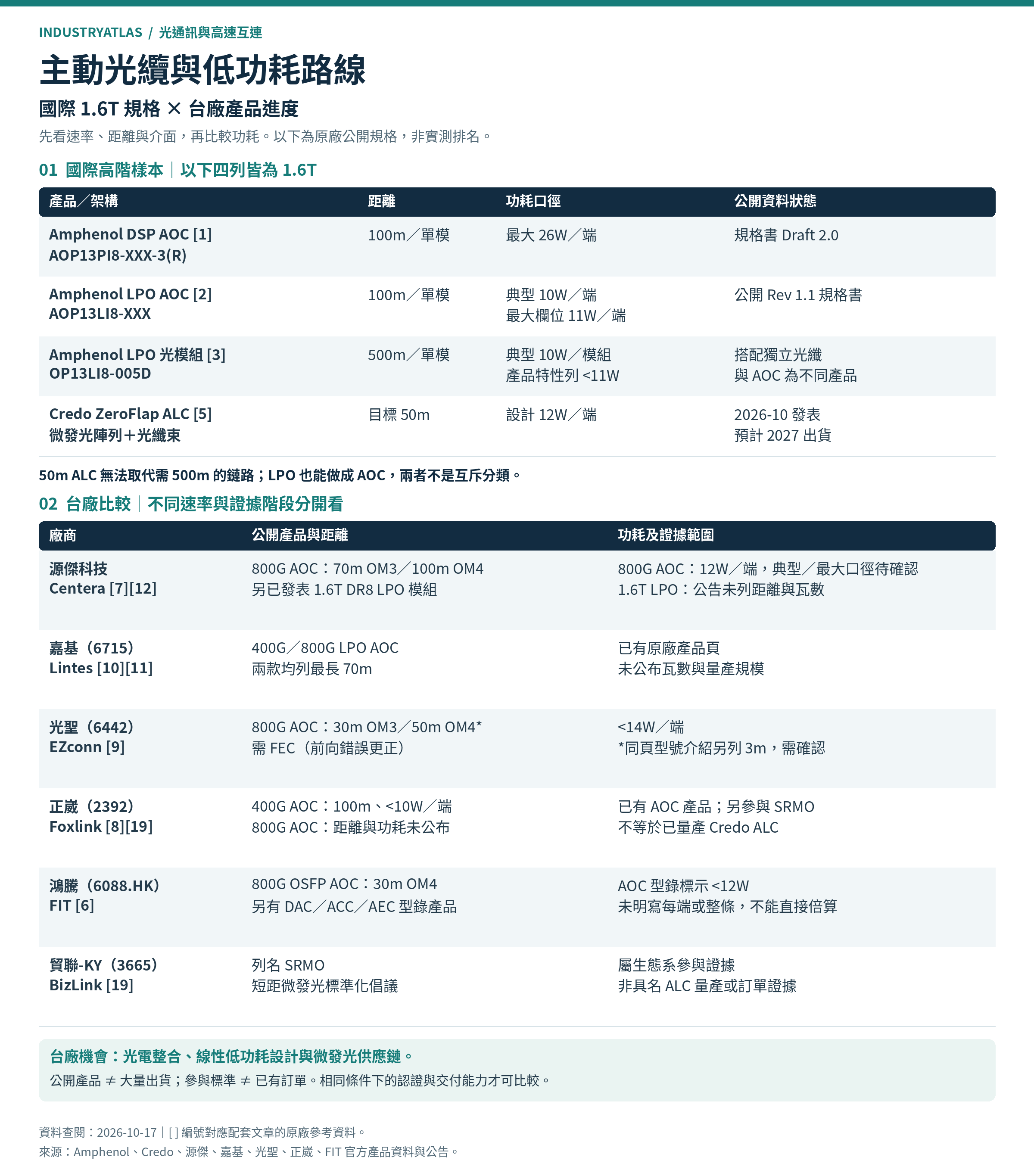
Chart note: The upper panel compares reach and per-end power for international 1.6T products; the lower panel summarizes Taiwanese suppliers’ published products and low-power approaches. Products at different speeds, reaches, and development stages cannot be ranked directly. Detailed conditions and sources appear in the article.
The disclosures reveal three forms of competitiveness.
First is the ability to design and deliver a complete optoelectronic cable. Centera’s 800G AOC supports a published 100m over OM4; ezconn, Foxlink, and FIT also offer products with different reaches, connectors, and speeds. These companies integrate optoelectronics at both ends with the cable, a role extending beyond conventional cable processing.
Second is the move from established AOCs to low-power architectures. Lintes explicitly lists LPO AOCs, while Centera has announced a 1.6T LPO transceiver. The former is supported by complete-cable product pages, the latter by a new transceiver announcement. Their commercialization progress should be tracked separately.[10][11][12]
Third is the coexistence of markets with different reach requirements. APAC Opto Electronics (4908), for example, publishes 800G OSFP transceivers including 500m DR8 and 2km FR4 products. These are modules used with separate fiber, rather than the short-reach AOCs in the table. A 50m ALC cannot meet those longer-distance needs.[17]
IndustryAtlas’s assessment is that Taiwanese suppliers participate in multiple high-speed interconnect segments. Public catalogs alone cannot establish who has the lowest cost, highest yield, largest market share, or most 1.6T orders. More useful comparisons will focus on power consumption under equivalent specifications, customer qualification, reliability, and volume-delivery capability.
6. Why will lower power matter more?
A difference of a few watts per cable may seem small for one device. Across the many high-speed links in an AI cluster, it can materially affect power distribution and cooling design.
Consider a simple example: 10,000 two-ended links saving an average of 5W at each end would reduce combined consumption by 100kW. Continuous year-round operation would correspond to approximately 876,000kWh. This calculation assumes constant power; it is not a measured savings commitment for any product and excludes cooling and power-supply losses.
The motivation therefore extends beyond electricity bills. Heat density around front panels and modules also affects airflow, fans, and system configuration. Dell has publicly supported an LPO solution linking switches and server network interface cards, indicating that energy-saving architectures are moving beyond component specifications toward coordinated system deployment.[13]
Assessment still needs to cover the entire link: does lower module power require different host-side signal-processing settings? Is reliability maintained? Can the product interoperate with existing equipment? These conditions determine whether specified savings translate into deployed benefits.
7. How do LPO and ALC reduce power consumption?
LPO: reducing high-speed digital processing inside the optical module
LPO stands for Linear-drive Pluggable Optics. Its core approach removes the optical module’s separate high-speed DSP / retiming stage, relying on the host SerDes’s signal-processing capabilities alongside analog circuits such as linear drivers and TIAs.[14]
This does not eliminate all electronics. Light sources, drivers, receiver amplification, monitoring, and management still require power. Signal-quality requirements remain, with greater dependence on coordinated design across the host, electrical channel, and optical components.
The approach creates room to improve power, latency, and component cost, while increasing the importance of interoperability, signal integrity, and system validation. NewPhotonics’ LPO+ technical material, for example, highlights optical-domain equalization and interoperability.[15]
AOC and LPO describe different aspects of a product. AOC describes an assembly delivered as fiber plus optoelectronics at both ends; LPO describes a linear-drive signal-processing architecture. DSP AOCs, LPO AOCs, and LPO transceivers used with separate fiber can therefore coexist. Amphenol and Lintes provide concrete examples.[2][3][10][11]
ALC: distributing high-speed data across more, lower-speed optical channels
Here, ALC refers to Credo’s ZeroFlap Active Light Cable. It uses a wide-parallel micro-emitter architecture to distribute data from high-speed electrical lanes across multiple lower-speed optical channels using NRZ modulation, reducing dependence on complex high-speed signal recovery.[5]
Credo says its platform can use microVCSELs or microLEDs with photodetector arrays and fiber bundles. It should therefore not be described universally as a “microLED cable.” The design also includes redundant channels and link monitoring, emphasizing reliability and maintenance for short-reach connections.[16]
Credo’s announced 1.6T ALC targets a maximum reach of 50m and a design power of 12W per end. Shipments are expected in 2027, primarily targeting row-scale scale-out and front-end networks.[5]
This makes ALC worth following, but does not establish comprehensive superiority over other optical interconnects. Amphenol’s LPO AOC already publishes typical power of 10W and maximum power of 11W per end. Architecture, reach, and commercialization stage differ, so one number cannot determine which solution is better.
For system vendors, ALC’s appeal will depend on whether it can jointly deliver reliability, cabling density, cost, compatibility, and supply availability in its intended applications.
8. Which Taiwanese companies have LPO products or participate in the ALC-related ecosystem?
Lintes has identifiable LPO AOC products. Its website lists 400G and 800G QSFP-DD LPO AOCs, both supporting up to 70m. This confirms the product direction, but the pages do not disclose wattage or shipment scale. Other suppliers’ savings ratios or production quantities cannot be applied to them.[10][11]
Centera has announced a 1.6T DR8 LPO transceiver. On March 17, 2026, it announced a product using NewPhotonics’ NPG10203 LPO+ PIC, integrating light sources, modulators, and optical signal processing. This is a clear example of a Taiwanese company participating in 1.6T low-power module design. The announcement did not give complete reach and wattage specifications or volume-shipment figures for the model.[12]
BizLink (3665) and Foxlink (2392) are listed as participants in the SRMO initiative. Credo announced the Short-Reach Micro-Emitter Optics standardization initiative on October 12, 2026, naming both companies among the initial participants and targeting OCP approval of the specification in 2027. This indicates participation in the micro-emitter interconnect ecosystem, but does not establish that either company is mass-producing Credo ALCs or has confirmed ALC orders.[19]
Taiwanese suppliers’ opportunities consequently extend beyond complete modules. Micro-emitter arrays, dense fiber bundles, connectors, packaging and coupling, and end-to-end cable testing could create new specialized roles. Identifying actual component suppliers still requires named products or disclosed partnerships; contracts cannot be inferred from an initiative’s membership list.
IndustryAtlas perspective: establish link requirements, then assess who can reduce power
High-speed interconnect development cannot be reduced to “fiber replaces copper” or “ALC replaces AOC.”
Within suitable short distances, copper may retain cost and power advantages. AOCs serve fixed-length equipment connections. Pluggable transceivers paired with passive fiber remain valuable for longer reach or separately managed cabling. LPO is an architectural option for lowering signal-processing power, while ALC explores wide-parallel micro-emitters to improve both reliability and efficiency in short-reach optical connections.
For Taiwan’s supply chain, the next priorities are more substantive than another product acronym: actual power consumption at equal speed and reach; compatibility and qualification on customer platforms; and progress from announcements or sampling to consistent shipments. Suppliers that deliver all three are better positioned to turn technical capability into sustained commercial competitiveness.
Sources & notes
- 1. Amphenol: 1.6T OSFP DSP AOC, AOP13PI8-XXX-3(R), Draft 2.0. Pages 1–3 specify per-end power and 100m reach; the revision history is dated December 26, 2025.
- 2. Amphenol: 1.6T LPO OSFP AOC, AOP13LI8-XXX, Rev 1.1. Pages 1–3 list typical / maximum power and cable lengths. The first page states <11W while the maximum-power field states 11W; this article preserves the respective definitions.
- 3. Amphenol: 1.6T OSFP LPO 2×DR4, OP13LI8-005D, Rev 2.0. The 500m reach and power figures apply to this transceiver, not to the AOC.
- 4. GIGALIGHT: 1.6T OSFP224 AOC / HYBRID AOC. Lists 500m over SMF, with the part number TBD and no wattage disclosed.
- 5. Credo: 1.6T ZeroFlap ALC announcement, October 12, 2026. Designed for 12W per end, targeting 50m; shipments expected in 2027.
- 6. FIT: External High Speed Products catalog. Distance and power specifications for 800G DAC, ACC, AEC, and AOC products must be read from their respective rows.
- 7. Centera: 800G QSFP-DD Active Optical Cable. 70m over OM3 / 100m over OM4; the power wording includes “Typical,” “Max.,” and “each port.”
- 8. Foxlink: Active Optical Cable product page. The scope of disclosure differs between 400G and 800G products.
- 9. ezconn: 800G QSFP-DD AOC. The model description lists 3m while the features list 30m / 50m; applicable conditions require manufacturer clarification.
- 10. Lintes: 400G QSFP-DD Active Optical Cable LPO. Product page lists up to 70m.
- 11. Lintes: 800G QSFP-DD Active Optical Cable LPO. Product page lists up to 70m but no wattage.
- 12. Centera company announcement: 1.6Tbps DR8 LPO and NewPhotonics LPO+ PIC, March 17, 2026. Company-issued release distributed by PR Newswire.
- 13. Dell: switch and server LPO solution, June 12, 2025. Used to illustrate system support, not as a power benchmark for the 1.6T products in this article.
- 14. Adtran: What are linear pluggable optics?. Explains the division of signal-processing responsibilities between LPO and host-side SerDes.
- 15. NewPhotonics: LPO+ Link Training and interoperability, March 3, 2025. Explains signal-integrity and multi-vendor compatibility challenges in linear architectures.
- 16. Credo: ZeroFlap ALC products and micro-emitter architecture. Lists microVCSEL / microLED platforms and redundancy design; the timetable in this article follows the launch announcement.
- 17. APAC Opto Electronics: 800G OSFP optical transceivers. Lists 500m DR8 and 2km FR4.
- 18. Walsin Lihwa: communications optical cable. Represents the passive cable-manufacturing role.
- 19. Credo: SRMO standardization initiative and initial participants, October 12, 2026. BizLink and Foxlink are named; participation in standardization is not a supply contract.
- ## Related companies
- Amphenol, GIGALIGHT, Credo, NewPhotonics, Centera Photonics, ezconn (6442), Foxlink (2392), FIT Hon Teng (6088.HK), Lintes Technology (6715), BizLink (3665), APAC Opto Electronics (4908), and Walsin Lihwa (1605).