
INDUSTRY ANALYSIS
Vera Rubin Supply Chain Update After OCP 2026
Vera Rubin is driving demand for high-voltage DC power distribution, liquid cooling, and advanced passive components, but specification upgrades, supplier qualification, and revenue growth follow different timelines. This article reviews public disclosures from Delta, LITEON, AVC, Auras, Jentech, YAGEO, and Walsin Technology, distinguishing realized business, company forecasts, and unresolved questions.
OCP makes the supply-chain direction clearer
The OCP Global Summit in October 2026 extended the implications of Vera Rubin beyond GPUs to the entire data center. NVIDIA contributed rack and compute-tray designs to OCP through its MGX architecture and expanded liquid-cooling, power, and modular interfaces, allowing system vendors and component suppliers to develop products around shared specifications.[1]
For Taiwan's suppliers, opportunities center on three paths: delivering electricity to the rack, removing heat from chips, and maintaining stable power within circuits. Delta Electronics and LITEON cover power and liquid-cooling systems; AVC, Auras, and Jentech operate at different stages of thermal management; YAGEO and Walsin Technology participate in passive components.
Commercial progress differs across these paths. Shipping products does not mean next-generation high-voltage distribution has become universal; generating AI revenue does not establish qualification for a particular Rubin part. Assessing the benefits requires separating products, platforms, and revenue.
What demand does each upgrade create?
| Upgrade | Problem addressed | Main supply-chain segments affected |
|---|---|---|
| 800VDC high-voltage DC distribution | Rising rack power increases the current, copper, and wiring burden of low-voltage distribution | Power racks, DC converters, distribution equipment, busbars, and battery backup |
| Liquid cooling and rack-level thermal management | Dense computing requires more comprehensive heat-transfer and coolant-distribution designs | Heat spreaders, cold plates, manifolds, connectors, and coolant distribution units |
| More advanced passive components | Higher power consumption and more complex power management increase filtering, decoupling, and power-stability requirements | MLCCs, resistors, tantalum capacitors, and other components |
800VDC describes the distribution voltage; it does not mean a GPU operates directly at 800V. At the same power level, raising voltage reduces current. Power still needs successive conversion after reaching the rack or board. Delta's OCP demonstration, for example, included a DC/DC power shelf converting 800VDC to 50V.[1][2]
The scope of “fully liquid-cooled” also matters. NVIDIA's MGX 1.2 description includes fanless liquid-cooled compute trays, blind-mate liquid-cooling interfaces, and liquid-cooled busbars. This does not mean every device in a data center loses its fans or that servers are immersed in liquid. It integrates liquid cooling more deeply into rack design.[1]
For power suppliers, distinguish shipping products from voltage architecture
Delta has a broad portfolio, but 800VDC revenue still needs tracking
At its July 2026 earnings briefing, Delta expected mass production of ±400V and 800V products to begin in the third quarter, with limited shipments that year and a more meaningful ramp in 2027. The company also noted that some Rubin products could still use low-voltage solutions, with adoption of high-voltage architecture depending on data-center customers.[3]
At OCP in October, Delta displayed 800VDC power racks, battery backup, DC/DC conversion, and liquid-cooling equipment, demonstrating coverage of multiple power and cooling stages.[2] Demonstrations and earlier production plans, however, do not substitute for actual shipment revenue.
The key questions are how quickly high-voltage distribution moves from product readiness to customer deployment and how much these products contribute to revenue. Delta's overall AI growth cannot all be attributed to 800VDC.
LITEON has evidence of volume shipments of Rubin 110kW power shelves
At OCP on October 14, a LITEON U.S. executive said that 110kW power shelves developed for Vera Rubin had begun shipping in volume, with deliveries continuing through year-end.[4]
But 110kW measures power and 800VDC measures voltage; the two are not interchangeable. LITEON's second-quarter announcement still listed its 800VDC Power Rack as undergoing validation in the second half. Its projection that AI would account for more than 30% of full-year revenue was a company forecast, not the revenue share of 800VDC products.[5]
| Company | Confirmed progress | What to monitor |
|---|---|---|
| Delta Electronics (2308) | Demonstrated integrated high-voltage DC and liquid-cooling products and provided a production timetable | Customer deployment and actual high-voltage product revenue |
| LITEON (2301) | An executive confirmed volume shipments of Rubin 110kW power shelves | Completion of 800VDC validation and subsequent volume growth |
Three updates to the liquid-cooling supply chain
Heat spreaders, cold plates, and coolant distribution units perform different tasks. A heat spreader sits in the chip package's thermal path; a cold plate transfers heat to flowing coolant; manifolds and coolant distribution units manage fluid distribution and heat exchange over a larger area. These interconnected stages cannot be reduced to a single “cooling market share.”[2][6]
AVC's server growth already appears in its financial results
AVC's official second-quarter 2026 presentation reported approximately NT$32.4 billion in revenue from server applications, representing 66% of total revenue and 116% year-over-year growth. These are realized financial results, but they cover different customers and platforms and cannot all be treated as Rubin contributions.[7]
TrendForce's August research expected AVC to start shipping Rubin cold-plate modules in the third quarter.[6] It is important to distinguish a research firm's projected shipment schedule from server revenue already reported by the company.
Auras has returned to the Rubin cold-plate supply chain
In May, Auras said Rubin cold plates were not in its supply scope at that time because of capacity allocation. On September 1, its chairman confirmed that renewed discussions had brought the company back into the supply chain; it was then conducting intensive testing and preparing shipments.[8]
Continuing to describe Auras as absent from Rubin cold plates would therefore understate its subsequent opportunities. Rejoining the supplier list, completing testing, and delivering in volume remain separate stages, however. Order allocation cannot be inferred from its inclusion alone.
Jentech's supplier position must be considered alongside heat-spreader design
TrendForce's August research identified Jentech as Rubin's sole heat-spreader supplier at that time. The same report said the originally planned two-piece design had temporarily shifted to a one-piece transitional solution because of issues including substrate warpage.[6]
An assessment of the benefits must therefore account for both supplier position and product version. Any assumption of higher unit prices based on a two-piece design needs reconsideration when the design changes. The research firm's assessment of exclusivity at that time also does not establish exclusive supply of all cooling components or future generations.
Public figures remain insufficient to build a complete earnings model for these three companies' Rubin content per rack, precise order allocation, and production yields. Gross margin reflects pricing, product mix, costs, and other factors; it is not a measure of manufacturing yield.
Nearly doubling MLCC counts does not mean supplier revenue doubles
In May 2026, TrendForce estimated that a NVIDIA GB200 board used around 6,500 MLCCs, compared with approximately 12,000 for a Rubin board—an increase of about 85%. This is a research firm's estimate of component counts per board, not a complete rack bill of materials released by NVIDIA.[9]
To translate component counts into supplier benefits, at least three further questions must be answered: which specifications are increasing, who wins the orders, and how many systems actually ship. Even when total unit counts rise, suppliers can experience different revenue outcomes because of product mix, prices, and allocation.
YAGEO already generates direct AI revenue across several component types
At its second-quarter earnings briefing, YAGEO disclosed that AI-related revenue accounted for 16% of sales. Tantalum capacitor sales increased 44% year over year, while MLCCs and resistors grew faster than the company overall. It also said price adjustments and an improved AI product mix supported gross margin.[10]
These disclosures indicate that YAGEO's benefits include direct AI demand, multiple passive-component categories, and pricing. Its AI revenue cannot all be assigned to MLCCs, and 16% cannot be read as Rubin's share of revenue.
Walsin Technology should be included among direct beneficiaries of AI demand
In June, Walsin Technology's president forecast that AI applications would contribute 15%–20% of 2026 revenue and outlined approximately 10%–15% capacity expansion in resistors and capacitors. Some products had already undergone price increases.[11]
Its potential benefits therefore include direct AI orders and price adjustments. Japanese and Korean manufacturers shifting capacity toward advanced applications can also affect supply and demand elsewhere, but that does not justify treating Walsin Technology solely as an indirect beneficiary.[9][11]
| Company | AI revenue disclosure | How to interpret it |
|---|---|---|
| YAGEO (2327) | A 16% share disclosed for the second quarter | AI business across product categories, not Rubin MLCC revenue |
| Walsin Technology (2492) | A company forecast of 15%–20% for the full year | Full-year guidance, not realized results |
The periods and definitions differ, so these figures do not directly establish which company's AI exposure is greater. Specific part numbers, qualification status, and allocation for Rubin MLCCs require clearer disclosure.
Supply-chain changes across seven Taiwanese suppliers
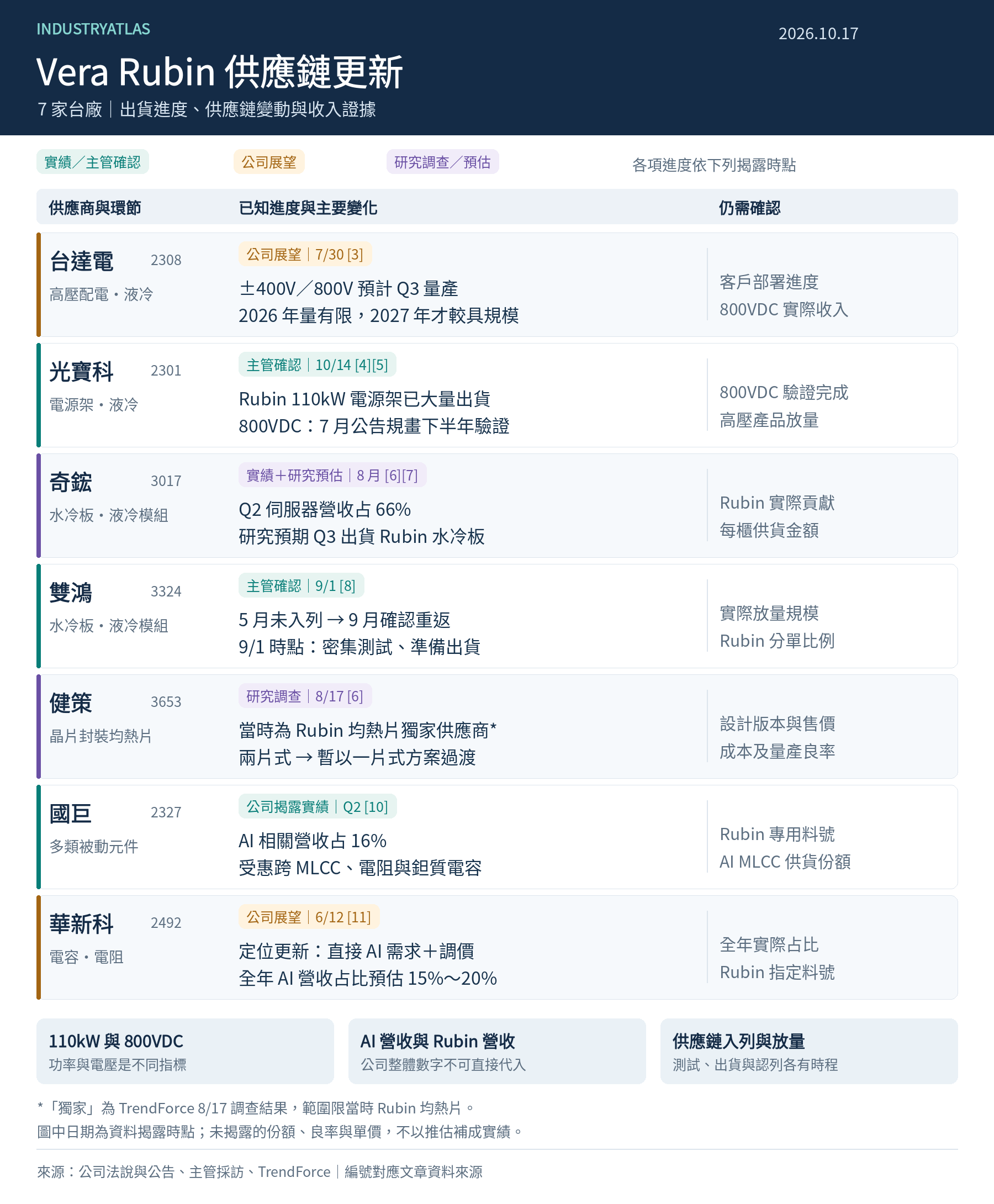
Chart note: Colors distinguish company results or executive confirmations, company forecasts, and research-firm findings or projections. The main changes are Auras returning to the supply chain, a change to Jentech's heat-spreader design, and Walsin Technology's direct AI business. Each item has its own disclosure date; the chart does not imply that every status was reconfirmed in October.
IndustryAtlas perspective
Vera Rubin increases the importance of power, liquid cooling, and passive components while making it more important to distinguish suppliers' roles. The same AI growth trend can translate into different revenue outcomes through higher unit volumes, more advanced specifications and prices, greater allocation, or entry into additional system segments.
Based on the available information, LITEON's Rubin 110kW power shelves have relatively clear shipment evidence, while Delta's high-voltage and liquid-cooling positioning is supported by specific products. AVC has already reported server revenue growth, and Auras's supplier position has changed. Jentech requires monitoring of how design versions affect prices and costs. YAGEO and Walsin Technology both have direct AI demand, but this is insufficient to rank their Rubin MLCC supply shares.
Sources & notes
- 1. NVIDIA OCP 2026 announcement, October 12, 2026
- 2. Delta OCP 800VDC power and cooling announcement, October 15, 2026
- 3. Delta second-quarter earnings transcript, July 30, 2026
- 4. USTV on-site OCP interview, October 14, 2026
- 5. LITEON second-quarter results, July 31, 2026; distributed by Business Wire
- 6. TrendForce liquid-cooling supply-chain research, August 17, 2026
- 7. AVC second-quarter earnings presentation, August 12, 2026
- 8. CNA interview with Auras's chairman, September 1, 2026
- 9. TrendForce MLCC component-count and market research, May 18, 2026
- 10. YAGEO second-quarter earnings presentation, July 29, 2026
- 11. CNA interview with Walsin Technology's president, June 12, 2026
- [1]: https://blogs.nvidia.com/blog/ocp-global-summit-vera-rubin-scale-ai-factories/
- [2]: https://www.delta-americas.com/en-US/news/delta-highlights-collaboration-with-nvidia-in-advancing-energy-efficient-800-vdc-power-and-cooling-solutions-for-ai-data-centers-at-ocp-global-summit-2026
- [3]: https://filecenter.deltaww.com/IR/download/calendar/2Q26_Transcript.pdf
- [4]: https://news.ustv.com.tw/newsdetail/20261014A050
- [5]: https://markets.financialcontent.com/buffnews/article/bizwire-2026-7-31-liteon-reports-second-quarter-2026-results
- [6]: https://www.trendforce.com.tw/presscenter/news/20260817-13182.html
- [7]: https://mopsov.twse.com.tw/nas/STR/301720260812M001.pdf
- [8]: https://www.cna.com.tw/news/afe/202609010238.aspx
- [9]: https://www.trendforce.com.tw/presscenter/news/20260518-13045.html
- [10]: https://yageogroup.com/content/Resource%20Library/Financial/YAGEO%202Q26_Earnings%20Conference%20Presentation_CH.pdf
- [11]: https://www.cna.com.tw/news/afe/202606120157.aspx