INDUSTRY ANALYSIS
What Is DSX POD? NVIDIA’s Modular AI Factories, 14-Day Deployment, and the Supply Chain
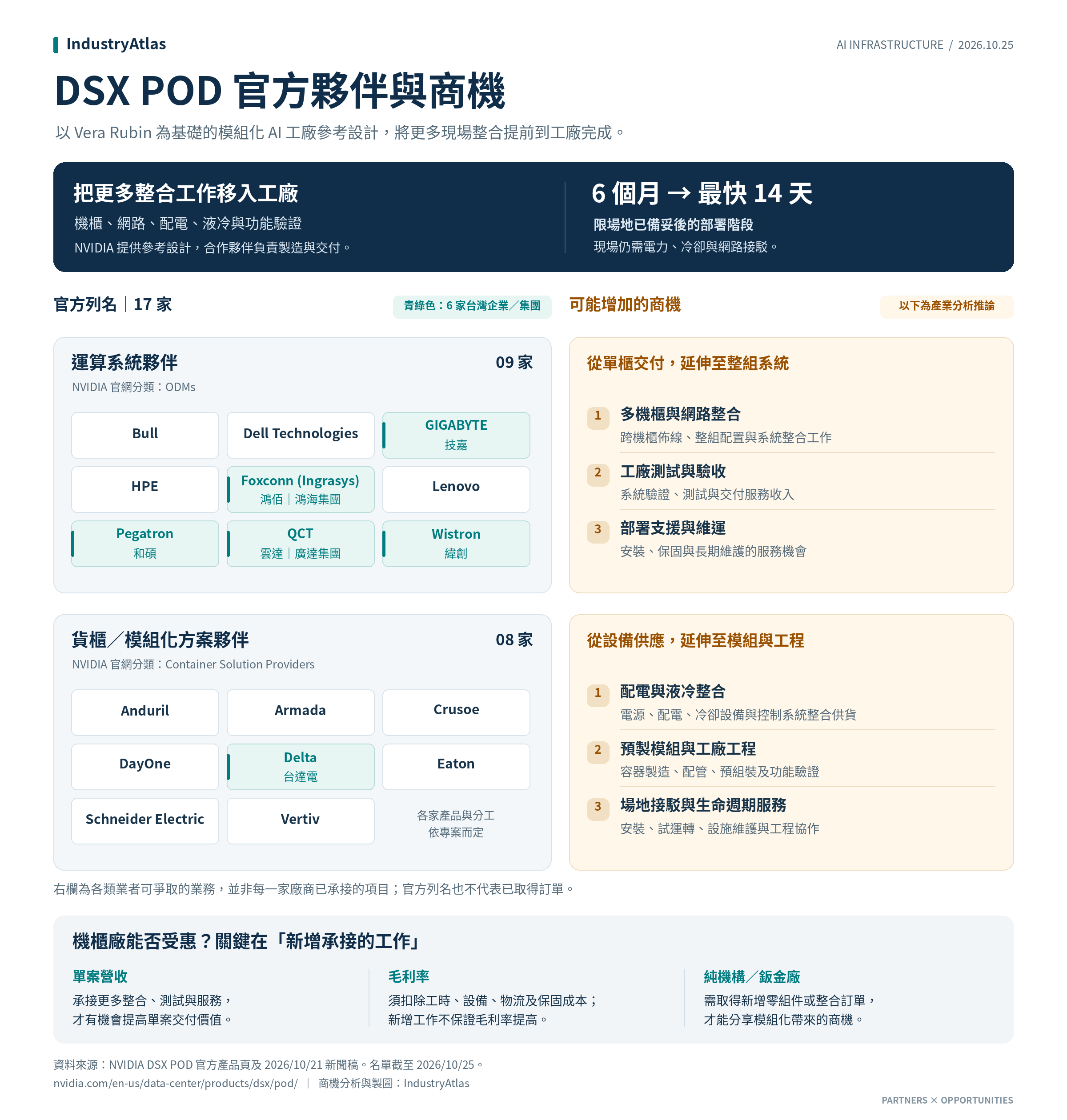
NVIDIA DSX POD integrates Vera Rubin compute systems with networking, power, and liquid cooling into modular units tested before shipment. It aims to cut deployment at a prepared site from about six months to as little as 14 days. This article identifies the 17 official partners, including six Taiwanese suppliers, and examines the changing division of work between rack integrators and facility engineers. The key questions are who can take on more integration work and whether added revenue can become profit.
After production, AI servers still need power, cooling, networking, and integrated testing before they become usable compute capacity. When equipment is connected only after arriving on site, construction sequencing, specialist labor, and system compatibility can delay commissioning.
NVIDIA’s DSX POD, announced at GTC Berlin on October 21, 2026, brings more integration into the factory before prefabricated units are shipped to the customer’s site. Official plans call for partners to begin worldwide deliveries in early 2027.[1]
1. DSX POD is an AI-factory design for prefabricated delivery
DSX POD is a modular AI-factory reference design built around Vera Rubin. It can be understood as an AI data-center module that is assembled, connected, and tested in advance. The delivered unit combines compute equipment with some of its supporting infrastructure.[1][2]
Vera Rubin is the compute platform. DSX is the broader architecture coordinating compute, networking, storage, power, cooling, and software. DSX POD implements that architecture through factory-prefabricated, containerized delivery.[3]
NVIDIA provides a validated design foundation; partners handle engineering, manufacturing, customization, integration, services, and delivery. Companies with different specialties can therefore complete a project together, rather than one supplier manufacturing every component.[2]
Dell has announced a corresponding modular data-center solution covering compute, storage, networking, rack-level power, and liquid cooling, with integration, testing, deployment, and ongoing management included. This illustrates suppliers extending their deliverables from individual equipment to complete systems.[4]
2. Deployment in as little as 14 days assumes the site is ready
NVIDIA says DSX POD can reduce deployment at a prepared site from approximately six months to as little as 14 days. This is a target for a particular deployment stage. It does not include all the time needed to acquire land, build power infrastructure, and manufacture the prefabricated units.[1]
Two factors shorten the schedule: some installation work is completed beforehand, and factory prefabrication can run in parallel with site preparation. This reduces the wait associated with sequential installation, coordination, and testing only after equipment arrives.[3]
| Scope of work | DSX POD arrangement |
|---|---|
| Network, power, and control wiring between racks within a module | More work completed in the factory |
| Assembly, flushing, and pressure-testing of internal liquid-cooling pipes | More work completed in the factory |
| Equipment configuration and integrated functional verification | Important checks completed before shipment |
| Land, foundations, external power, water, and heat-rejection infrastructure | Still require site preparation |
| Connections and commissioning after delivery | Still require on-site inspection and testing |
*Compiled from NVIDIA’s technical materials. Individual projects must still define the interfaces between the module and the site.[3]*
DayOne describes a similar boundary: DSX POD handles factory integration of AI infrastructure, while DayOne’s modular platform supports surrounding data-center facilities and scaled delivery. Its prefabricated scope can include power, cooling, and modules housing IT equipment.[7]
“Fourteen days” therefore does not mean power, cooling, or site engineering is no longer required. Nor can it be converted directly into an equivalent percentage reduction in supplier labor or costs.
3. Who are the 17 official partners?
NVIDIA’s announcement names 17 partners. Its product website groups them under “ODMs” and “Container Solution Providers,” covering compute-system suppliers and containerized / modular infrastructure partners, respectively.[1][2]
| Official display category | Listed companies |
|---|---|
| ODMs: nine compute-system partners | Bull, Dell Technologies, GIGABYTE, HPE, Foxconn (Ingrasys), Lenovo, Pegatron, Quanta Cloud Technology (QCT), Wistron |
| Container Solution Providers: eight partners | Anduril, Armada, Crusoe, DayOne, Delta, Eaton, Schneider Electric, Vertiv |
*Categories follow NVIDIA’s website. “ODMs” is the website’s label; it does not mean every branded company in that group operates solely as a contract manufacturer.[2]*
Company announcements provide more detail on individual roles:
| Company | Public solution or responsibilities |
|---|---|
| Dell Technologies | Announced Dell Modular Data Center with NVIDIA DSX POD, integrating compute and supporting infrastructure for delivery, with availability planned for early 2027.[4] |
| HPE | Announced DSX POD support, drawing on its existing AI Mod Pod modular data-center experience and services to deliver AI factories.[5] |
| Armada | Announced cooperation with Johnson Controls on engineering, manufacturing, integration, and deployment of prefabricated Vera Rubin factories.[6] |
| DayOne | Supports surrounding data-center needs through standardized designs, prefabricated power and cooling modules, and delivery capabilities.[7] |
Johnson Controls is not among NVIDIA’s 17 named partners, but is explicitly identified in Armada’s announcement. Actual project relationships therefore extend beyond the launch list.[6]
For other listed partners, including Anduril, NVIDIA’s list alone cannot establish which equipment, manufacturing processes, or order volumes they will handle. Their roles should be updated as product and project announcements emerge.
4. Six Taiwanese suppliers span compute systems and infrastructure
The official list includes Delta, Foxconn subsidiary Ingrasys, GIGABYTE, Pegatron, Quanta subsidiary QCT, and Wistron.[1][2]
| Taiwanese company / group | Official listed name | Website category |
|---|---|---|
| Ingrasys, part of Hon Hai / Foxconn (2317) | Foxconn (Ingrasys) | Compute-system partner |
| QCT, part of Quanta Computer (2382) | Quanta Cloud Technology (QCT) | Compute-system partner |
| Wistron (3231) | Wistron | Compute-system partner |
| Pegatron (4938) | Pegatron | Compute-system partner |
| GIGABYTE (2376) | GIGABYTE | Compute-system partner |
| Delta Electronics (2308) | Delta | Container / modular-solution partner |
*Tickers refer to Taiwan-listed companies. For Ingrasys and QCT, they identify the parent groups rather than separately listed subsidiaries.*
The first five can be assessed through compute-system supply and integration. Delta already offers power, cooling, and modular data-center products. Its COMPUTEX 2026 demonstrations included Vera Rubin cold plates, coolant-distribution equipment, and high-voltage DC power solutions.[8]
These six did not begin participating in Vera Rubin only when DSX POD was announced. Foxconn, GIGABYTE, Pegatron, QCT, and Wistron appeared in earlier NVIDIA Vera Rubin system-vendor announcements, while Delta already had relevant solutions. The change to monitor is how established capabilities extend into modular delivery.[8][9]
International partners show a similar pattern. Bull announced cooperation with Foxconn in June on manufacturing and integrating Vera Rubin NVL72. Eaton, Schneider Electric, and Vertiv participated in the Vera Rubin DSX ecosystem as early as March. A new product’s partner list does not mean every company is a new supply-chain entrant.[10][11]
5. What it means for rack suppliers: potentially more work per project
IndustryAtlas’s assessment is that DSX POD creates opportunities for companies with electrical, mechanical, and system-integration capabilities to expand their scope of work.
Customers might previously have paid separately for complete racks and for on-site wiring, piping, and integration testing. A supplier extending its offering to the POD level could include more of those items in its delivery contract. Even if a project’s GPU count stays unchanged, the amount that supplier can contract for may increase.
Benefits depend on actual capabilities. A company making rack structures does not automatically receive electrical and mechanical integration revenue simply because work moves into a factory. Companies able to connect multiple racks, install piping, test systems, and deliver complete units are better placed to expand their business scope.
Existing facility and engineering companies can also participate in prefabrication. Armada’s partnership with Johnson Controls illustrates modular delivery combining different firms’ engineering and manufacturing expertise.[6] DayOne’s shift of some mechanical, electrical, and piping work into the factory shows that data-center operators and developers can participate too.[12]
Profitability requires separate consideration of revenue, gross profit, and gross margin. A broader supply scope may increase revenue; only what remains after materials, labor, testing, and logistics becomes additional gross profit. If the integrator merely purchases more equipment on the customer’s behalf or assumes greater warranty obligations, gross margin may not rise alongside revenue.
Sources & notes
- [1] NVIDIA, October 21, 2026, “NVIDIA Introduces DSX POD AI Factories to Accelerate Europe’s Infrastructure Deployment.”
- https://nvidianews.nvidia.com/news/nvidia-introduces-dsx-pod-ai-factories-to-accelerate-europes-infrastructure-deployment
- [2] NVIDIA, “DSX POD Reference Design for AI Factory Infrastructure,” product overview, partner categories, and FAQ; accessed October 25, 2026.
- https://www.nvidia.com/en-us/data-center/products/dsx/pod/
- [3] NVIDIA Technical Blog, October 21, 2026, “Achieve Productive AI Capacity Faster and More Predictably with NVIDIA DSX POD.”
- https://developer.nvidia.com/blog/achieve-productive-ai-capacity-faster-and-more-predictably-with-nvidia-dsx-pod/
- [4] Dell Technologies, October 21, 2026, “Dell Technologies Advances Enterprise Agentic AI from the Deskside to Data Center with NVIDIA.”
- https://investors.delltechnologies.com/news-events/press-releases/detail/1659/dell-technologies-advances-enterprise-agentic-ai-from-the-deskside-to-data-center-with-nvidia
- [5] HPE, October 21, 2026, “HPE teams with NVIDIA to advance secure agentic AI across enterprises and industrial environments.”
- https://www.hpe.com/us/en/newsroom/press-release/2026/10/hpe-teams-with-nvidia-to-advance-secure-agentic-ai-across-enterprises-and-industrial-environments.html
- [6] Armada, release body dated October 21, 2026, “Armada Unveils Superintelligence Factories Built Within NVIDIA DSX POD, Deployable in Months, Not Years.”
- https://www.armada.ai/blog/armada-superintelligence-factory-NVIDIA-DSX-POD
- [7] DayOne, October 23, 2026, “How DayOne’s Modular Platforms Support NVIDIA DSX POD.”
- https://dayonedc.com/partnerships/how-dayones-modular-platforms-support-nvidia-dsx-pod
- [8] Delta, “Delta @ COMPUTEX 2026,” event dates June 2–5, 2026.
- https://www.deltaww.com/en-US/landing/Computex-2026
- [9] NVIDIA, March 16, 2026, “NVIDIA Vera Rubin Opens Agentic AI Frontier.”
- https://nvidianews.nvidia.com/news/nvidia-vera-rubin-platform
- [10] Bull, June 17, 2026, “Bull and Foxconn advance European AI infrastructure with NVIDIA Vera Rubin NVL72 platform built in Europe.”
- https://www.bull.com/en/press-releases/bull-foxconn-advance-european-ai-infrastructure-with-nvidia-vera-rubin-nvl72
- [11] NVIDIA, March 16, 2026, “NVIDIA Releases Vera Rubin DSX AI Factory Reference Design and Omniverse DSX Digital Twin Blueprint With Broad Industry Support.”
- https://nvidianews.nvidia.com/news/nvidia-releases-vera-rubin-dsx-ai-factory-reference-design-and-omniverse-dsx-digital-twin-blueprint-with-broad-industry-support
- [12] DayOne, October 21, 2026, “DayOne Supports NVIDIA DSX POD Reference Design, Advancing Standardized Infrastructure for AI.”
- https://dayonedc.com/headliners/dayone-supports-nvidia-dsx-pod-reference-design-advancing-standardized-infrastructure-for-ai