
INDUSTRY ANALYSIS
What Is NPO? Architecture Differences from CPO, Adoption Examples, and Taiwan’s Supply Chain
Near-packaged optics moves optical engines beside compute or switch-chip packages, shortening electrical paths while preserving flexibility in assembly and cooling. NPO shares many optoelectronic components and manufacturing capabilities with CPO, but differs in integration location, electrical interfaces, and maintenance. This article examines technical choices, supplier roles, and disclosed progress—from international systems to Taiwan’s Lintes, FIT, Elite Advanced Laser, Centera, and RVi. AI data-center interconnect upgrades are changing the distance between optical modules and main chips. Moving electrical-to-optical conversion from the chassis front panel toward switches or accelerators shortens high-speed electrical paths and may reduce the power needed for signal compensation.
Co-packaged optics (CPO) is one approach. Near-packaged optics (NPO) provides another: placing optical engines close to the main-chip package while preserving separate package boundaries.[1]
The difference extends beyond product appearance to who performs assembly, when testing occurs, what gets replaced after a failure, and how value is distributed across the supply chain. Understanding NPO requires examining architecture, commercialization, and specific supply relationships together.
1. NPO and CPO differ in where optical and electrical functions are integrated
An optical engine converts between electrical and optical signals. It may contain a photonic integrated circuit, drivers, receiver circuits, and control functions. How these are divided or integrated varies by technology platform.
A typical NPO design places packaged optical engines near the main-chip package, connected through short electrical links. They may sit on a PCB, daughterboard, or additional high-performance substrate. CPO integrates the engines and main chip within a shared packaging system, moving electrical interconnection further into the package.[1]
| Comparison | NPO: near-packaged optics | CPO: co-packaged optics |
|---|---|---|
| Integration location | Optical engines beside the main-chip package, with separate packages | Optical engines and main chip within a shared packaging system |
| High-speed electrical path | Usually crosses package contacts, board traces, or connectors | Typically uses shorter in-package connections |
| Design priorities | Board-level signal integrity, interfaces, assembly, and cooling | In-package signal integrity, optoelectronic integration, and co-packaging yield |
| Integration flexibility | Main-chip and optical-engine packaging and assembly can be arranged more independently | Greater coordination among main chip, optical engine, and package design |
| Maintenance | Depends on sockets or soldering; some designs allow optical-engine replacement | Depends on fiber and optical-engine interfaces; CPO cannot universally be classified as non-replaceable |
*This compares typical architectures. Actual products must be assessed from package cross-sections and interface designs.[1][2][5][14]*
Market terminology is not entirely consistent. Some NPO products are also classified as on-board optics (OBO). Assessment should examine package boundaries, actual electrical paths, and interfaces—not merely whether the engine and main chip share a substrate.
NPO also does not necessarily mean a socketed optical module. Lightmatter’s Passage L20, for example, uses a reflow-solderable BGA package, while replaceable NPO sockets represent another design category.[5][14] “Near-packaged” therefore does not guarantee direct field replacement, much less hot swapping.
2. Manufacturing can be separated, but CPO engines can also be tested before integration
One attraction of NPO is that the main-chip package and optical engine can be manufactured, packaged, and tested independently before board-level integration. This offers more flexibility in supplier responsibilities and assembly scheduling and helps screen out defective components before integration.[1]
Pretesting is not exclusive to NPO, however. NVIDIA’s public CPO technical materials describe screening optical engines before integration and using engines that have passed testing in subsequent assembly.[2]
| Stage | Typical NPO arrangement | Typical CPO arrangement |
|---|---|---|
| Component manufacturing and initial testing | Main chip and optoelectronic components manufactured and tested separately | Front-end testing of chips and optoelectronic components is likewise required |
| Packaging and prevalidation | Main-chip and optical-engine packages can be completed separately | Optical engines can also become testable units before co-packaging |
| System integration | Packaged components soldered or installed into board-level interfaces | Main chip and optical engines integrated into a shared packaging system |
| Final validation | Complete electrical, optical, thermal, and mechanical validation | Complete post-integration validation is also required |
*This compares integration levels, not a universal process sequence. Fiber-installation timing also varies by design.[1][2]*
The real difference is where integration risks concentrate. NPO leaves more challenges at board-level interconnection and assembly. CPO requires earlier coordination of optical, electrical, mechanical, and thermal design within the shared package. Even individually tested components can develop contact, coupling, or thermal-deformation problems after assembly.
3. Which system vendors have publicly adopted NPO?
“Using NPO” can mean either incorporating it into a switch or compute-system design, or a data-center operator actually deploying that equipment. Clear public examples exist for the former; the latter requires further evidence of customer identity, deployment scale, and delivery status.
The following are representative systems confirmed in official materials, not a complete market list.
| System vendor | Public product and NPO application | Confirmed progress |
|---|---|---|
| Ruijie Networks | Published 25.6T and 51.2T silicon-photonics NPO liquid-cooled switches; the 51.2T design uses 3.2T NPO modules and provides 64 × 800G ports | A later company technical article states that the 51.2T NPO switch was commercially launched at the end of 2023, but supplies no customer or unit data sufficient to quantify shipments.[3] |
| Huawei | Announced the Atlas 960E SuperPoD with Hi-ONE NPO optical engines in September 2026; stated capacity is 7.2 Tbit/s per engine, with an integrated light source | The release says Hi-ONE engines are in mass production, while another architecture announcement that day describes the Atlas 960 NPO system as under testing. Engine production and full-system deployment must be assessed separately.[4] |
These examples establish concrete NPO designs for switches and AI compute systems. A commercial launch, optical-engine mass production, and large-scale complete-system deployment are distinct milestones. The materials reviewed do not establish widespread, large-scale NPO adoption by major cloud operators.
4. Who is supplying or developing NPO optical engines?
Optical-engine suppliers are not necessarily the final system adopters. Separating these roles clarifies the ecosystem’s maturity.
| Supplier | Public NPO product or technology | Disclosed progress and interpretation |
|---|---|---|
| Lightmatter | Passage L20 for NPO / OBO; 6.4 Tbps in each direction, placed near an ASIC on a PCB or daughterboard | Announced in March 2026, with sampling expected by year-end. A product page alone does not establish volume shipments.[5] |
| Broadcom | Publicly demonstrated a VCSEL-based NPO direction at OFC 2026 | Official material describes a linear-drive pluggable module as the proof-of-concept vehicle for future 3.2T NPO. This is technology validation, not mass production of a complete NPO product.[6] |
| Ranovus | ODIN optoelectronic platform supporting NPO and CPO formats | Announced manufacturing cooperation with Jabil in 2025 to support high-volume demand; the announcement does not disclose actual shipment scale.[8] |
| GIGALIGHT | 1.6T NPO using a compression socket | Announced engineering-sample availability in September 2026: a concrete hardware and sampling stage.[9] |
| Samtec | HALO mid-board optical transceivers and a 112 Gbps PAM4 demonstration officially positioned as NPO | Public demonstrations exist, but the HALO page still labels the product under development; formal supply status requires monitoring.[10] |
NPO is not synonymous with one optical technology. It can use silicon photonics or other optoelectronic approaches, as Broadcom’s VCSEL demonstration illustrates. Lasers, fiber, reach, and manufacturing methods may differ, so one fixed bill of materials cannot describe all NPO products.[6][8]
Broadcom also develops CPO and stated in a 2025 announcement that Tomahawk 5–Bailly CPO systems had entered mass production.[7] The industry is therefore not neatly divided into NPO and CPO camps: one company may pursue multiple approaches for different system needs.
5. Breaking down the NPO supply chain: what has public support?
The supply chain includes photonic chips, electronics, light sources, fiber connections, electrical connections, packaging, assembly, and testing. The table includes products, platforms, and services explicitly mentioning NPO, rather than treating general optical capabilities as NPO orders.
| Stage | Public supplier and offering | CPO overlap and evidence limits |
|---|---|---|
| Photonic-chip design and wafer fabrication | OpenLight announced a 3.2T DR8 PIC prototype manufactured on Tower Semiconductor’s PH18DA platform, explicitly identifying NPO / CPO applications.[11] | One platform can serve both architectures. Prototype and sampling disclosures do not establish adoption by a particular NPO system. |
| External light sources | Lightmatter Guide 1 explicitly supports NPO, CPO, and OBO; its page indicates sampling.[12] | Light-source platforms can be shared. External-laser use depends on design; NPO can also integrate a light source. |
| Electrical sockets and shared optical / copper interfaces | Lintes announced a shared NPC / NPO interconnect platform, reporting design validation and sampling in June 2026 and targeting volume production in 2027.[13] | Establishes NPO product plans and progress; the announcement alone does not prove CPO orders. |
| NPO sockets | TE Connectivity describes a dual-sided compression xLGA NPO socket addressing contact, signal, and mechanical integration.[14] | Establishes an NPO product direction, not supply to a particular system customer. |
| Fiber-to-chip connections | Molex TeraVERSE detachable optical chiplet connectors explicitly support NPO / CPO.[15] | A clear example of fiber-connection capabilities shared across both architectures. |
| Fiber interconnects | Passage L20 specifications list Corning CPO Flexconnect.[5] | A product named “CPO” appears in NPO / OBO engine specifications; the name does not imply exclusive application. |
| Optical-engine manufacturing and assembly | Ranovus and Jabil announced manufacturing cooperation for ODIN.[8] | The platform supports both architectures, so manufacturing cooperation can span both; actual volumes need separate evidence. |
| Optoelectronic testing and automation | Sunyu Photonics publishes NPO wafer-level and die-level testing solutions, alongside CPO testing.[16] | Equipment and automation can serve both architectures. Service pages do not disclose customers or shipment histories. |
*Public products or capabilities differ from confirmed supply relationships. Clearer named partnerships or product links include OpenLight–Tower, Ranovus–Jabil, and the Corning interconnect listed in Passage L20 specifications.*
These materials indicate that when similar optical technologies are used, NPO and CPO share substantial upstream capabilities; the main differences arise in packaging integration, electrical connections, and system assembly. Public information is insufficient to convert that overlap into a reliable supply-chain percentage.
Likewise, silicon-photonics or high-speed interconnect capabilities at a foundry, packaging company, or laminate supplier do not independently establish participation in a specific NPO product. Analysis must return to named partnerships, specified adoption, qualification, and shipment announcements.
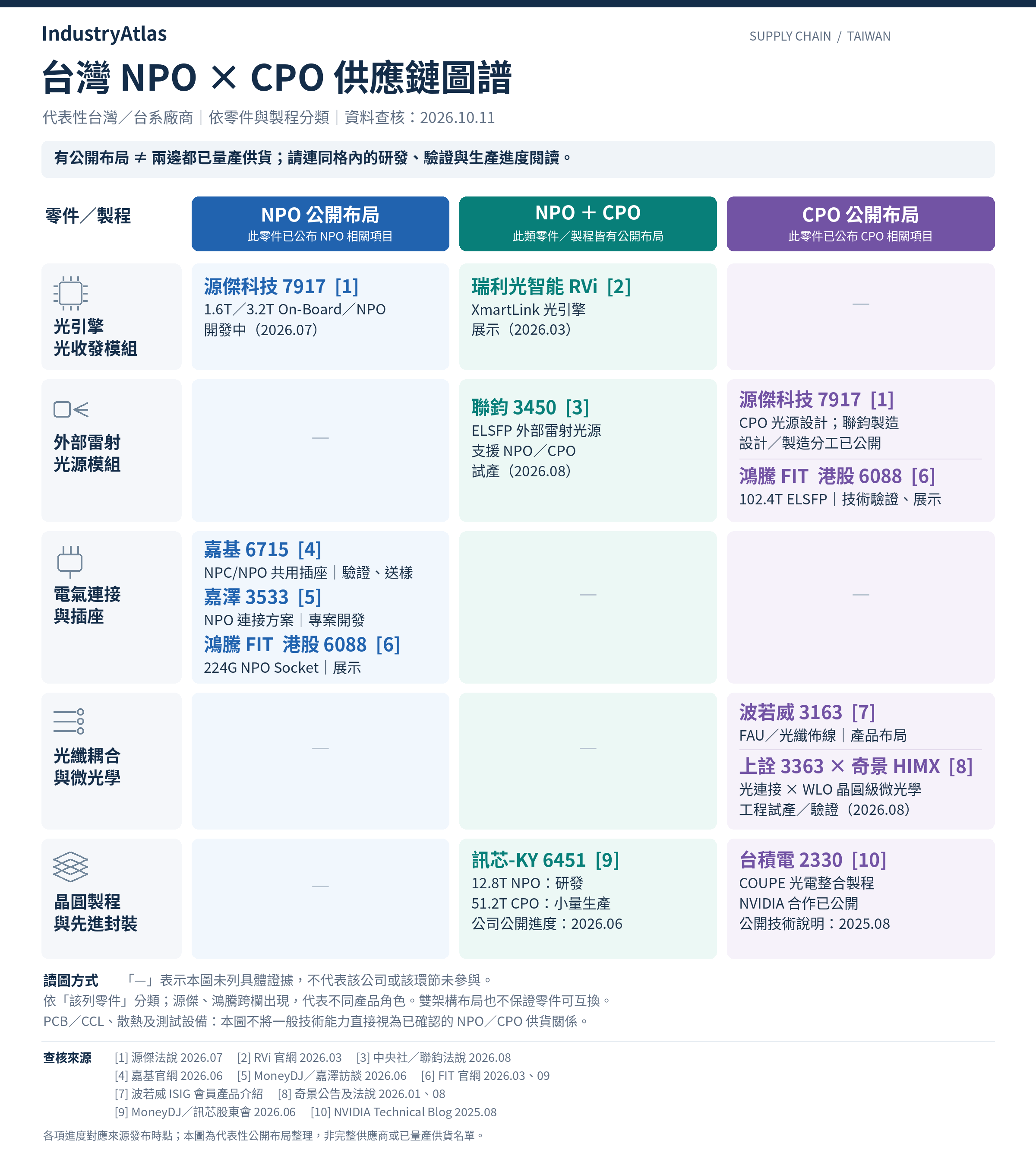
6. Taiwanese participation: optical engines, sockets, and external light sources
For Taiwan, NPO’s significance extends beyond international chip vendors’ architecture choices to the products Taiwanese companies can supply. Public disclosures span optical engines, optoelectronic platforms, electrical connections, external light sources, and packaging development, with progress ranging from research and demonstrations to sampling and trial production.
Seven Taiwanese or Taiwan-affiliated companies with explicit NPO product or development information are listed below. This is a participation list, not a list of suppliers already shipping in volume. Their supply-chain roles also differ.
| Company | NPO role | Public disclosure and progress |
|---|---|---|
| Lintes Technology (6715) | Optoelectronic platform and shared NPC / NPO sockets | Announced a shared optical / copper socket platform in June 2026, supporting up to 6.4T per socket. Reported design validation and sampling, targeting volume production in 2027. This is a company target, not realized shipment results.[13] |
| FIT Hon Teng (6088.HK) | High-speed NPO electrical sockets | The Foxconn-group company announced a 224G NPO Socket demonstration for AI-server racks at CIOE 2026. A specific product is confirmed, but NPO shipment scale is undisclosed. FIT’s own ticker should be distinguished from parent Hon Hai’s.[20] |
| RVi | NPO / CPO optical engines and microVCSEL packaging | The Taiwanese company demonstrated its XmartLink optical engine at OFC 2026, integrating electronic ICs and microVCSELs with explicit NPO / CPO support. This establishes a demonstration, not volume shipments.[21] |
| Centera Photonics (7917) | On-board / near-packaged optical-module design | Its July 2026 investor presentation explicitly listed 1.6T and 3.2T On-Board / NPO as “under development.” It is a concrete product developer, but this progress must be separated from production of existing optical modules.[22] |
| Elite Advanced Laser (3450) | ELSFP external laser-source modules and optoelectronic manufacturing | In CNA’s August 2026 earnings-briefing coverage, its president said external sources support both NPO and CPO, were jointly developed with laser-chip suppliers, and had entered trial production. This is light-source-module progress, not complete NPO-system mass production.[23] |
| LOTES (3533) | NPO connection solutions | A MoneyDJ company interview reported joint NPO development with customers, with production aligned to their schedules. Development participation is confirmed; actual scaling requires subsequent delivery evidence.[24] |
| ShunSin Technology (6451) | Optical-engine packaging and NPO product development | In June 2026 shareholder-meeting coverage, its president identified 12.8T NPO as an ongoing R&D direction. This must not be combined with the company’s disclosed limited CPO production.[25] |
*Lintes, FIT, RVi, and Centera are supported by official announcements or presentations. Elite Advanced Laser, LOTES, and ShunSin disclosures include media records of executives’ public statements. Listed speeds refer to different interfaces or module capacities and cannot directly rank technical capability.*
Concrete examples of overlap with Taiwan’s CPO supply chain
RVi explicitly says the same optical-engine product line supports NPO and CPO deployments. Elite Advanced Laser says its external laser sources address both architectures. These examples show that some optoelectronic technologies, packaging, and manufacturing capabilities can carry from CPO into NPO, without implying identical component specifications or assembly.[21][23]
Centera and Elite Advanced Laser also provide a named division of responsibilities. Centera’s official presentation describes Centera designing CPO external light sources for switch vendors and Elite Advanced Laser manufacturing them. This public relationship clarifies design and manufacturing roles, but cannot establish the same arrangement or shipment status for all Centera NPO projects.[22]
The opportunities identified here include optical-engine design and packaging, external light sources, and board-level optical / electrical connections. Socketed NPO interfaces in particular must meet high-speed signal, mechanical-contact, and thermal-integration requirements. Lintes’ and FIT’s published solutions show concrete activity in this segment.[13][14][20]
Accton and Alpha Networks: standards participation, with products still to be tracked
| Company | Public participation | Appropriate interpretation |
|---|---|---|
| Accton Technology (2345) | Listed as an Open CPX MSA participant | Confirms participation in the shared NPO / CPO specification ecosystem. Membership alone does not establish mass production of a particular NPO switch.[17] |
| Alpha Networks (3380) | Listed as an Open CPX MSA participant | Confirms cooperation on related interface specifications. Product models, customer qualification, and supply announcements require separate tracking.[17] |
LOTES and FIT are also listed as Open CPX participants.[17] For these companies, record standards participation, product announcement, completed qualification, and actual shipments separately. This identifies the problem each supplier addresses and avoids treating one AI-optics theme as an identical realized opportunity for every participant.
7. NPO bottlenecks: electrical channels, thermal-mechanical design, and production testing
Moving the optical engine near the main chip still leaves a high-speed electrical channel. Traces, vias, solder joints, and socket contacts affect loss and reflection. Every detachable interface also adds contact and mechanical conditions requiring validation. TE’s NPO socket design treats high-speed signals, compression force, and overall structure as interrelated issues.[14]
Whether NPO lowers system cost therefore cannot be determined from optical-engine price alone. Shorter electrical paths may save power, but sockets, board materials, assembly precision, and testing add costs. The engineering assessment here is to compare the complete channel and system rather than one component.
PCBs need low loss; thermal conductivity depends on the heat-flow path
“Low electrical properties” is not a precise description of NPO board requirements. More useful measures are low dielectric loss (Df), a stable dielectric constant (Dk) suited to impedance design, and the effects of copper foil and board processing on high-speed channels. Material selection must also account for dimensional stability, moisture absorption, heat resistance, and reliability. High-speed materials documentation lists electrical, thermal, and mechanical properties separately.[19]
Low loss, high-temperature resistance, and high thermal conductivity are different properties. Engines near high-power chips need effective thermal management, but heat may primarily leave through structures above the package or a cold plate. Passage L20 specifications, for example, list cold-plate cooling.[5]
NPO therefore does not universally require high-thermal-conductivity PCBs. Conductivity direction, heat-source location, cold-plate contact, and optical-engine temperature tolerance all affect selection. Some locations need efficient heat removal; others need to limit heat transfer from the main chip into the engine. Establish the heat-flow path before choosing materials.
Replaceability still requires thermal-cycling and assembly validation
For socketed NPO, contact pressure, substrate warpage, thermal-expansion differences, and fiber tension can affect long-term stability. GIGALIGHT also identifies thermal-expansion matching and compression structures as engineering challenges.[9][14]
“Removable” and “easy to maintain” are consequently different achievements. Systems must preserve electrical contact, optical connectivity, and cooling after removal and reinstallation. Soldered NPO likewise requires control of reflow, optical coupling, and final assembly yield. Pretesting reduces integration risk but cannot replace complete-system validation.
8. Shared standards are emerging, bringing competition toward system integration
Supply-chain overlap appears in standards activity as well. In September 2026, Open CPX MSA released specifications covering both architectures, including 6.4T and 7.2T connection formats, internal or external light sources, and liquid-cooling designs. Founding members include Ciena, Coherent, Marvell, Molex, Samtec, and TeraHop.[17]
OIF also lists a 12.8 Tb/s NPO work item, planning implementation agreements for 12.8T and 6.4T optical engines using 200G-per-lane technology.[18] These efforts help establish common interfaces, but publication of a specification and completed interoperability validation across vendors remain different stages.
The public examples suggest that NPO’s value lies in enabling optical engines, main-chip packages, and system cooling to be configured more independently. This creates opportunities for board-level design, connectors, fiber management, and assembly testing to play larger roles in optoelectronic interconnect upgrades.
NPO and CPO share many underlying technologies, but their commercial competitiveness ultimately depends on the complete system’s balance among power, density, manufacturing yield, and maintenance costs.
Sources & notes
- 1. Ericsson, “Co-packaged optics in radio-access networks”; OIF, Co-Packaging Framework Document.
- 2. NVIDIA, “Scaling Power-Efficient AI Factories with NVIDIA Spectrum-X Ethernet Photonics,” January 2026.
- 3. Ruijie Networks, “Silicon Photonics: Revolutionizing Sustainable Data Centre Networks for the Future.”
- 4. Huawei, “Huawei Launches the World’s First NPO-based SuperPoD – the Atlas 960E SuperPoD” and “Huawei Pioneers a New Computing Architecture for the AI Era,” September 17, 2026.
- 5. Lightmatter, “Passage L20 Unified Optical Engine for NPO and OBO Applications,” March 11, 2026; Passage L20 specifications.
- 6. Broadcom, “Broadcom Showcases Industry-Leading Solutions for Scaling AI,” March 2026; official OFC 2026 VCSEL / NPO proof-of-concept explanation.
- 7. Broadcom, “Broadcom Announces Third Generation Co-Packaged Optics (CPO),” May 15, 2025.
- 8. Ranovus, “Ranovus Collaborates with Jabil,” March 31, 2025.
- 9. GIGALIGHT, “GIGALIGHT Unveils Crimp-Socket-Based 1.6T NPO,” September 7, 2026.
- 10. Samtec, “112 Gbps PAM4 Near-Package Optics for Next-Gen HPC Applications,” January 14, 2026; HALO product page.
- 11. OpenLight, “OpenLight Introduces 3.2T DR8 Silicon Photonics PICs,” March 10, 2026.
- 12. Lightmatter, Guide 1 product page.
- 13. Lintes Technology, “Next-generation AI-server solution: shared NPC / NPO optoelectronic interconnects,” June 22, 2026, company-issued announcement.
- 14. TE Connectivity, Near-Packaged Optics (NPO) Socket.
- 15. Molex, TeraVERSE Detachable Optical Chiplet Connectors.
- 16. Sunyu Photonics, NPO Testing Solutions and CPO Testing.
- 17. Open CPX MSA / TeraHop, “Open CPX MSA Group Releases Specification for High Density, Pluggable CPO/NPO,” September 17, 2026.
- 18. OIF, Current Work: 12.8 Tb/s Near-Packaged Optics.
- 19. Isola, Tachyon 100G Laminate and Prepreg datasheet. Used only as a reference for high-speed material properties, not as evidence that the NPO products above adopt this material.
- 20. FIT Hon Teng, “FIT deepens AI optical-interconnect initiatives at Shenzhen CIOE 2026,” September 7, 2026, official news page.
- 21. RVi, “RVi showcases XmartLink optical engine at OFC 2026,” March 17, 2026.
- 22. Centera Photonics, July 2026 pre-Emerging-Stock-Board investor presentation; see “Product positioning and product lines” and “Centera + Elite Advanced Laser strategic alliance.”
- 23. Central News Agency, “Elite Advanced Laser: COSA capacity nearly doubles annually; ELSFP enters trial production,” August 18, 2026, reporting from the earnings briefing.
- 24. MoneyDJ, “Positioning for optical interconnects: LOTES says customers are actively adopting NPO,” June 12, 2026, company interview reproduced by First Bank.
- 25. MoneyDJ, ShunSin shareholder meeting and CPO / NPO product-progress report, June 26, 2026, including the president’s comments on 12.8T NPO R&D.