
INDUSTRY ANALYSIS
The Semiconductor Cycle Through ASML, TSMC, and Micron Earnings: Where Is Demand Strong, and Which Recoveries Remain Unconfirmed?
ASML’s equipment demand, TSMC’s advanced-node revenue, and Micron’s HBM supply agreements point to continued growth in the core AI supply chain. Mature and specialty processes, industrial chips, and automotive chips also show improvement, but the breadth and durability of recovery remain uncertain. Smartphones and PCs show a divide between high-end products and overall unit sales; higher upstream prices or revenue alone do not establish a broad recovery in end demand.
The Three Companies Observe Demand at Different Points in the Supply Chain
Assessing the semiconductor cycle requires more than looking at one company’s total revenue. Equipment makers see chipmakers’ investment and process upgrades; foundries see customer wafer starts and capacity requirements; memory manufacturers are affected simultaneously by shipments, pricing, and product mix.
| Company | Primary information used in this article | Main point of observation | Limits of interpretation |
|---|---|---|---|
| ASML | Q3 2026, released October 14 | Lithography equipment, installed-base upgrades, and customer investment | Equipment demand can reflect both capacity expansion and technology upgrades; it does not directly equal end-product unit sales |
| TSMC | Q3 2026, released October 15 | Wafer fabrication, advanced processes, and customer capacity planning | Provides direct evidence of advanced-logic demand; its evidence for HBM is primarily indirect |
| Micron | Q4 FY2026, released September 30 | DRAM, HBM, NAND, and customer supply agreements | Memory revenue must be separated into pricing, bit shipments, and product mix |
Micron’s quarter ended on September 3, 2026, so its reporting period is not identical to ASML’s and TSMC’s third quarters. This article centers on these three companies and supplements their results with UMC, GlobalFoundries, and Texas Instruments (TI) to assess mature processes and end markets. [1][2][3]
Here, “strong demand” means demand currently supported by revenue, shipments, or supply agreements. “Recovery still to be confirmed” means improvement has occurred, but there is not yet enough evidence to conclude that the whole market has entered sustained expansion. These are assessments of industry conditions, not rankings of individual stocks’ potential returns.
ASML Shows Continued Equipment-Investment Momentum, but Not All Growth Can Be Attributed to HBM
ASML reported third-quarter revenue of €11.662 billion, including €3.289 billion from installed-base services and field upgrades. The company said customers continued to raise their near- and medium-term equipment requirements, primarily reflecting their views on the scale and duration of AI investment. Demand for productivity upgrades also remained strong. [1]
This shows two types of spending occurring together: purchases of new equipment and improvements to the output of existing tools. Service and upgrade revenue cannot all be treated as new tool installations, nor can total company growth be translated directly into additional wafer capacity.
In its July second-quarter earnings call, ASML had already explained that supply-demand conditions for both conventional DDR and HBM were driving DRAM capacity expansion. Transitions to advanced DRAM processes were also increasing lithography demand, involving both EUV and immersion DUV. [4]
Therefore, growth in memory-related equipment does not mean all of it comes from HBM; growth in DUV does not mean mature processes are recovering across the board. Incremental equipment demand must be assessed in the context of end demand, capacity expansion, and the lithography steps required by each process.
ASML also said some customers were interested in arranging orders for 2029 and 2030 ahead of time. This indicates long-term planning intentions. It should not be described as all orders for those years being finalized, much less as a guarantee of end demand. [1]
Areas with More Direct Supporting Evidence
Advanced Logic Processes: Realized Revenue and the Outlook Reinforce Each Other
TSMC’s third-quarter revenue in US dollars increased 41.2% year over year. Processes at 7 nm and below accounted for 79% of wafer revenue, including 8% from 2 nm and 33% from 3 nm. The company explicitly stated that strong demand for advanced processes supported its business during the quarter. [2]
Its fourth-quarter revenue guidance was US$52.3–54.3 billion, with the midpoint approximately 14% above the third quarter. Drivers included the rapid ramp of 2 nm. This is management guidance, not reported fourth-quarter results. [2]
IndustryAtlas assessment: Advanced logic remains an area with clear demand. This conclusion combines realized revenue, the company’s explanation of growth drivers, and its next-quarter outlook; it is not based solely on advanced processes’ high revenue share.
TSMC also highlighted AI accelerators, CPUs related to agentic AI, and networking chips, and planned to more than double annual N2-family capacity in 2027. These applications collectively support advanced processes, but they should not all be assumed to generate HBM demand in the same proportion. [5]
HBM: Shipment Momentum and Multiyear Supply Visibility
Micron said its HBM revenue grew faster than total company revenue in Q4 FY2026. Agreements had been completed for the vast majority of its calendar-2027 HBM bit supply, at prices significantly higher than the previous year. [6]
IndustryAtlas assessment: Direct evidence supports near-term HBM demand and order visibility for 2027. This evidence comes from Micron itself; it cannot be extended to mean that every manufacturer’s entire capacity is sold out. Agreements for future supply also do not mean the products have already been delivered and revenue recognized.
This is why including Micron matters: TSMC can confirm demand for advanced chips, while Micron provides commercial evidence for HBM itself.
Server Memory and Data-Center SSDs: Growth Extends Beyond HBM
Micron’s latest results showed that revenue from its server LPDDR SOCAMM portfolio more than doubled sequentially, while several data-center SSD products entered customer shipments or ramp-up. [3]
Quarterly data-center SSD revenue approached US$10 billion, accounting for more than two-thirds of Micron’s NAND revenue. This indicates that data centers have become an important growth driver for its storage business. [6]
IndustryAtlas assessment: Actual business performance also supports high-end server memory and data-center storage demand. However, rapid growth in specific products cannot be applied directly to every DDR generation, consumer SSDs, or every module supplier. Nor should growth rates for products ramping from a low base be used directly to compare the size of entire markets.
Advanced Lithography and Equipment Upgrades: Demand Is Supported, but Benefits Depend on Product Position
ASML’s disclosures support continued demand for equipment related to advanced processes and for productivity upgrades. [1][4] For supply-chain analysis, the next step is to identify suppliers’ actual products, customer qualifications, and revenue exposure.
For example, a supplier’s capability in an advanced process establishes an opportunity to participate. Winning volume-production orders, increasing shipments, and improving profitability remain separate stages. Growth at these three industry leaders cannot automatically validate the prospects of every equipment, materials, packaging, or testing company.
Recovery Evidence Exists, but Breadth and Durability Remain Unconfirmed
Mature and Specialty Processes: Shipments and Utilization Have Improved
Mature processes cannot simply be labeled “non-AI,” nor can they be assessed using a single nanometer figure. Power management, analog, sensors, microcontrollers, and radio-frequency products have different process and end-use requirements; some also participate in AI systems. [7]
UMC’s second-quarter wafer shipments increased 10.6% sequentially, and capacity utilization reached 85%. The company said demand for power-management ICs, sensors, and microcontrollers was driving recovery in its 8-inch product portfolio. However, its statement that third-quarter utilization could exceed 90% was still guidance at the time. [7]
GlobalFoundries’ second-quarter revenue rose approximately 6% year over year, while 12-inch-equivalent wafer shipments increased approximately 8% both year over year and sequentially. The two foundries’ data show that improvement is more than one company’s subjective assessment. [8]
IndustryAtlas assessment: Improvement in parts of the mature- and specialty-process market can be confirmed; sustained recovery across the overall market still requires validation. The next question is whether higher utilization is accompanied by sustained shipments, pricing, and orders, after accounting for seasonality, restocking, product mix, and capacity adjustments.
Industrial and Automotive Chips: Revenue Has Recovered, but End-Customer Demand Still Needs Confirmation
TI’s second-quarter revenue increased 23% year over year and 13% sequentially, with the company attributing growth to industrial, data-center, and automotive markets. [9] TSMC’s third-quarter automotive-platform revenue also increased 23% sequentially. [5]
These figures demonstrate improvement in suppliers’ results, but they do not directly establish simultaneous growth in global vehicle sales, industrial-equipment investment, or all related chip demand. Greater semiconductor content per vehicle, changes in customers’ market share, and inventory replenishment can all allow chip suppliers to outperform end markets.
IndustryAtlas assessment: Industrial and automotive chips show signs of recovery, but confirmation requires more quarters and evidence from more suppliers. Particular attention should be paid to the health of customer and channel inventories, and whether improvements extend across products and regions.
Smartphones and PCs Remain Divided Markets, Not Yet a Broad Recovery
Micron said high-end products supported PC and smartphone revenue, but full-year device shipments in both markets could still decline by double digits. TSMC also cautioned that consumer and price-sensitive markets remained affected by rising component prices and economic uncertainty. [5][6]
Three things must be distinguished: how many devices are sold, how much or how advanced the semiconductor content in each device is, and the prices of the chips themselves.
Even when device unit sales fall, higher memory capacity per device, a larger share of advanced chips, or rising component prices can increase revenue for some upstream suppliers. The effects vary by supplier: high-end product providers may benefit, while component suppliers dependent on overall unit volumes may not.
IndustryAtlas assessment: Opportunities remain in high-end demand and product upgrades, but a recovery in total smartphone and PC unit sales has not yet been confirmed.
Overview of Industry Conditions
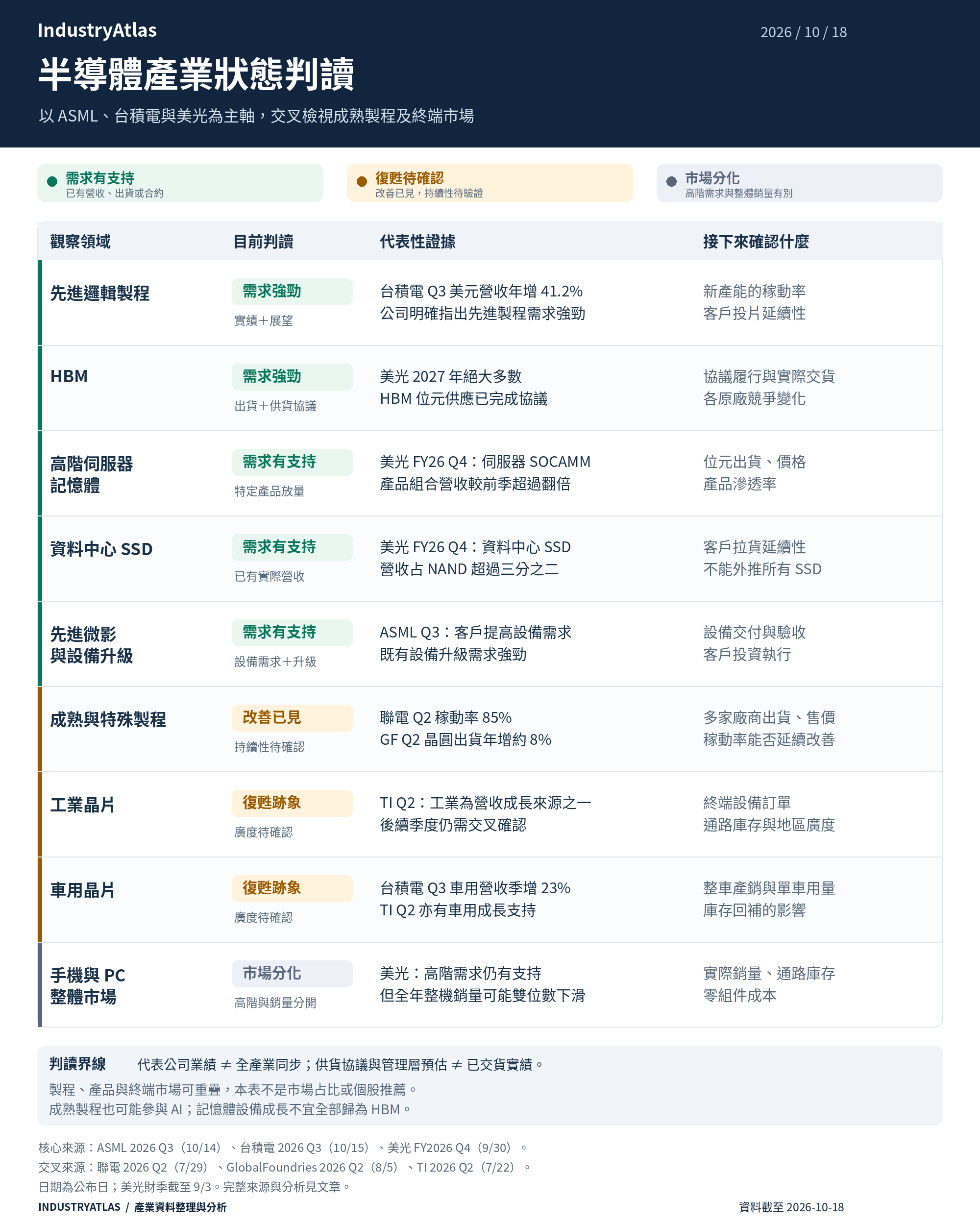
Figure: Compiled by IndustryAtlas from public information available as of October 18, 2026. The classifications reflect the strength of representative evidence, not uniform performance across all companies. Reporting periods and sources are provided in the tables and source notes.
| Area | Current assessment | Main evidence | What to verify next |
|---|---|---|---|
| Advanced logic processes | Strong demand | TSMC’s realized revenue and Q4 outlook reinforce each other | Utilization after new capacity enters production and the durability of demand |
| HBM | Strong demand | Micron is shipping products and has completed agreements for most of its 2027 bit supply | Contract execution, actual deliveries, and competition among manufacturers |
| High-end server memory | Strong demand, with product differences | Micron’s server SOCAMM revenue is ramping | Bit shipments, pricing, and product penetration |
| Data-center SSDs | Demand is supported | Micron has actual data-center SSD revenue and product ramps | Sustained customer purchases and demand outside data centers |
| Advanced lithography and equipment upgrades | Demand is supported | ASML’s customer equipment requirements and upgrade business | Equipment delivery, acceptance, and execution of customer capital spending |
| Mature and specialty processes | Improvement is visible; durability remains unconfirmed | Higher UMC utilization and improved GlobalFoundries wafer shipments | Whether shipments, prices, and utilization continue to improve across multiple suppliers |
| Industrial chips | Signs of recovery; breadth remains unconfirmed | TI identifies industrial markets as a growth driver | End-equipment orders, channel inventories, and demand across regions |
| Automotive chips | Signs of recovery; breadth remains unconfirmed | Improvement in TI’s and TSMC’s automotive businesses | Divergence among vehicle production/sales, semiconductor content per vehicle, and restocking |
| Overall smartphone and PC markets | High-end and mass-market segments are diverging | High-end product demand coexists with pressure on device unit sales | Actual unit sales, channel inventories, and component costs |
Sources: [1]–[9]. This table presents IndustryAtlas’s combined assessment. Processes, products, and end markets represent different levels of observation; rows can overlap and cannot be added together as market shares.
The most reasonable current picture is that advanced logic, HBM, and certain data-center memory and storage products remain strong; mature processes, industrial chips, and automotive chips are improving; and smartphones and PCs remain divided markets.
For supply-chain research, the most important next step is to place each company’s products, customers, and revenue mix within this picture. Strong industry demand is only a starting point. Whether it translates into an individual company’s shipments and profits depends on the part of the supply chain in which that company actually participates.
Sources & notes
- 1. ASML, Q3 2026 earnings press release, October 14, 2026 (SEC public filing).
- 2. TSMC, Q3 2026 earnings press release, October 15, 2026.
- 3. Micron, Q4 and full-year FY2026 results, September 30, 2026.
- 4. ASML, Q2 2026 investor-call transcript, July 15, 2026. This source supplements the discussion of the relationship among DDR, HBM, and lithography demand; it is not treated as new third-quarter guidance.
- 5. TSMC, Q3 2026 earnings-call transcript, October 15, 2026.
- 6. Micron, Q4 FY2026 prepared remarks, September 30, 2026.
- 7. UMC, Q2 2026 operating results, July 29, 2026.
- 8. GlobalFoundries, Q2 2026 results, August 5, 2026.
- 9. Texas Instruments, Q2 2026 results, July 22, 2026.