
INDUSTRY ANALYSIS
FA/FAU and Optical Coupling: Will Largan Become FOCI's Partner or Competitor?
CPO brings optical communications components next to compute or switch chips, bringing fiber alignment, cooling space, and production-yield challenges into the package. Starting with the roles of FAs and FAUs, this article compares precision positioning, lenses, micromirrors, and detachable connections. It then examines the basis of FOCI's cooperation with Himax and the entry strategies of lens makers such as Largan and Genius Electronic Optical. At this stage, Genius's high-precision component strategy is more clearly defined. Largan could change the existing division of responsibilities if it expands its integration and manufacturing capabilities, but the eventual balance of cooperation and competition remains unproven. Information cutoff: October 2, 2026. Company progress is assessed against the publication dates of the cited disclosures. The cooperation and competition scenarios are the author's analysis, not confirmed supplier relationships.
Why is connecting fiber to a chip a business in its own right?
Discussions of co-packaged optics (CPO) often focus on silicon photonics chips, switches, and lasers. Yet a working optical communications system also depends on something else: how efficiently light travels from fiber into the chip, and from the chip back into fiber.
The optical field in a fiber differs in size and distribution from the field in a chip's tiny waveguide. Even if the two appear physically aligned, light may not transfer efficiently. Optical coupling uses appropriate structures, optical components, and alignment to match these fields and reduce energy loss. [1][2]
This problem existed well before CPO attracted market attention. Lens manufacturers are entering a market whose requirements for density, precision, and manufacturing capability continue to rise.
What are FAs and FAUs? First establish what the supplier actually delivers
A fiber array (FA) is a group of fibers fixed at specified pitches, in a defined arrangement and position. A common manufacturing method places fibers in precision V-grooves, then fixes, cuts, grinds, or polishes them to create an end face that can interface with other optical components. [1]
A fiber array unit (FAU) emphasizes an assembly-ready unit built around a fiber array. Suppliers do not all use the term in exactly the same way. Some products consist of fibers and a positioning base; others also integrate beam-turning elements, lenses, or connection structures. “FAU = FA plus lenses” is therefore not a universal definition. [1][4]
When reading supply-chain information, three questions matter more than the label. Does the company deliver a single component or an assembled unit? Is it responsible for coupling to the photonic chip? Who takes responsibility for final testing and reliability?
This explains why two companies both described as “FAU-related stocks” may still occupy upstream and downstream positions in the same supply chain.
The challenge: accurate alignment, fast assembly, and long-term stability
The first challenge in optical coupling is loss. A mismatch in position, angle, or optical-field size can prevent some light from entering the intended waveguide. Fiber arrays also require control of channel-to-channel variations. Good performance on one channel does not guarantee the same quality across the entire array. [2][3]
The second challenge is manufacturing efficiency. Active alignment measures optical power during assembly, moving components to find a better position. Passive alignment uses geometric features such as grooves and locating surfaces to place components in predetermined positions. The former provides optical feedback; the latter can improve assembly efficiency but shifts more of the burden onto component precision and tolerance control. Real production flows can combine both methods. [2]
The third challenge is stability after packaging. Temperature changes, material expansion, or changes in the bond can shift the optical path after fixation. If the optical unit must pass through solder reflow, it must withstand that process. An alternative is to use a detachable interface to change the assembly sequence, allowing some fiber components to avoid reflow. [4][7]
Relevant capabilities therefore include loss, channel consistency, alignment time, thermal stability, serviceability, and production yield. A single claim of “micrometer-level precision” cannot describe the entire solution. Fiber-core position error, groove-machining accuracy, and final assembly alignment error must also be distinguished. Measurements of different things cannot be used directly to rank technologies.
Where light enters the chip and how the connection is built are different questions
There are two common chip interfaces. Edge coupling (EC) brings light through the side of the chip and typically requires optical mode-size conversion. Grating coupling (GC) uses a grating on the chip surface to direct light into or out of the chip from above at a designed angle. Edge coupling can support a broad operating wavelength range, while grating coupling facilitates optical access and testing from the wafer surface. The actual trade-off depends on the chip design. [2][3]
Lenses, prisms, micromirrors, precision V-grooves, and detachable connectors address the optical path and assembly between fiber and chip. They can be combined with different chip interfaces. EC, GC, lenses, and FAUs should not be presented as four mutually exclusive alternatives.
The following table compares the main problems these approaches address. Rows can be combined, and none implies that a supplier works exclusively on that technology.
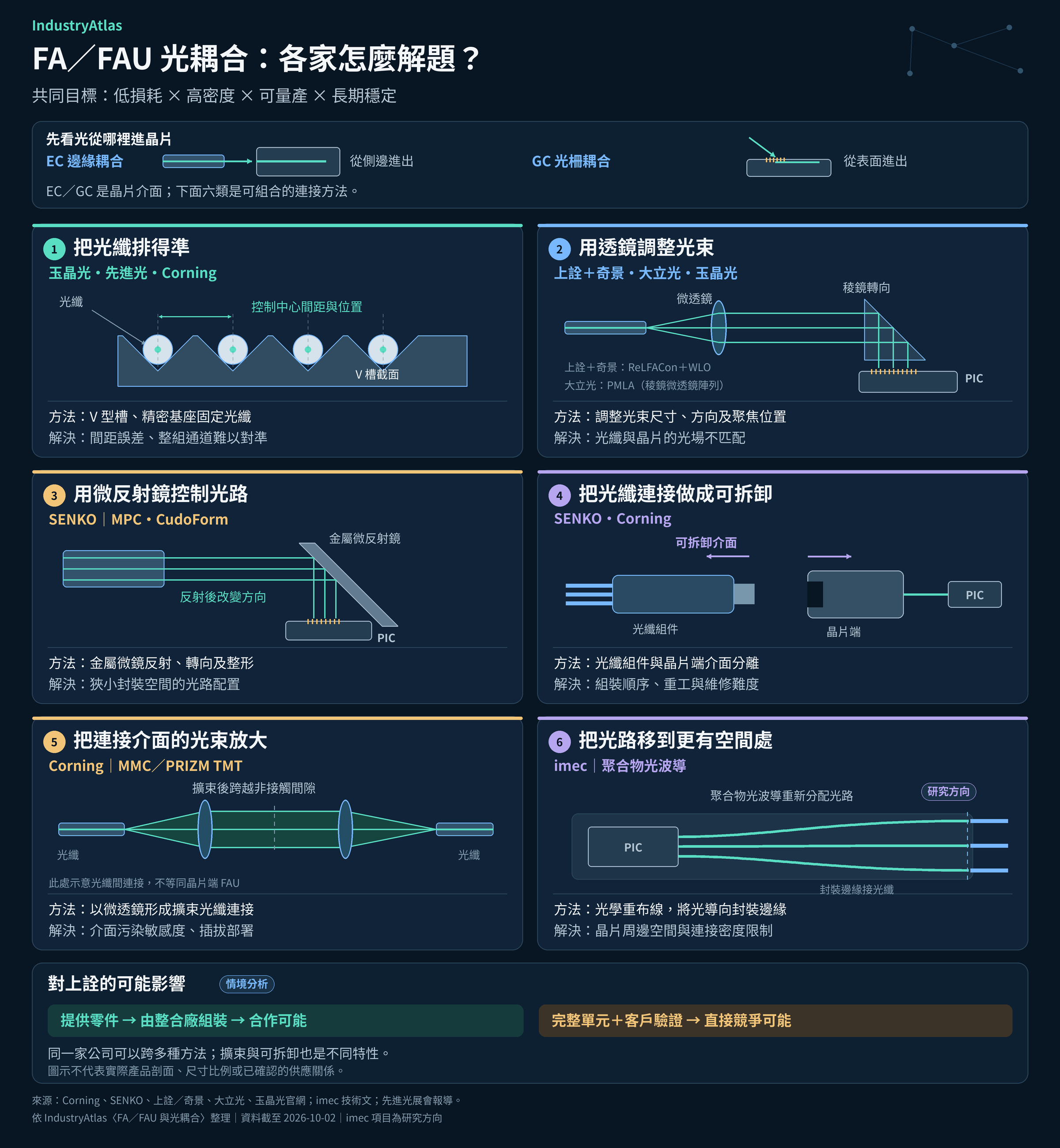
| Approach | Main problem addressed | Public examples | What still needs to be assessed |
|---|---|---|---|
| Precision arrangement and positioning | Control fiber pitch and position for repeatable multichannel assembly | Corning's V-groove FAUs; imec research on self-aligning V-grooves and edge coupling. [1][2] | Component precision must translate into coupling performance across the full array, with post-bonding shifts controlled |
| Beam shaping with lenses and prisms | Adjust beam size, direction, and focal position | FOCI's ReLFACon combined with Himax wafer-level optics (WLO); Largan's publicly shown prism microlens arrays. [4][5][13] | Multiple optical surfaces and components require joint design, alignment, and testing |
| Beam shaping with micromirrors | Turn, focus, or expand beams using reflective structures | SENKO's MPC uses a metallic optical bench and a micromirror array. [6] | Compare actual loss, assembly tolerances, and thermal stability; reflection versus refraction alone does not establish superiority |
| Detachable and expanded-beam connections | Improve assembly, rework, serviceability, or contamination tolerance at a connection interface | SENKO's detachable MPC; Corning's detachable chip-side connection and MMC/PRIZM TMT expanded-beam connection products. [7][8] | Detachability and beam expansion are different features; chip-side and fiber-to-fiber connections are also different interfaces |
| Waveguides that reroute optical paths | Extend connections to a less constrained location and increase interconnect density inside the package | imec research on optical redistribution layers formed with polymer waveguides. [9] | This is another packaging-integration approach; research results do not establish a mature, mass-produced substitute |
The final column is the article's analytical framework. Expanded beams, in particular, can improve tolerances at certain connection interfaces, but they do not eliminate all precision-alignment requirements at the chip. Corning's disclosed expanded-beam fiber connection products should not be treated as the same design as its chip-side FAU. [8]
FOCI and Himax: integrating optical components into a usable connection solution
FOCI introduced ReLFACon in 2023. Its name denotes a reflowable, lensed fiber array connector. The disclosed positioning is to connect fiber arrays to silicon photonics CPO components while meeting semiconductor packaging-process requirements. [4]
In 2024, Himax announced a further investment in FOCI, describing the combination of FOCI's fiber-connection technology and Himax's WLO capabilities. Cross-company integration of optical lenses and fiber arrays was therefore already under way before the current wave of lens manufacturers entered the field. [5]
According to Himax's August 2026 disclosure, the partners' first-generation products supporting 1.6T/3.2T and second-generation products targeting 6.4T began engineering production ramp-up in the third quarter. The timing of volume production remained dependent on customer deployment. [10]
These disclosures support the conclusion that the two companies have an established basis for joint development and engineering introduction. They do not prove global market-share leadership or guarantee that every future customer will retain the same architecture. Himax's “first generation” and “second generation” describe its own product roadmap, not an industry-wide standard for CPO generations.
In this article's assessment, FOCI's key value is its ability to integrate fibers, optical components, connection structures, and customer requirements into products it can deliver consistently. New component suppliers may strengthen that capability or compete for part of the work.
Genius's strategy is clearer; Largan's integration scope warrants closer attention
Genius Electronic Optical: addressing tighter precision requirements
Genius Electronic Optical's website lists optical communications product directions including high-precision prisms, microlens arrays, metalenses, V-grooves, and MT ferrules. [11]
In an executive interview published in June 2026, the company linked the opportunity to upgrades toward 3.2T and 6.4T transmission capacity and tighter component-precision requirements. It described requirements tightening from approximately 0.5 μm to ±0.2–0.3 μm as an entry point for its manufacturing capabilities. [12]
Calling Genius's strategy “more clearly established” here means that its product direction and approach have been explained more clearly in public. It does not establish orders, revenue scale, or qualification for a specific 6.4T platform. The cited precision figures should not be treated as customer-validated volume-production data.
From a supply-chain perspective, supplying high-precision components to module integrators could create opportunities for upstream/downstream cooperation. If Genius expands delivery to complete coupling units, its overlap with existing integrators could increase. The actual relationship depends on product scope and the customer's division of responsibilities.
Largan: the potential impact depends on how much it can integrate
Largan's website displays prism microlens arrays and one- and two-dimensional fiber arrays. June 2026 trade-show reporting also described integrated optical-component solutions and plans to move toward FAU modules. [13][14]
This article sees the potential for Largan to change the competitive landscape because its activities span both fiber arrays and micro-optical components. If it can combine these with automated assembly, inspection, and reliability management into a solution customers adopt, it could change existing suppliers' responsibilities and bargaining positions.
That is a conditional industry inference. Product demonstrations alone do not establish better cost, yield, or customer adoption than incumbent suppliers. Whether smartphone-lens manufacturing experience translates into reliable CPO delivery must be demonstrated by subsequent engineering and production results.
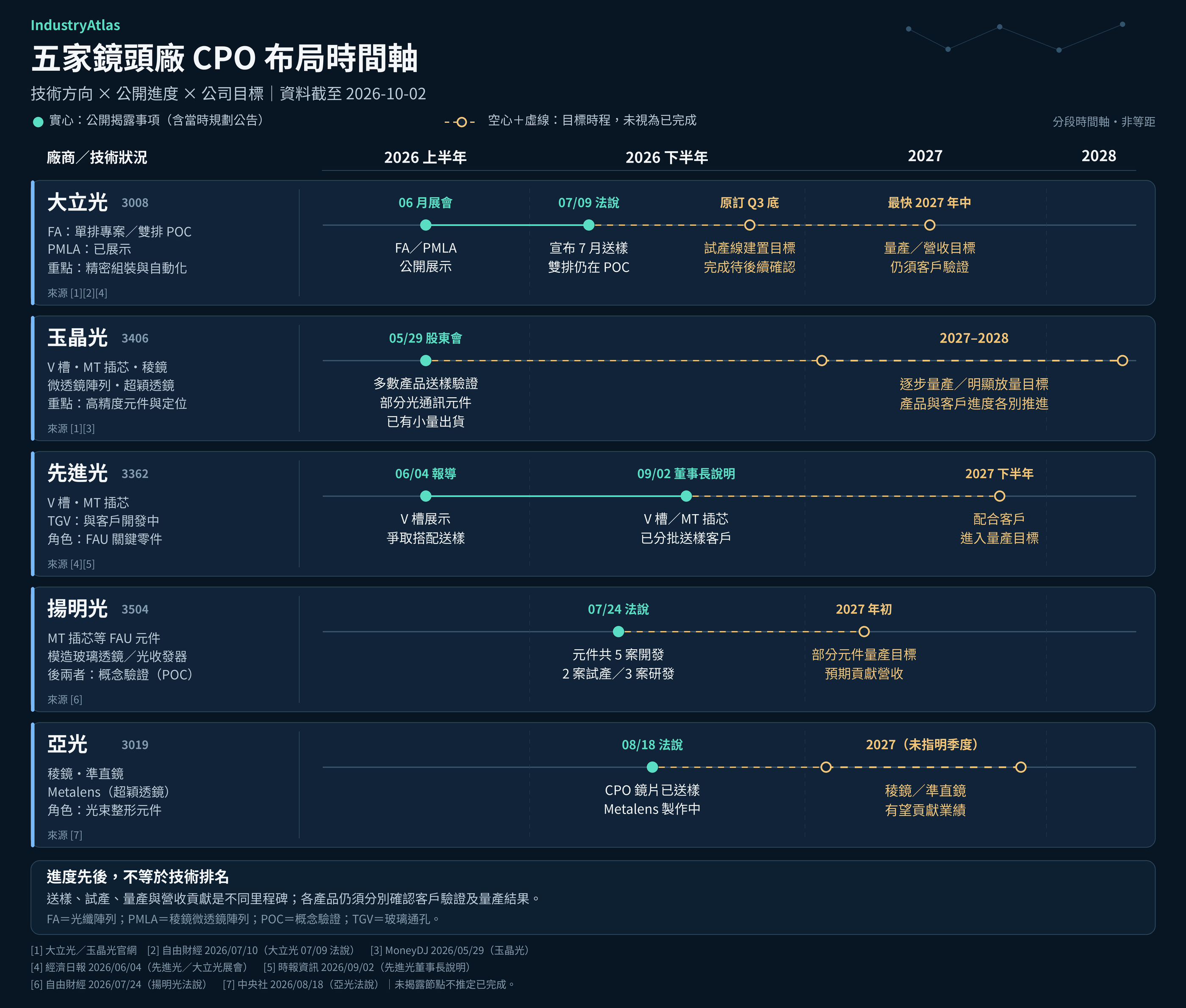
Other lens makers are entering at different levels. Ability Opto-Electronics Technology is pursuing joint sampling with Largan through V-grooves. Young Optics has disclosed trial production of components such as MT ferrules, alongside lens and optical-transceiver module development. Asia Optical has announced progress on CPO prisms, collimating lenses, and metalenses. [14][15][16]
These moves show that lens manufacturers are finding different responsibilities they can take on. They do not justify classifying every company as a direct competitor supplying complete FAUs.
For FOCI, cooperation and competition may occur at the same time
Whether Largan and Genius become partners or threats depends on what customers ultimately buy from each supplier and who is responsible for overall performance. The following are possible scenarios, not confirmed business relationships.
| Possible scenario | Division of responsibilities | Potential impact on FOCI |
|---|---|---|
| Component-supply cooperation | Entrants supply V-grooves, fiber arrays, or specific optical components; FOCI handles downstream integration and validation | More sourcing options and support for specification upgrades; the benefit still depends on cost and integration results |
| Competition within part of the same solution | Customers add a second source for selected optical components, FAs, or submodules | FOCI may retain integration work, while pricing and responsibilities within the existing supply chain change |
| Direct competition in complete coupling units | Entrants provide a complete alternative and qualify it on the same customer platform | More direct pressure on FOCI's module orders, control over the technical solution, and bargaining power |
Another possibility is that customers choose different chip interfaces and packaging architectures, allowing several solutions to coexist. A company could then cooperate on one project and compete on another.
Largan's entry deserves close attention, but current evidence does not establish that it will replace FOCI or necessarily become a new supplier to it. Likewise, FOCI and Himax's confirmed cooperation cannot be extended into an assumed exclusive relationship involving every new lens manufacturer. [5][10]
The following original timeline summarizes publicly reported progress by related companies.
Sources & notes
- The product pages below establish disclosed product scope. Company releases and executive interviews establish the progress announced by those companies; they are not independently verified performance rankings. Source descriptions are retained from the Chinese article. Where it did not supply a URL, no link has been inferred.
- [1] Corning, Fiber Array Unit (FAU) Series, specification OEM-039-AEN, revised September 3, 2019. Used to explain FAU structures and coupling methods, not as a 2026 performance benchmark. Original PDF.
- [2] imec, Silicon photonics technology for next-generation datacenter interconnects, 2019. Covers optical mode conversion, self-aligning V-grooves, and active/passive alignment.
- [3] imec, Developing silicon photonics technologies with a wafer-level test station, April 2018. Covers grating coupling, alignment, and wafer-level testing.
- [4] FOCI, FOCI releases advanced new CPO connector: ReLFACon, January 18, 2023.
- [5] Himax Technologies, release on its investment in FOCI's private placement and strategic CPO cooperation, June 2024. Original Chinese PDF.
- [6] SENKO, MPC — Metallic PIC Coupler, official product page, accessed October 2, 2026.
- [7] SENKO, SENKO Unveils Detachable Metallic PIC Connector (MPC) at SEMICON Taiwan 2025, August 2025. Company product description published on the trade show's website.
- [8] Corning, Corning To Showcase New Cable and Connectivity Innovations To Accelerate and Streamline AI Network Growth at ECOC 2026, September 17, 2026.
- [9] imec, Interfacing silicon photonics for high-density co-packaged optics, accessed October 2, 2026. Used to explain research on optical redistribution.
- [10] Himax Technologies, Inc. Reports Second Quarter 2026 Financial Results; Provides Third Quarter 2026 Guidance, August 6, 2026. Company release distributed through GlobeNewswire.
- [11] Genius Electronic Optical, Optical Communications and Co-Packaged Optics, official product page, accessed October 2, 2026. Translated title.
- [12] Economic Daily News, Liu Fang-miao, report on Genius Electronic Optical's CPO expansion, June 22, 2026. Interview with the chairman and president, indexed by IEK's industry intelligence service.
- [13] Largan Precision, CPO applications under Products and Services, official product page, accessed October 2, 2026.
- [14] Economic Daily News, Liu Fang-miao, report on Ability Opto-Electronics Technology seeking to sample CPO products alongside those of major shareholder Largan, June 4, 2026.
- [15] Liberty Times Finance, Ou Yu-hsiang, report on Young Optics' three CPO initiatives and FAU trial production, July 24, 2026. Coverage of an investor conference.
- [16] Central News Agency, Chao Min-ya, report on Asia Optical's humanoid-robot lens samples and potential CPO component revenue the following year, August 18, 2026. Coverage of an investor conference.