
INDUSTRY ANALYSIS
Why AI Agents Drive CPU Demand: Workloads, Foundries, and the Named Supply Chain
As AI moves from answering questions to gathering information, operating software, running code, and repeatedly verifying results, data-center workloads are changing. Large-model inference relies mainly on GPUs and AI accelerators, while the tools, programs, and enterprise applications driven by those models place additional demands on CPUs, memory, and I/O systems. This is why “agent CPU” demand is attracting attention.[1][2] The implications extend beyond which CPU vendor sells more. Processors from competing brands may be manufactured by the same foundry before passing through different substrate, packaging, testing, and server-integration processes. Tracing workloads through the supply chain helps identify where demand may grow and which relationships are confirmed.
What is an agent CPU?
An “agent CPU” can be understood as a CPU handling AI-agent workloads. It is not yet a standardized hardware category with uniform specifications, separate shipment statistics, and a consistent market-share definition. Existing Intel Xeon, AMD EPYC, and various Arm-based server CPUs can all participate in agent systems. Some new products explicitly emphasize agents, tool execution, and reinforcement-learning environments in their design and marketing.[1][2][3]
Consider a coding agent. After the model proposes changes, the system must create an isolated environment, read and write files, compile code, run tests, and return results to the model. These steps often require actual CPU execution. A data-analysis agent also queries databases, processes data, runs Python, and checks output formats. The CPU’s role therefore includes both task coordination and execution.[1][2]
Model inference and CPU execution typically alternate, while the system may also serve many tasks concurrently. If the CPU layer cannot finish work promptly, overall response time increases. Conversely, adding CPUs may not help when the bottleneck is an external API, storage, or network waiting time. Demand must be assessed across the full workflow, not simply by counting agents.
Why might CPU demand increase?
First, a single user request can trigger multiple tool operations. Moving from “generate an answer” to “complete a task” adds code execution, data processing, and verification steps that consume CPU time. Second, enterprise deployments serve many users simultaneously and maintain multiple containers or sandboxes. Greater concurrency increases requirements for cores, memory capacity, and bandwidth. Agent reinforcement learning and evaluation also require environments to run repeatedly and results to be checked.[1][2][3]
This creates opportunities to scale the CPU compute layer independently. NVIDIA has introduced Vera CPU racks, while AMD has proposed expanding a CPU-server layer alongside GPU infrastructure. These products and architectures show suppliers configuring hardware for tool execution, data processing, and large numbers of isolated environments.[1][3]
More work does not, however, imply proportionate growth in CPU unit shipments. Faster single-core performance, higher core density, software optimization, and better utilization can absorb some growth. Each agent also does not require a dedicated CPU. Frequently cited CPU-to-GPU ratios should therefore be treated as observations or forecasts for specific architectures, not universal ratios for every data center.
More competitors, with different supply models
This market includes Intel, AMD, NVIDIA, Arm, and Ampere supplying server processors externally, as well as AWS, Microsoft, and Google designing CPUs for their own cloud services. The former reach customers through system vendors, cloud operators, and enterprise deployments. For the latter, commercial results often appear in cloud-instance cost and performance rather than revenue from selling CPUs.[3][7][8][9][10]
Arm’s roles also need separating. Licensing the Arm architecture and core IP is one business; supplying processors under the Arm AGI CPU brand is another. Counting every Arm-based CPU as a shipment of Arm’s own chips confuses the boundaries between design, licensing, and supply.[8]
Who manufactures each vendor’s CPUs?
The following chart selects representative products relevant to the current discussion. Process information refers primarily to the main compute die or the official product-level description. Base and I/O dies within a multi-die package may use different nodes. Names such as Intel 18A, Intel 3, TSMC N2, and N3 cannot be compared simply by their numbers to determine performance or density.
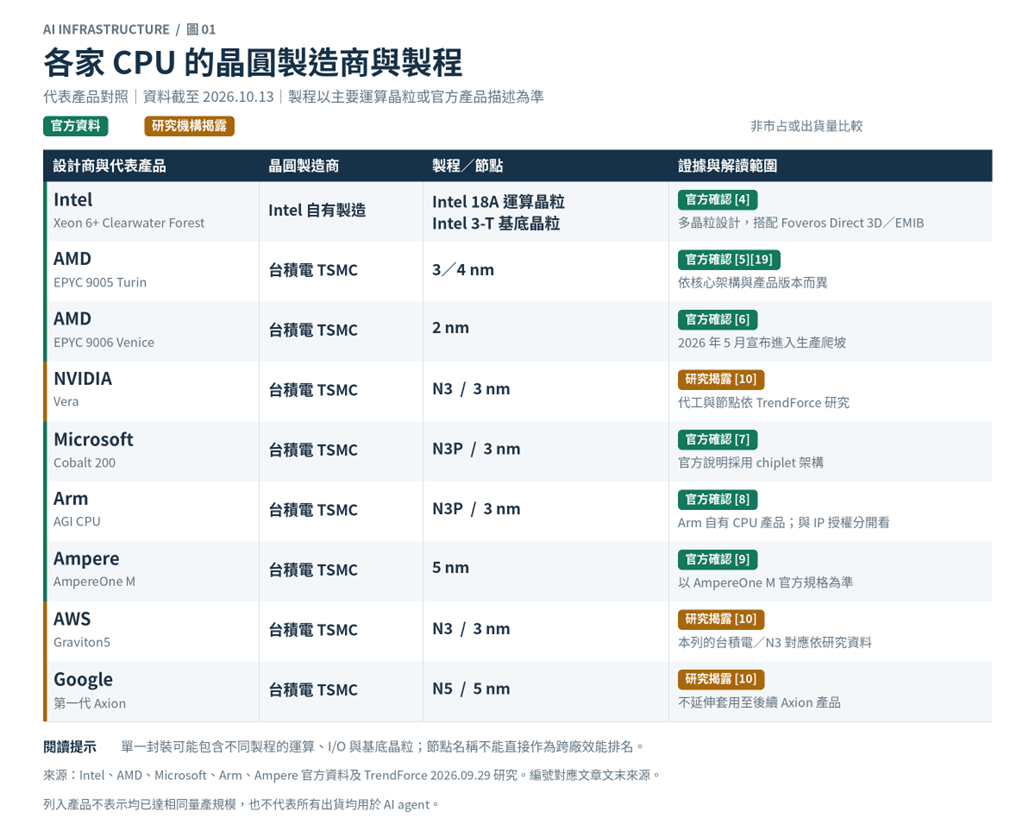
*Figure 1: Wafer manufacturers and process nodes for representative products. Green indicates official confirmation; orange indicates research-firm reporting. Inclusion does not imply equal production scale or that all shipments serve agents.*
Intel’s Clearwater Forest uses Intel 18A, together with Intel 3-T base dies, Foveros Direct 3D, and EMIB packaging, representing an in-house manufacturing and multi-die integration approach. AMD continues to work with TSMC: EPYC 9005 uses 3nm / 4nm processes, while AMD has announced the production ramp of Venice on TSMC’s 2nm process.[4][5][6][19]
Official information for Microsoft Cobalt 200 and Arm AGI CPU points to TSMC N3P; AmpereOne M’s official specifications list TSMC 5nm. The TSMC process mappings for NVIDIA Vera, AWS Graviton5, and first-generation Google Axion appear in TrendForce research. Those mappings should retain their research-source attribution rather than being rewritten as individual official confirmations from all three companies.[7][8][9][10]
This creates a notable structure: competition among CPU brands can simultaneously broaden one foundry’s product portfolio. A product list establishes supply relationships but cannot directly determine TSMC’s or Intel’s share of “agent CPU wafers.” Estimating wafer demand also requires shipment volumes, die area, yields, and actual applications.
How does demand reach upstream suppliers and system vendors?
In manufacturing terms, additional CPU demand first affects chip design and wafer starts, then package substrates, packaging, and testing. Completed processors must be combined with memory, motherboards, networking, and storage, then integrated into servers or racks. Demand across these stages does not necessarily arrive simultaneously or grow at the same rate.
For example, more cores per CPU do not necessarily mean more CPU units. Larger dies, more chiplets, or more complex packages may nevertheless increase silicon area and packaging resources per processor. Large numbers of concurrent sandboxes may first increase memory-capacity and server-density requirements. These are supply-chain inferences; actual outcomes depend on customer architecture and procurement volumes.
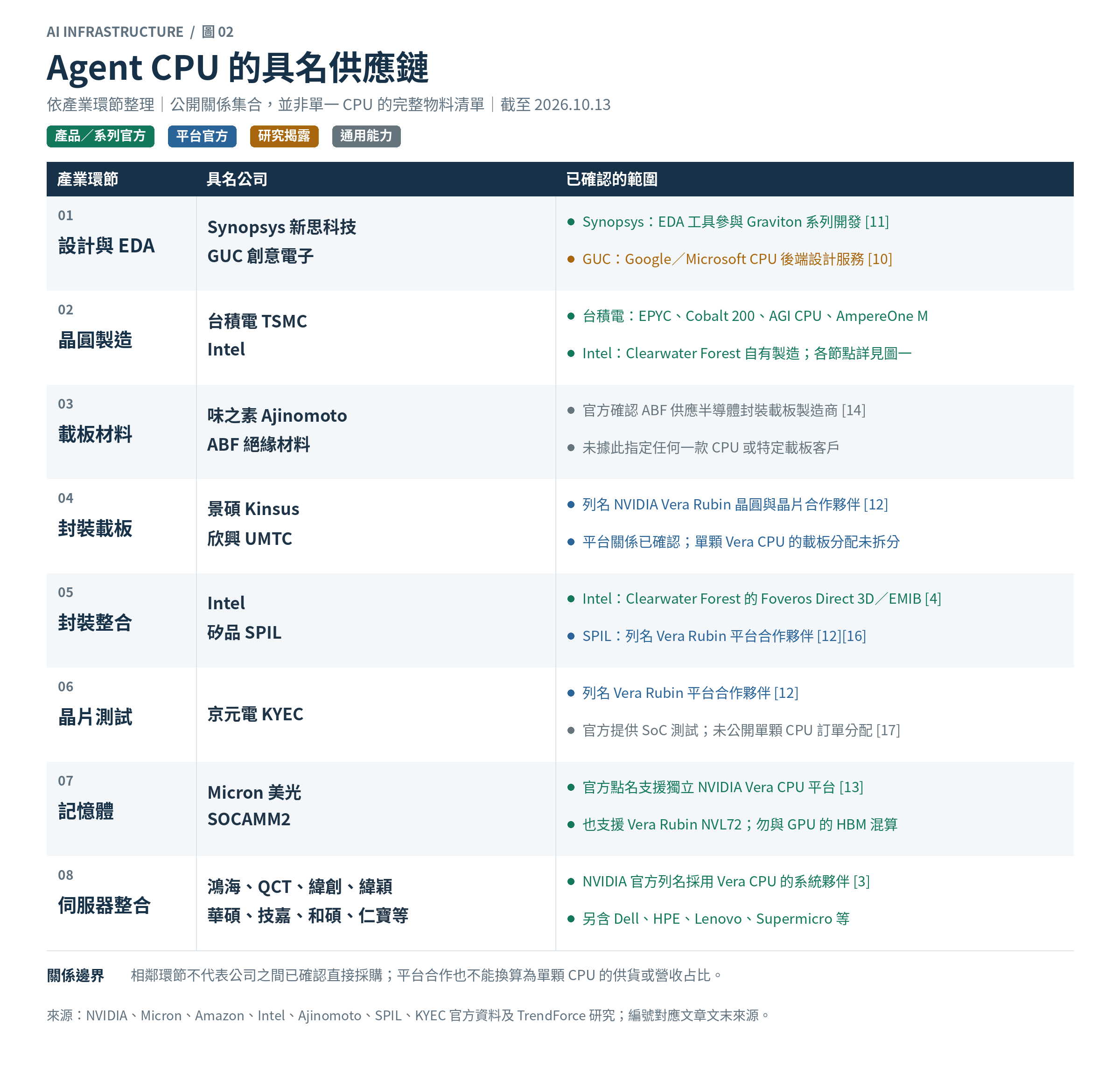
*Figure 2: Named companies organized by manufacturing and system stage. This combines public relationships across different products and platforms; it is not a complete bill of materials for any single CPU. Adjacent placement does not establish a direct purchasing relationship.*
Four types of evidence for named supply-chain relationships
The most direct evidence identifies which CPU or system a supplier’s product serves. Micron, for example, announced that its SOCAMM2 memory supports NVIDIA Vera Rubin NVL72 and standalone Vera CPU platforms. This establishes a more specific product relationship than simply “supplying AI memory.” NVIDIA also names Vera CPU system partners including Hon Hai / Foxconn, QCT, Wistron, Wiwynn, ASUS, GIGABYTE, Pegatron, Compal, Dell, HPE, Lenovo, and Supermicro.[3][13]
The second type is an official platform-level relationship. In describing Taiwan’s Vera Rubin ecosystem, NVIDIA named TSMC, SPIL, Kinsus, KYEC, and Unimicron among wafer and chip partners. This confirms participation in the platform ecosystem, but does not establish which Vera CPU substrates Kinsus or Unimicron supplies, how much CPU packaging SPIL handles, or the volume of testing orders KYEC receives for a specific model.[12]
The third type is industry research. TrendForce reported that Global Unichip (GUC) handles back-end CPU design services for Google and Microsoft. This can inform supply-chain monitoring, but should remain labeled as research-firm reporting. It cannot be extrapolated to identical responsibilities or revenue contributions for every Axion and Cobalt generation.[10]
The fourth type is general product capability. Ajinomoto’s ABF is an insulating material used in high-performance semiconductor package substrates. Kinsus publicly describes FCBGA substrates for CPUs and GPUs, SPIL offers IC packaging, and KYEC provides SoC testing. These materials identify each company’s manufacturing role, but capabilities alone do not establish procurement for a particular model.[14][15][16][17]
Design tools are also part of the supply chain. AWS has publicly discussed Synopsys EDA tools in the development of Graviton, Nitro, and Trainium. This is product-family-level cooperation evidence and should be distinguished from wafer, packaging, or memory supply for an individual processor.[11]
What can financial statements establish?
Financial results can help identify changes in server demand, product mix, and prices, but may not isolate agent applications. Intel’s second-quarter 2026 Form 10-Q, for example, reported server-product unit sales up 9% year over year and average selling prices up 48%. The company attributed the price change mainly to a greater high-end product mix, with a smaller effect from demand-driven pricing adjustments. This supports a stronger server-business assessment, but does not attribute all growth to agents.[18]
Calculating an “agent CPU shipment share” requires knowing how many CPUs actually serve agents and whether the denominator is units, cores, compute hours, or revenue. A single server may mix agents, databases, and conventional cloud workloads. Without a consistent definition and application breakdown, server-CPU share, x86 share, Arm adoption, or cloud-customer penetration cannot be converted into agent CPU share.
Likewise, confirmation of a named supplier does not mean its revenue share is public. Moving from an industry theme to financial estimates still requires production timelines, customer procurement scale, component configurations per system, unit prices, and supplier allocation.
What to watch next: workload growth and production scale
AI agents create CPU opportunities through additional real work around the model: code must execute, data must be processed, tools must be coordinated, and results must be verified. CPU designers compete on the cost, power consumption, and latency of completing those tasks. For foundries and back-end suppliers, the key questions are which products reach volume and how many manufacturing resources each chip and system requires.
Identifiable manufacturing relationships show TSMC serving multiple CPU brands and in-house cloud designs, while Intel retains its own manufacturing route. Taiwanese substrate, packaging, testing, and system suppliers have also been named in some platform announcements. The most informative signals will be sustainable deployment volumes, production deliveries, and verifiable supplier revenue—not simply whether a product carries the agent label.
Sources & notes
- [1] AMD, “Agentic AI Changes the CPU/GPU Equation,” May 7, 2026. https://www.amd.com/en/blogs/2026/agentic-ai-changes-the-cpu-gpu-equation.html
- [2] Raj et al., “Towards Understanding, Analyzing, and Optimizing Agentic AI Execution: A CPU-Centric Perspective,” research preprint; first submitted November 1, 2025, revised April 16, 2026. https://arxiv.org/abs/2511.00739
- [3] NVIDIA, “NVIDIA Launches Vera CPU, Purpose-Built for Agentic AI,” March 16, 2026. https://nvidianews.nvidia.com/news/nvidia-launches-vera-cpu-purpose-built-for-agentic-ai
- [4] Intel, “Kevin O’Buckley Talks Progress on Intel 18A,” describing Clearwater Forest’s process and packaging. https://www.intel.com/content/www/us/en/newsroom/news/kevin-obuckley-talks-progress-intel-18a.html
- [5] AMD, “5th Gen AMD EPYC Processor Architecture,” document 70353, March 17, 2025, Rev. B. https://docs.amd.com/v/u/en-US/5th-gen-amd-epyc-processor-architecture-white-paper
- [6] AMD, “AMD Announces Production Ramp of Next-Generation AMD EPYC Processor Venice on TSMC 2nm Process Technology,” May 21, 2026. https://newsroom.amd.com/news/amd-announces-production-ramp-of-next-generation-a/
- [7] Microsoft Azure, “New Azure Cobalt 200 VMs deliver 50% performance improvement, fully optimized for modern agentic AI workloads,” June 2, 2026. https://azure.microsoft.com/en-us/blog/new-azure-cobalt-200-vms-deliver-50-performance-improvement-fully-optimized-for-modern-agentic-ai-workloads/
- [8] Arm, “The agentic inflection point and how Arm AGI CPU powers the next phase of AI infrastructure,” May 15, 2026. https://developer.arm.com/community/arm-community-blogs/b/ai-blog/posts/the-agentic-inflection-point-and-how-arm-agi-cpu-powers-the-next-phase-of-ai-infrastructure
- [9] Ampere, “AmpereOne M Product Brief.” https://amperecomputing.com/briefs/ampereone-m-product-brief
- [10] TrendForce, “Not Just GPUs: Agentic AI Brings CPUs Back,” September 29, 2026. Process-node mappings and GUC relationships are research-firm disclosures. https://www.trendforce.com/insights/agentic-ai-cpu-gpu
- [11] Amazon, “AWS Graviton5 chip now generally available,” including the Synopsys relationship. https://www.aboutamazon.com/news/aws/aws-graviton-5-cpu-amazon-ec2
- [12] NVIDIA, “Taiwan’s Industry Titans Turbocharge World’s AI Infrastructure Buildout With NVIDIA,” May 31, 2026. https://blogs.nvidia.com/blog/taiwan-ecosystem-ai-infrastructure/
- [13] Micron, “Micron in High-Volume Production of HBM4 Designed for NVIDIA Vera Rubin, PCIe Gen6 SSD and SOCAMM2,” March 16, 2026. https://investors.micron.com/news/press-release/2026/Micron-in-High-Volume-Production-of-HBM4-Designed-for-NVIDIA-Vera-Rubin-PCIe-Gen6-SSD-and-SOCAMM2-03-16-2026/default.aspx
- [14] Ajinomoto, “Our Technologies,” Electronic Materials section. https://www.ajinomoto.com/innovation/rd-organizations-and-facilities/bioscience_chemicals/technology
- [15] Kinsus, product overview, FCBGA section. https://www.kinsus.com.tw/zh-tw/product/products/products_overview
- [16] SPIL, “IC Packaging.” https://spil.com.tw/IC_Packaging
- [17] KYEC, “System on Chip.” https://www.kyec.com.tw/en/Solution/system-on-chip-soc
- [18] Intel, second-quarter 2026 Form 10-Q, Management’s Discussion and Analysis, page 30. https://www.sec.gov/Archives/edgar/data/50863/000005086326000157/intc-20260627.htm
- [19] AMD, “TSMC empowers semiconductor fabrication expansion with AMD,” confirming TSMC as the manufacturing partner for the EPYC family. https://www.amd.com/en/resources/case-studies/tsmc.html