
INDUSTRY ANALYSIS
TPCA Show 2026: Physical Limits, Supply-Chain Beneficiaries, and Competition in Taiwan’s NT$1 Trillion PCB Industry
Taiwan’s PCB production value is projected to exceed NT$1.13 trillion in 2026. Drawing on the technologies and executive warnings presented at TPCA Show 2026, this article examines which supply-chain segments stand to benefit from physical material bottlenecks, and which face new entrants and competing technology routes.
The Taiwan Printed Circuit Association Show 2026 (TPCA Show 2026, October 20–22) took place at Taipei Nangang Exhibition Center [1]. According to the latest estimates from the Taiwan Printed Circuit Association (TPCA) and ITRI’s Industry, Science and Technology International Strategy Center (ISTI), expanding demand for AI server infrastructure and high-end networking is expected to lift Taiwanese PCB manufacturers’ domestic and overseas production value to NT$1.1365 trillion in 2026, crossing the trillion-dollar milestone. Including equipment and materials, the entire industry chain approaches NT$1.77 trillion [1].
Behind the record production value, however, the show’s first Advanced Packaging Zone highlighted an industry at the intersection of the physical limits of conventional organic materials and increasingly semiconductor-like manufacturing processes [1]. As package sizes multiply and transmission speeds move toward 800G/1.6T, previously stable divisions of labor across the supply chain are breaking down.
Drawing on technical presentations at the show, publicly disclosed operating data, and executive remarks, this article examines two structural questions: Which segments control physical bottlenecks and therefore enjoy pricing power? Which face intensifying competition from new entrants as technology paradigms shift?
---
1. Three Key Observations: Physical Limits Drive Technology Inflection Points
1.1 The Challenge of a Fourteenfold Increase in Package Area: From ABF Warpage to Glass Core Substrates
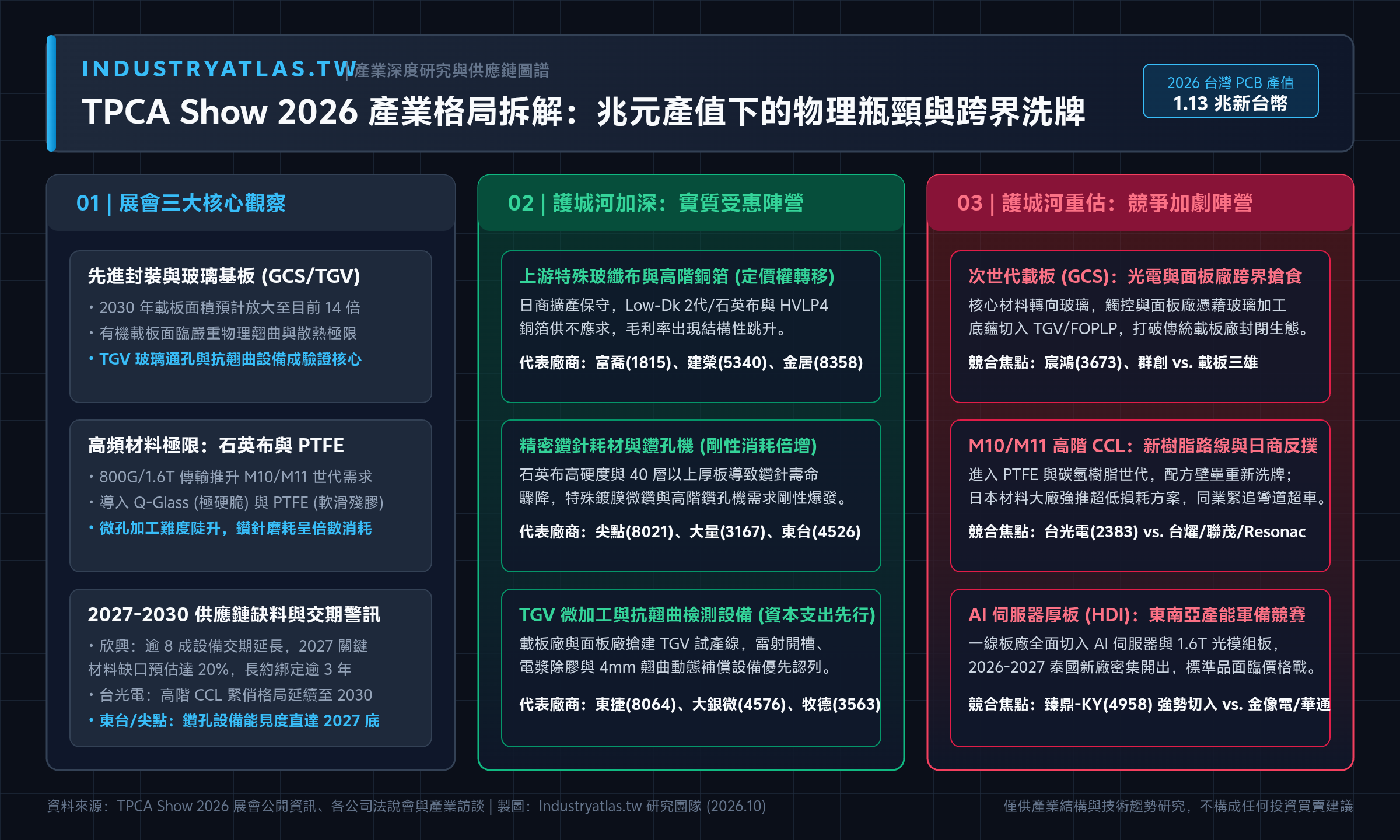
During the show, Unimicron (3037) chairman Jian Shanjie (簡山傑) said that, as AI chip computing power and chiplet-based heterogeneous integration expand, the area of high-end IC substrates is projected to reach 14 times its current level by 2030 [2].
As substrate dimensions move toward 515 × 510 mm and larger, the inherent limitations of conventional organic polymer materials used in ABF substrates—in coefficient of thermal expansion (CTE) matching and rigidity—create severe warpage and thermal-management bottlenecks [2, 8]. This is moving glass core substrates (GCS) and through-glass vias (TGV), with their high flatness, low thermal expansion, and excellent electrical properties, from laboratory concepts into the engineering race for mass production in 2027–2028 [2, 9].
1.2 A Machining Challenge for High-Frequency, High-Speed Materials: Quartz Cloth and PTFE
To meet the ultra-low-loss requirements of next-generation AI servers and 1.6T switches, copper-clad laminates (CCLs) are advancing from the M8/M9 generations toward M10/M11 [3, 10]. Two important formulation changes are emerging:
* Glass-cloth upgrades: First- and second-generation low-dielectric-constant (Low-Dk) glass cloth is giving way to quartz cloth, or Q-Glass, which offers extremely high purity and a lower dielectric constant [5, 7]. * Diverging resin systems: Alongside conventional modified polyphenylene ether (PPE) and hydrocarbon resins, the use of polytetrafluoroethylene (PTFE, commonly known as Teflon) is increasing markedly [5, 10].
These changes create substantial processing barriers for downstream PCB manufacturers. Quartz cloth is very hard on the Mohs scale and brittle, whereas PTFE is slippery and soft, has a high CTE, and is especially prone to leaving resin smear on hole walls during drilling [5]. These contrasting physical properties are directly changing consumable usage rates and microvia-processing methods [5, 6].
1.3 An Unusually Consistent Warning from Supply-Chain Executives: Material Shortages and Longer Lead Times in 2027
At the show, leading manufacturers issued closely aligned, quantified warnings about capacity bottlenecks over the next two to four years:
* Equipment and material shortages: Unimicron said that lead times have lengthened significantly for more than 80% of high-end equipment, and projected a supply shortfall of up to 20% for certain critical raw materials in 2027. To secure capacity, AI customers are shifting toward ecosystem partnerships anchored by contracts lasting more than three years [2]. * A prolonged tight market for high-end CCL: Elite Material (2383) chairman Dong Dingyu (董定宇) stated that the structurally tight supply-demand balance for high-end CCL is expected to persist through 2030 [3]. * Order visibility for processing equipment: Drilling-equipment maker Tongtai (4526) and drill-bit maker Topoint (8021) both signaled that visibility for high-end orders already extends to the end of 2027 [5, 6].
---
2. Who Benefits from Concentrated Supply and Bottlenecks? Three Segments with Tangible Upside
In the early stages of a technology upgrade, the most dependable commercial returns often concentrate in upstream materials with the slowest capacity expansion and equipment and consumables whose usage rises as processing becomes more difficult, rather than in final assembly.
2.1 Specialty Glass Cloth and High-End Copper Foil: Pricing Power Shifts to Sellers
* Industry logic: High-end Low-Dk glass cloth and quartz cloth have historically been dominated by major Japanese suppliers such as Nittobo. Japanese suppliers have expanded conservatively, while the investment and qualification cycle for new specialty-glass furnaces takes 1.5–2 years. Once leading cloud service providers (CSPs) and AI chip companies lock up high-end capacity, Taiwanese manufacturers with advanced fiber-drawing and weaving capabilities gain structural opportunities for order transfers and stronger pricing [2, 7]. Likewise, fourth- and fifth-generation HVLP copper foil, used to address the skin effect in high-frequency signals, remains undersupplied [7]. * Operating evidence: At glass-cloth maker Fulltech Fiber Glass (1815), a growing share of high-end Low-Dk products helped lift its recently disclosed preliminary September gross margin to 51.9%, indicating that upstream shortages are already translating into financial gains [7]. Nittobo subsidiary Baotek (5340) and high-end copper-foil maker Co-Tech (8358) are exposed to similar industry tailwinds [7].
2.2 Precision Drill Bits and High-End Machining Equipment: Harder Materials Consume Tools Faster
* Industry logic: AI server PCBs commonly contain 30–40 layers or more, have very high thickness-to-hole-diameter ratios, and increasingly use hard quartz cloth and smear-prone PTFE. Mechanical drill bits that could previously drill thousands of holes in conventional FR-4 or standard high-frequency boards suffer a sharp decline in tool life and achievable hole count when processing quartz cloth and high-layer-count boards. Specialized coatings and micrometer-scale staged drilling techniques are also required [5]. * Operating evidence: Regardless of which CCL or PCB manufacturer wins a major AI order, adopting the new materials drives multiples of the previous drill-bit consumption. Topoint (8021) demonstrated microdrilling technologies specifically for quartz cloth and PTFE and disclosed its monthly-capacity expansion schedule at the show [5]. Drilling-machine makers TA LIANG (3167) and Tongtai (4526) benefit directly from equipment purchases as PCB manufacturers expand high-end capacity in Southeast Asia and Taiwan [6].
2.3 Micromachining and Inspection Equipment for Warpage Control and TGV Glass Processing
* Industry logic: Although large-scale commercial production of glass core substrates remains two to three years away, around 2028, major substrate makers and display-panel companies entering the field must build pilot lines in 2026–2027 [8, 9]. Laser modification and grooving of glass, plasma desmear, dynamically compensated exposure, and automated optical inspection (AOI) for large substrates with warpage of up to 4 mm are becoming leading indicators of capital spending [8]. * Operating evidence: Contrel (8064) partnered with Fulin (富臨) to demonstrate a combined laser-micromachining and plasma-process solution [8]. HIWIN Mikrosystem (4576) showcased a positioning platform capable of dynamically correcting 4 mm of warpage and direct-write exposure technology that breaks the 1 μm linewidth barrier [8]. Together with high-end inspection-equipment suppliers such as Machvision (3563) and Utechzone (3455), these companies are direct beneficiaries of the advanced-packaging R&D investment race [8].
---
3. Where Are New Rivals Encroaching? Three Areas of Intensifying Competition
The show’s most closely watched technology segments also face risks: established competitive barriers are weakening, capital-spending pressure is rising, and technology routes are being reshuffled.
3.1 Advanced Packaging Substrates (GCS/TGV): Optoelectronics and Panel Makers Enter the Market
* Competitive dynamics: High-end ABF substrates have long been protected by the substantial process and yield barriers built by major suppliers such as Unimicron (3037), Kinsus (3189), and Nan Ya PCB (8046). When the core material of next-generation substrates shifts from organic resin to glass, however, touch-panel and display-panel makers with experience in large-area glass thinning, etching, optical coatings, and mass transfer gain a strong entry point into advanced semiconductor packaging [9]. * Reshuffling risk: Touch-panel maker TPK-KY (3673) made a prominent first appearance at TPCA this year, announcing completion of a TGV pilot line at its Zhongli plant. It targets customer qualification by the end of 2027 and mass production in 2028 [9]. With Innolux (3481) and AUO (2409) also investing in fan-out panel-level packaging (FOPLP) and glass substrates [9], incumbent substrate makers may no longer enjoy a closed, concentrated competitive environment in next-generation packaging standards after 2028. They must also absorb substantial equipment depreciation and capital-spending pressures associated with longer lead times for more than 80% of equipment [2].
3.2 Next-Generation M10/M11 CCL: Diverging Resin Routes and a Renewed Japanese Challenge
* Competitive dynamics: In the current M8/M9 AI server market, Elite Material (2383) holds a commanding lead through its formulation patents and production scale; it has reported a record quarterly EPS of NT$42.46 [3]. As the industry advances toward M10/M11 materials for 1.6T networking and next-generation GPU architectures, however, material systems are shifting toward PTFE hybrid laminates and hydrocarbon resins. Competitive barriers built around conventional epoxy/PPE formulations therefore face reassessment [3, 10]. * Reshuffling risk: Japanese materials giants Resonac and Mitsubishi Gas Chemical (MGC) showcased ultra-low-dielectric-loss materials and advanced-packaging resin solutions at the show [10]. Meanwhile, Taiwan Union Technology (TUC, 6274) and ITEQ (6213) are seeking to gain ground through PTFE and high-frequency-material qualification [10]. Although overall demand for high-end CCL remains tight, a market structure centered on one dominant supplier faces intense challenges from peers and Japanese competitors.
3.3 High-Layer-Count AI Server Boards and HDI: Leading Suppliers Race to Expand in Southeast Asia
* Competitive dynamics: As AI ASIC and GPU server motherboard designs move toward advanced high-density interconnect (HDI) combined with high-layer-count (HLC) boards of more than 40 layers, leading global PCB makers are launching expansion programs in Thailand and across Southeast Asia [1, 4]. * Reshuffling risk: Global PCB leader Zhen Ding-KY (4958) displayed a full range of AI server motherboards, boards for co-packaged optics (CPO) modules, and IC substrates, while forecasting multiple-fold growth in its optical-module business in 2027 [4]. This introduces a heavyweight competitor with exceptional scale into a high-end AI server PCB market previously led by Gold Circuit Electronics (2368), Compeq (2313), and Unimicron [4]. As new Southeast Asian plants ramp up from late 2026 through 2027, standard server boards outside the highest-end specifications—such as M9 or above, or specialized hybrid laminates—will face competitive pressure on pricing and margins over the next two years [4].
---
4. Supply-Chain Competition and the Limits of Financial Validation
The table below summarizes each segment’s competitive dynamics, key operating indicators, and potential risks for readers tracking subsequent business performance.
| Supply-chain segment | Core technology transition | Representative structural beneficiaries | Intensifying competition / new entrants | Financial and operating indicators to monitor |
|---|---|---|---|---|
| Upstream glass cloth and copper foil | Second-generation Low-Dk, quartz cloth (Q-Glass), and HVLP 4/5 copper foil [5, 7] | Fulltech (1815), Baotek (5340), Co-Tech (8358) [7] | Standard-product suppliers without high-end qualification face overcapacity | High-end products’ revenue share; whether quarterly gross margins remain at elevated levels of 40%–50% or above; Japanese suppliers’ expansion progress [7] |
| Precision drill bits and drilling machines | Coated microdrills and laser equipment for hard quartz cloth and PTFE smear [5, 6] | Topoint (8021), TA LIANG (3167), Tongtai (4526) [5, 6] | Smaller suppliers without specialized coatings or microvia-processing capabilities risk being displaced | Utilization of expanded monthly drill-bit capacity; equipment makers’ contract liabilities (customer advances); share of high-end machine shipments [5, 6] |
| Advanced-packaging and warpage-control equipment | Laser grooving for TGVs, plasma desmear, and dynamic compensation for 4 mm warpage [8] | Contrel (8064), HIWIN Mikrosystem (4576), Machvision (3563) [8] | Long equipment-qualification cycles and competition from global semiconductor-equipment majors | Pilot-line equipment acceptance and revenue-recognition timing; changes in semiconductor/advanced-packaging equipment’s share of total revenue [8] |
| IC substrates and glass substrates | Larger substrate areas and a shift from organic ABF substrates to glass core substrates [2, 9] | Leaders with long-term customer contracts and scale advantages, including Unimicron (3037) [2] | Panel/optoelectronics makers such as TPK (3673) and Innolux (3481) enter TGV [9] | Depreciation pressure on gross margins; actual utilization impact of the projected 20% shortfall in critical materials in 2027 [2] |
| High-end copper-clad laminates (CCL) | M10/M11 generations using PTFE and hydrocarbon resin systems [3, 10] | Established high-end leaders: Elite Material (2383), TUC (6274) [3, 10] | Renewed competition from Resonac and MGC; reshuffling among peers across new resin routes [10] | Final material qualification lists and market-share allocation for next-generation AI server platforms, such as Rubin and 1.6T switches [3, 10] |
---
5. Market Pricing and Capital Flows: The Timing Gap Between Exhibition Themes and Fundamentals
From a capital-market perspective, long-term industry trends and short-term share-price performance often reflect very different expectation horizons.
On October 20, the opening day of TPCA Show, manufacturers presented positive long-term outlooks involving trillion-dollar production value and material shortages in 2027. Yet several equipment and substrate stocks that had already rallied on exhibition expectations—including HIWIN Mikrosystem, Tongtai, Kinsus, and Zhen Ding-KY—experienced sharp reversals, opening higher before falling and turning negative during the session [11]. This points to two underlying market dynamics:
1. A timing mismatch in revenue realization: Glass substrates/TGV and next-generation equipment were major technical highlights, but large-scale production is scheduled for late 2027 through 2028 [2, 9]. If near-term share prices capitalize too much distant capital-spending potential, the exhibition’s opening can trigger “sell-the-news” profit-taking [11]. 2. A divergence between realized earnings and thematic exposure: Compared with next-generation R&D projects with long payback periods, upstream high-end materials—Low-Dk glass cloth and high-end CCL—that have already entered a shortage-driven pricing cycle and shown structural gross-margin improvements in current financial statements [3, 7], alongside drill-bit consumables whose usage begins immediately with trial production of new materials [5], have a closer alignment between observable fundamentals and market pricing.
Sources & notes
- 1. Taiwan Printed Circuit Association (TPCA) and ITRI’s Industry, Science and Technology International Strategy Center (ISTI), “2026 Taiwan PCB Industry Production-Value Forecast and TPCA Show 2026 Press Release.” Forecasts NT$1.1365 trillion in domestic and overseas PCB production by Taiwanese manufacturers and a total industry-chain value of NT$1.77 trillion; announces the first Advanced Packaging Zone. October 20, 2026.
- 2. Unimicron (3037), chairman Jian Shanjie’s (簡山傑) remarks at the opening of and interviews during TPCA Show 2026. Outlook includes substrate area reaching 14 times its current level by 2030, longer lead times for over 80% of equipment, a 20% supply shortfall in certain critical materials in 2027, and AI customers shifting toward ecosystem partnerships with contracts lasting more than three years. October 20, 2026.
- 3. Elite Material (2383), chairman Dong Dingyu’s (董定宇) remarks during TPCA Show 2026, forecasting a tight high-end CCL market through 2030; and the company’s Q2 2026 financial report on the Taiwan Stock Exchange’s Market Observation Post System (MOPS), reporting quarterly EPS of NT$42.46. August / October 2026.
- 4. Zhen Ding-KY (4958), public presentations and management remarks at TPCA Show 2026. Displays AI server motherboards, IC substrates, and high-end optical-module boards using advanced mSAP processes; forecasts multiple-fold growth in the optical-module business in 2027. October 20, 2026.
- 5. Topoint Technology (8021), technical presentations and investor materials for TPCA Show 2026. Covers miniature deep-hole drill designs, specialized coatings, and monthly-capacity expansion plans for ABF substrates, quartz cloth (Q-Glass), and PTFE high-frequency materials. October 20, 2026.
- 6. Tongtai Machine & Tool (4526) and TA LIANG Technology (3167), public exhibitor information and media interviews at TPCA Show 2026. Tongtai states that demand for precision drilling machines, driven by AI server boards and Southeast Asian expansion, has extended order visibility through the end of 2027. October 20, 2026.
- 7. Fulltech Fiber Glass (1815), Baotek Industrial Materials (5340), and Co-Tech Development (8358), September 2026 preliminary earnings announcements on MOPS and recent investor-presentation materials. Fulltech reports a preliminary September gross margin of 51.9%, reflecting tight supply-demand conditions for high-end Low-Dk glass cloth and an improved product mix. October 2026.
- 8. Contrel Technology (8064), HIWIN Mikrosystem (4576), and Machvision (3563), technical presentations in the TPCA Show 2026 Advanced Packaging Zone. Contrel and Fulin (富臨) jointly demonstrate laser micromachining and plasma processing; HIWIN Mikrosystem demonstrates an inspection/positioning platform with dynamic compensation for 4 mm warpage and direct-write exposure technology breaking the 1 μm barrier. October 20, 2026.
- 9. TPK-KY (3673) and the panel-level-packaging supply chain, TPCA Show 2026 exhibitor presentations. TPK announces completion of its Zhongli TGV pilot line, targeting customer qualification by the end of 2027 and mass production in 2028 as it enters semiconductor glass substrates. October 20, 2026.
- 10. Resonac, Mitsubishi Gas Chemical (MGC), Taiwan Union Technology (6274), and ITEQ (6213), publicly presented technical specifications and high-frequency/high-speed materials forum presentations at TPCA Show 2026. Covers M10/M11 ultra-low-dielectric-loss materials and PTFE/hydrocarbon-resin solutions for 800G/1.6T transmission. October 20–21, 2026.
- 11. Taiwan Stock Exchange (TWSE) and Taipei Exchange (TPEx), end-of-day trading data for October 20, 2026, the first day of TPCA Show. Documents the opening-high-then-falling price pattern and profit-taking in some exhibiting equipment and substrate companies.